


Foundations in Wealth Management (FWM): Your Gateway to a Career in UK Private Wealth
Private wealth management is built around a responsibility that extends far beyond managing money. It involves understanding financial objectives, assessing investment risks, protecting long-term interests and helping clients make informed decisions about their wealth. For professionals looking to enter the UK financial services sector, this combination of analytical thinking, financial knowledge and client awareness makes wealth management an appealing career path.
Yet entering the industry requires more than an interest in investments. Professionals need to understand the financial environment in which they operate, the principles behind investment decisions and the importance of ethical conduct when dealing with clients. Developing this knowledge early can help aspiring professionals make more informed career choices and prepare for further learning.
The Foundations in Wealth Management (FWM) programme from CIFA offers a structured way to explore these essential areas. For graduates, career changers and early-career finance professionals, it provides an opportunity to build a broader understanding of wealth management and consider how that knowledge fits into a long-term professional plan.
Understanding the World of Private Wealth Management
Wealth management brings together several aspects of personal finance to help individuals organise and manage their financial resources. Depending on a client's circumstances, this may involve investment planning, risk assessment, retirement considerations, taxation and ongoing financial reviews.
Private wealth management often serves clients with more complex financial circumstances, requiring professionals to consider how different financial decisions interact. An investment strategy, for example, should not be viewed independently of the client's objectives, financial commitments, time horizon or tolerance for risk.
This is what makes the profession distinctive. It combines technical financial knowledge with the ability to understand individual needs and explain financial information clearly. Building a foundation in these areas can help aspiring professionals understand the expectations associated with wealth management roles.
What Is the Foundations in Wealth Management (FWM) Programme?
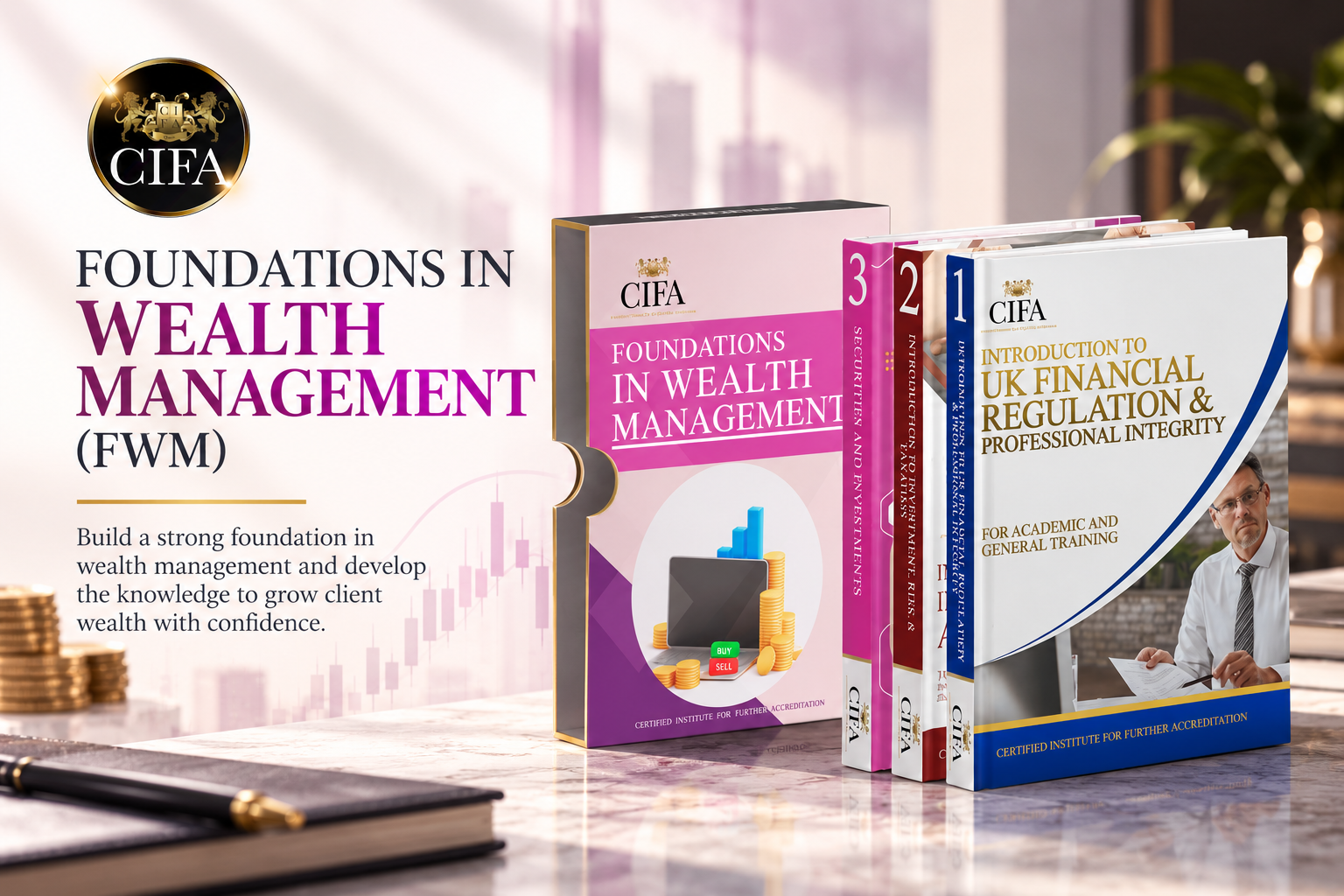
The Foundations in Wealth Management (FWM) programme is a digital course bundle offered by CIFA. Its structure brings together three areas of study: UK financial regulation and professional integrity, investment risk and taxation, and securities and investment.
CIFA lists the programme at £897, with a stated duration of 423 hours. The bundle is designed to provide structured learning across subjects relevant to financial services and wealth management. Prospective learners should review the current course information and confirm the latest fees, assessment requirements and any additional charges before enrolling.
The combination of subjects is particularly relevant because wealth management requires professionals to look at financial decisions from several perspectives. Understanding investments is important, but so is recognising risk, appreciating regulatory responsibilities and considering the wider circumstances surrounding a client's financial position.
For learners who prefer a defined programme rather than studying separate subjects without a clear sequence, a bundled course can offer a more organised approach to professional development.
Three Areas of Knowledge That Matter in Wealth Management
1. Financial regulation and professional integrity
Trust is central to the relationship between a financial professional and a client. Individuals making decisions about their wealth need clear information, responsible guidance and confidence that professional obligations are being taken seriously.
Understanding UK financial regulation introduces learners to the standards and responsibilities that shape financial services. Professional integrity adds another important dimension, encouraging honest communication, appropriate conduct and awareness of conflicts of interest.
These principles are relevant throughout a finance career, not only in senior advisory positions. Even professionals working in administrative, support or operational roles benefit from understanding why compliance, confidentiality and responsible behaviour matter.
2. Investment risk and taxation
Every investment involves considerations that extend beyond its potential return. Market movements, liquidity, the possibility of loss and the investor's individual circumstances can all influence whether a financial option is appropriate.
Studying investment risk helps learners develop a more analytical approach to financial information. It encourages them to consider uncertainty rather than assume that past performance or attractive returns guarantee future outcomes.
Taxation is another important consideration in financial planning. The tax implications of a decision can affect its overall value, making it essential to understand the relevant principles and recognise when specialist guidance is needed.
Together, these subjects help learners appreciate why wealth management requires careful assessment rather than a one-size-fits-all approach.
3. Securities and investment
Securities and investment knowledge helps professionals understand the financial instruments and markets that form part of the wider investment environment. Developing familiarity with these concepts can make it easier to interpret financial information and understand the factors that influence investment decisions.
For aspiring wealth management professionals, this knowledge provides useful context when exploring how portfolios are structured, how different assets behave and why diversification and risk assessment are important considerations.
A course can establish the theoretical foundation, while practical experience and further study help learners develop a more detailed understanding of how investment principles are applied in professional settings.
Which Careers Could This Knowledge Support?
Wealth management includes a variety of roles, and the most suitable starting point depends on a person's background, experience and qualifications.
Wealth management support roles may suit individuals who want to develop an understanding of client administration, financial documentation and the processes behind advisory services.
Private banking support positions can offer exposure to client relationships, financial services operations and the needs of individuals with more complex banking requirements.
Investment-related entry-level roles may appeal to learners interested in financial markets, investment products and the analytical side of financial services.
Financial planning support roles can provide experience with the information and processes used to understand clients' financial circumstances and objectives.
The FWM programme may help learners build relevant subject knowledge as they investigate these options. However, completing a course does not guarantee employment or automatically qualify someone for every role. Employers may require additional qualifications, practical experience or role-specific technical skills.
Anyone aiming for a regulated advisory position should check the relevant UK regulatory and qualification requirements before treating the programme as a complete route into that profession.
Who Should Consider Studying FWM?
The programme may be worth exploring for finance graduates who want to understand the relationship between investments, regulation and financial decision-making. It may also suit early-career professionals seeking to broaden their knowledge beyond their current responsibilities.
Career changers can use structured study to investigate whether wealth management aligns with their interests before committing to a more specialised professional pathway. Those already working in banking or financial services may also find value in revisiting foundational subjects from a broader perspective.
The key is to approach the course with a clear objective. Learners should identify what they want to understand, which roles interest them and whether the programme's content matches the requirements of their intended career direction.
Is the FWM Course Worth the Investment?
The value of a professional course depends on more than its title or certificate. It should provide relevant learning, fit the learner's circumstances and support a realistic development plan.
Before enrolling, consider the stated 423-hour duration and whether you can commit sufficient time to study. Review the curriculum carefully to ensure it covers the subjects you want to learn, and check the assessment format to understand what successful completion involves.
It is equally important to consider the total cost. CIFA lists the FWM bundle at £897, while its course price information also lists study support separately. Confirm what is included in the enrolment fee and whether examinations, additional resources or resits may involve extra charges.
You should also compare the course with the requirements found in relevant job descriptions. This helps you identify whether you need broader financial knowledge, a specific professional qualification or practical experience to progress towards your preferred role.
For a wider view of available learning options, visit About CIFA to explore the provider's finance education programmes and compare them with your professional objectives.
Turning Financial Education into Professional Progress
A strong foundation becomes more valuable when learners apply it to their wider development. Following financial services news, becoming familiar with professional terminology and learning to explain financial concepts clearly can help connect study with workplace expectations.
It is also useful to examine the skills employers request. Some positions place greater emphasis on analytical ability, while others require client communication, attention to detail or an understanding of compliance procedures. Recognising these differences helps learners make more focused decisions about their next steps.
Wealth management is a field where continued learning matters. Financial markets change, client circumstances evolve and professional responsibilities require careful attention. A willingness to develop knowledge over time can therefore be just as important as completing an initial course.
Final Thoughts
The Foundations in Wealth Management (FWM) programme from CIFA may be a useful starting point for individuals who want structured learning across financial regulation, investment risk, taxation and securities. Its combined curriculum offers a way to explore several connected areas of finance while developing a clearer understanding of wealth management as a professional field.
Its suitability ultimately depends on your goals, available study time and intended career path. For aspiring professionals, the most effective approach is to connect course learning with job research, practical skill development and any additional qualifications their chosen role requires.
A career in private wealth management is built on informed decisions, professional integrity and an understanding of what matters to each client. Developing that foundation can be a meaningful first step towards a more focused future in UK finance.

 English
 Arabic
 French
 Spanish
 Portuguese
 Deutsch
 Turkish
 Dutch
Dutch
 Italiano
 Russian
 Romaian
 Greek
Greek
