


Introduction to Compliance and Anti-Money Laundering (ICAM): Why This Course Matters for Business Beginners
A successful business needs more than a good product, strong finances and ambitious plans. It also needs to operate responsibly.
Behind almost every modern organisation are rules, procedures and professional standards designed to protect customers, businesses and the wider financial system. For beginners entering finance, banking, business operations or regulated industries, understanding these principles can provide a valuable foundation for professional growth.
This is where compliance and Anti-Money Laundering (AML) knowledge becomes particularly important.
Compliance helps businesses operate within relevant legal and regulatory requirements, while AML measures are designed to reduce the risk of financial systems being misused for money laundering and related financial crime. For someone new to these areas, however, the terminology can initially feel complicated.
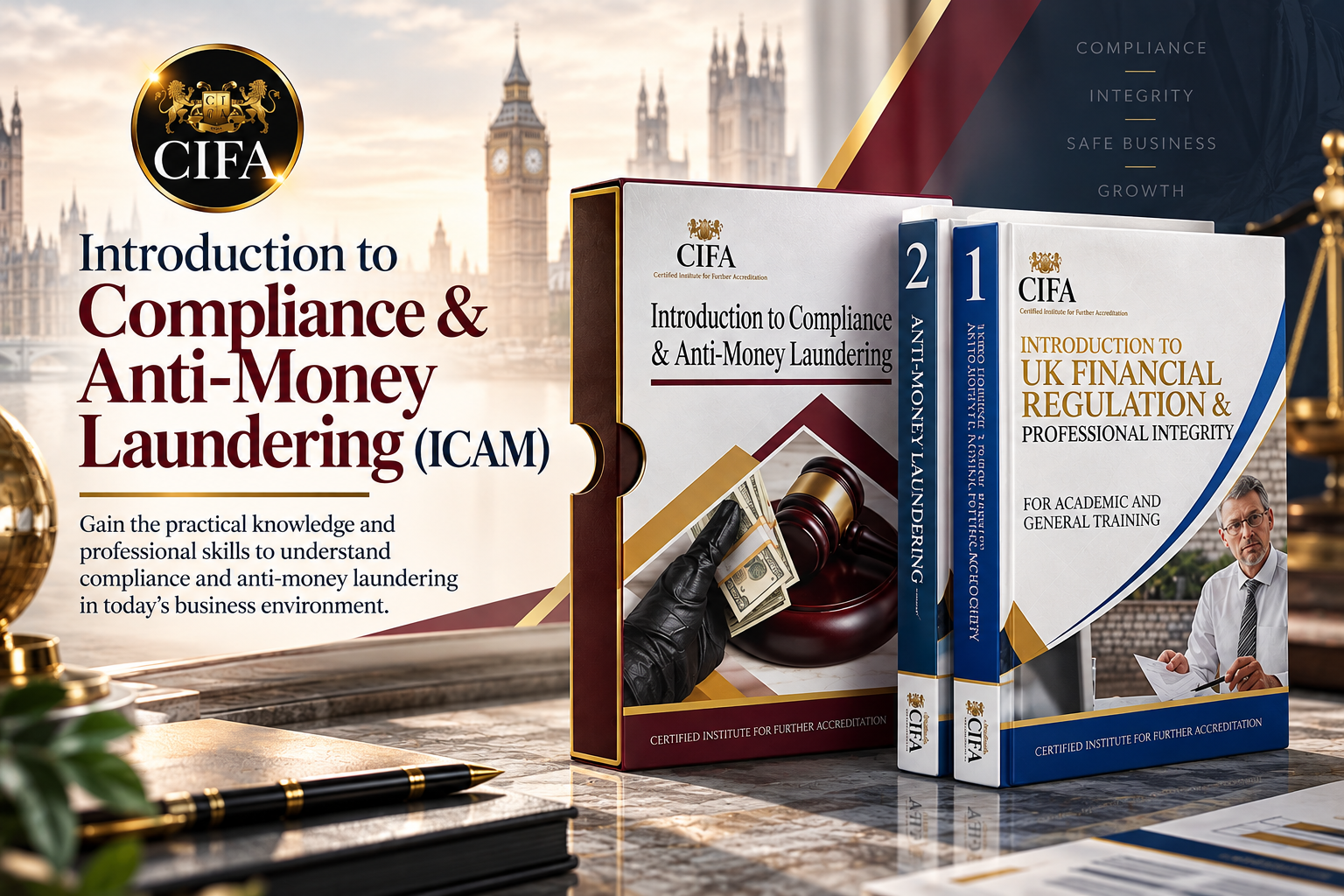
The Introduction to Compliance and Anti-Money Laundering (ICAM) course offers a structured introduction to these subjects, bringing together UK financial regulation, professional integrity and practical AML concepts in one learning pathway. CIFA's published course information highlights areas including regulatory responsibilities, Customer Due Diligence, Know Your Customer principles, risk assessment and suspicious activity reporting.
Why Should Business Beginners Learn About Compliance?
Compliance is sometimes viewed as something that belongs exclusively to banks or specialist compliance departments.
In reality, its influence reaches much further.
Businesses make decisions every day that can involve customers, payments, financial information, suppliers, employees and external partners. In regulated environments, those activities may need to meet specific legal and professional requirements.
Even when someone is not working directly as a compliance officer, having a basic understanding of compliance can help them recognise why certain processes exist.
For a beginner, this is an important shift in perspective.
Instead of seeing policies as paperwork or internal bureaucracy, you begin to understand their purpose. Compliance can help businesses manage risks, protect stakeholders and maintain confidence in the way they operate.
What Does Anti-Money Laundering Actually Mean?
Anti-Money Laundering, commonly shortened to AML, refers to the systems and procedures used to help prevent criminals from disguising illegally obtained funds as legitimate money.
Money laundering can involve complicated transactions, multiple accounts, businesses or jurisdictions. This makes financial crime prevention more than simply checking whether a transaction looks unusual.
Businesses may need to understand who their customers are, assess relevant risks, monitor activity and respond appropriately when concerns arise.
For beginners, the most important lesson is that AML is fundamentally about awareness.
Professionals need to understand what normal activity may look like, recognise potential warning signs and know when concerns should be escalated according to the organisation's procedures.
The Connection Between Compliance and Professional Integrity
Rules alone cannot create a strong compliance culture.
Professional behaviour matters just as much.
A business can have detailed policies, but those policies are only effective when employees understand their responsibilities and apply them consistently.
Professional integrity means taking those responsibilities seriously. It involves honesty, accountability, appropriate handling of information and an understanding that decisions made within a business can affect customers, colleagues and the organisation itself.
This is particularly important in financial services, where trust plays such a central role.
For a beginner, learning about compliance alongside professional integrity provides a broader perspective than simply studying regulations in isolation.
Customer Due Diligence: Knowing Who You Are Dealing With
One of the key concepts beginners encounter when studying AML is Customer Due Diligence, or CDD.
The basic principle is straightforward: businesses need to take appropriate steps to understand who their customers are and assess the risks associated with the relationship.
This can involve verifying identity, understanding the nature of a customer's activities and considering information relevant to the level of risk.
Know Your Customer, or KYC, is closely connected to this process.
These procedures are not designed merely to create additional administration. They help organisations understand their customers and identify circumstances that may require further attention.
For someone entering finance or business operations, understanding this principle can provide useful context for many processes encountered in the workplace.
Learning to Recognise Financial Crime Risks
AML professionals are not expected to assume that every unusual transaction represents criminal activity.
That distinction is important.
A transaction may look unusual for completely legitimate reasons. The role of a professional is therefore not to make unsupported accusations but to recognise potential indicators, review relevant information and follow the appropriate internal process.
Risk assessment is central to this approach.
Different customers, transactions and business relationships may carry different levels of risk. A risk-based approach allows organisations to focus greater attention where the circumstances justify it.
CIFA's published ICAM information includes risk assessment, suspicious activity identification, CDD, KYC and Enhanced Due Diligence among the areas covered by the programme.
Why Financial Literacy Matters in Compliance
Compliance and finance are not completely separate subjects.
Understanding financial information can help professionals develop a better picture of how businesses operate and how transactions fit into the wider financial environment.
This is one reason the ICAM programme combines compliance and AML learning with financial literacy. CIFA's published course information also identifies financial statements, budgeting, forecasting and financial analysis among the learning areas associated with the programme.
For beginners, this broader approach can be useful.
It encourages learners to understand not only what a compliance process requires, but also the financial context in which those processes operate.
Who Can Benefit From ICAM?
A foundational compliance and AML course can be relevant to more people than those specifically targeting compliance officer positions.
It may be useful for aspiring compliance professionals, entry-level finance and accounting staff, regulatory or risk assistants, AML and KYC professionals, career changers and people working in onboarding, operations or administration.
Business owners can also benefit from understanding why compliance matters and how financial crime risks can affect an organisation.
The common thread is simple: anyone working in or around a regulated business can benefit from knowing how compliance principles work.
Turning Knowledge Into Workplace Awareness
One of the biggest advantages of learning compliance fundamentals early is that it changes how you look at everyday business activity.
You begin to ask better questions.
Why is customer identification required?
Why does a transaction need additional review?
Why are certain records retained?
Why might one customer relationship require more checks than another?
Why does an organisation need procedures for reporting suspicious activity?
These questions turn compliance from a collection of rules into a practical business discipline.
That understanding can become particularly valuable as a professional takes on greater responsibility.
Building a Foundation for a Career in Finance
Compliance, AML, risk and financial crime prevention have become established areas within the broader financial services sector.
A beginner does not need to understand every regulatory detail from the beginning. What matters first is developing a solid foundation and learning how the major concepts connect.
Structured professional education can provide a clearer starting point than trying to learn everything independently.
For learners exploring finance, compliance and related career paths, CIFA provides professional learning opportunities across financial and regulatory subjects. Building knowledge through structured courses can help learners develop a clearer understanding of where their interests and career goals may fit within the wider industry.
The objective should not be to collect qualifications without purpose. It should be to build knowledge that can eventually be applied in a professional environment.
Compliance Is Everyone's Responsibility
One of the most useful ideas for beginners to understand is that compliance cannot always be left to one department.
A compliance team may provide specialist oversight, but employees across an organisation can encounter information that becomes relevant to regulatory or financial crime risks.
A customer service employee may notice unusual behaviour. An operations professional may identify an inconsistency in documentation. A finance employee may see an unexpected transaction pattern.
The appropriate response will depend on the organisation and the circumstances, but awareness is the first step.
A strong compliance culture develops when people understand why their role matters.
What Beginners Should Take Away From ICAM
At its core, ICAM brings together several ideas that are highly relevant to modern business:
Compliance helps organisations understand and meet applicable requirements.
Professional integrity supports responsible decision-making and ethical conduct.
AML helps businesses identify and manage risks associated with financial crime.
Customer Due Diligence helps organisations understand customers and assess relevant risks.
Financial literacy provides greater context for understanding business activity and financial information.
Together, these concepts provide a useful foundation for someone beginning to explore regulated business environments.
Final Thoughts
Compliance can seem like a specialist subject when you first encounter it. Once the fundamental ideas are understood, however, its purpose becomes much clearer.
Businesses need systems that support responsible operations. Financial institutions need processes that help prevent financial crime. Professionals need to understand their responsibilities and know how to respond when something requires attention.
That is why learning about compliance and Anti-Money Laundering can be valuable even at the beginning of a business or finance career.
The Introduction to Compliance and Anti-Money Laundering (ICAM) pathway provides a structured starting point for understanding these areas, combining regulatory awareness, professional integrity, AML principles and financial knowledge.
For a beginner, that foundation can do more than introduce new terminology. It can develop a more informed way of looking at business, risk and professional responsibility.
And in a financial environment where trust matters, that understanding is worth building early.

 English
 Arabic
 French
 Portuguese
 Deutsch
 Turkish
 Dutch
Dutch
 Italiano
 Russian
 Romaian
 Portuguese (Brazil)
 Greek
Greek