


Why Is Keeping Track of Time Important? 9 Benefits for Work and Productivity
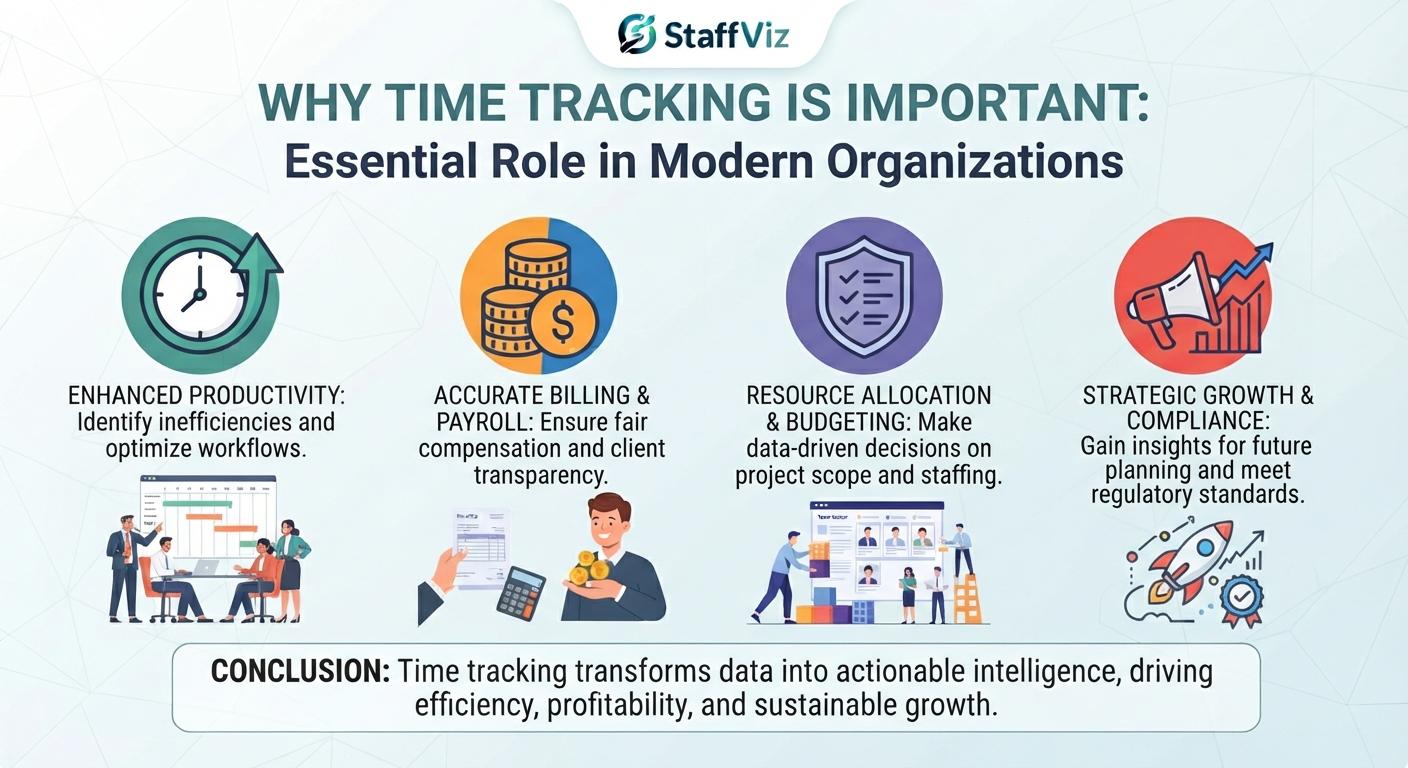
Time is one of the few resources that every employee, manager, and business has in equal measure. Yet, without knowing where those hours actually go, it is easy to spend too much time on low priority activities while important work continues to wait. This is why many people ask, why is keeping track of time important when they already know their daily schedules and responsibilities.
Keeping track of time is not simply about watching the clock. It creates a clearer picture of how work is performed, how long tasks take, where delays occur, and whether daily priorities are receiving enough attention. For businesses, accurate time records can also support project planning, workload management, attendance, reporting, and productivity analysis. StaffViz, for example, provides task based time tracking, timesheets, work hour records, and productivity insights that help organizations understand how time is being used.
1. It Shows Where Your Time Actually Goes
One of the biggest problems with time management is that people often estimate their time rather than measure it. An employee may believe a particular task takes thirty minutes, only to discover that emails, meetings, research, revisions, and interruptions turn it into a two hour activity.
Time tracking replaces assumptions with useful information. After recording work consistently, employees can identify recurring activities that consume more time than expected. This awareness makes it easier to adjust routines and protect time for important responsibilities.
2. It Helps Employees Improve Productivity
Productivity does not necessarily mean working longer hours. It means making better use of the time available.
When employees understand how their working hours are distributed, they can identify periods of strong concentration and recognize activities that frequently interrupt their workflow. For example, a software developer may discover that checking messages throughout the day repeatedly interrupts coding sessions. Adjusting communication periods could create longer blocks of focused work without increasing total working hours.
This is one of the practical benefits of tracking time because the data can encourage better working habits rather than simply measuring activity.
3. It Makes Project Planning More Accurate
Project managers frequently estimate how long tasks will take before work begins. When those estimates are based only on assumptions, deadlines and budgets can quickly become difficult to manage.
Historical time records provide a more useful reference. If similar design tasks consistently take six hours rather than four, future projects can be planned accordingly. Over time, this information can improve scheduling, resource allocation, deadline planning, and project forecasting.
For teams working on multiple projects, task based time tracking can also show how much effort different projects require. StaffViz supports tracking time directly against projects and tasks, making this type of operational information easier to review.
4. It Helps Identify Time Wasting Activities
Not every activity during a workday contributes equally to business objectives. Excessive meetings, repeated administrative tasks, unnecessary application switching, and frequent interruptions can gradually consume valuable working hours.
Keeping track of time makes these patterns easier to recognize. Once an organization knows where time is being spent, managers can investigate whether a process can be simplified or whether employees need better tools and clearer priorities.
The goal should not be to eliminate every non working minute. Breaks and reasonable periods away from tasks are important. Instead, the objective is to understand whether available work time is being used in a sustainable and productive way.
5. It Creates Better Workload Visibility
A common workplace problem is uneven workload distribution. One employee may be handling several urgent projects while another has considerably more available capacity.
Without reliable time information, this imbalance can be difficult to identify. Time records can give managers additional context when reviewing assignments, project progress, and employee workload.
StaffViz combines work hour tracking with task, project, and productivity information, allowing organizations to examine time utilization alongside other workforce data.
6. It Supports More Accurate Billing and Payroll
For businesses that bill clients according to hours worked, accurate records are particularly important. Estimates can create disputes, while incomplete records may cause businesses to undercharge for legitimate work.
Time tracking can connect working hours to specific projects or tasks, creating a clearer record of billable activity. Similarly, organizations with hourly employees can use accurate work hour records to support payroll calculations.
StaffViz's timesheet functionality is designed to record working hours and allocate time to specific projects or tasks, while supporting accurate billing and payroll processes.
7. It Encourages Better Accountability
Accountability does not have to mean micromanagement. When employees have a clear understanding of their responsibilities and recorded working time, they can become more aware of how their effort contributes to broader objectives.
For example, a marketing employee might track time spent on content creation, campaign management, research, and reporting. At the end of the month, those records can help the employee and manager discuss priorities based on actual work rather than vague impressions.
This makes performance conversations more practical and focused on outcomes.
8. It Helps Create Healthier Work Habits
The importance of keeping track of time extends beyond productivity. Time records can reveal when employees regularly work excessive hours or spend too much time on particular responsibilities.
If someone repeatedly needs extra hours to complete routine work, the solution may not be to ask that person to work faster. The underlying issue could be unrealistic deadlines, inefficient processes, insufficient resources, or excessive workload.
Time data can therefore become a starting point for improving work practices and creating more sustainable schedules.
9. It Turns Time Into Useful Business Data
The most valuable aspect of time tracking is what organizations can learn from the information they collect. Individual time records can become broader productivity insights when analyzed across projects, teams, and periods.
Managers can compare planned and actual project time, identify recurring workflow delays, examine workload patterns, and make more informed decisions about resources. StaffViz combines time tracking with productivity analytics and reporting to help businesses understand time utilization and operational performance.
The important principle is to use data as a tool for understanding work rather than treating a single time metric as a complete measure of employee performance.
How to Start Tracking Time Effectively
Effective time tracking does not require employees to record every tiny activity manually. Start with the areas that matter most to the business, such as projects, tasks, attendance, billable work, or recurring operational activities.
Choose consistent categories, review the information regularly, and look for patterns rather than isolated numbers. Most importantly, explain to employees why the organization is tracking time and how the information will be used. Transparency can make the process more useful and reduce concerns about unnecessary monitoring.
Conclusion
So, why is keeping track of time important? Because time data transforms an invisible resource into something that employees and businesses can understand, evaluate, and improve. It can reveal where hours are being spent, improve project planning, support workload management, strengthen accountability, improve billing accuracy, and highlight opportunities for greater productivity.
The real value comes from using time information intelligently rather than simply collecting numbers. Businesses that want a centralized way to track work hours, manage tasks, monitor projects, and understand productivity can explore StaffViz, which combines time tracking with workforce productivity and reporting capabilities.
When time is measured consistently and interpreted thoughtfully, it becomes more than a record of hours. It becomes useful information for making better decisions about how work gets done.
FAQs
1. Why is keeping track of time important for employees?
Keeping track of time helps employees understand how their working hours are being used. It can reveal distractions, improve prioritization, support better planning, and encourage more productive work habits.
2. What are the main benefits of tracking time at work?
The main benefits include improved productivity, more accurate project estimates, better workload visibility, accurate billing, stronger accountability, improved scheduling, and greater awareness of work patterns.
3. How does time tracking improve workplace productivity?
Time tracking provides information about how long tasks actually take. Employees and managers can use this information to identify inefficient processes, reduce unnecessary interruptions, and improve task planning.
4. Is tracking employee time the same as monitoring employees?
Not necessarily. Time tracking can focus on work hours, projects, tasks, and attendance, while employee monitoring may include additional activity information. Organizations should clearly explain what is collected and why.
5. How can businesses use time tracking for project management?
Businesses can compare estimated and actual task durations, monitor project hours, identify delays, improve resource allocation, and create more realistic schedules for future projects.
6. Can time tracking help improve work life balance?
Yes. Consistent time records can reveal excessive working hours and recurring workload problems. Managers can use this information to review workloads, deadlines, and processes before overwork becomes a regular pattern.
7. What is the easiest way to start tracking work hours?
Businesses can begin by tracking hours against projects, tasks, or shifts using a digital time tracking system. Automated timesheets and task based tracking can reduce the need for repetitive manual records.
8. How can time tracking data be used to improve business decisions?
Time data can be analyzed to understand project costs, workload distribution, productivity patterns, resource requirements, and operational efficiency. This gives managers a stronger factual basis for improving workflows and planning future work.
 Arabic
 English
 French
 Spanish
 Portuguese
 Deutsch
 Turkish
 Dutch
Dutch
 Italiano
 Russian
 Romaian
 Portuguese (Brazil)
 Greek
Greek