


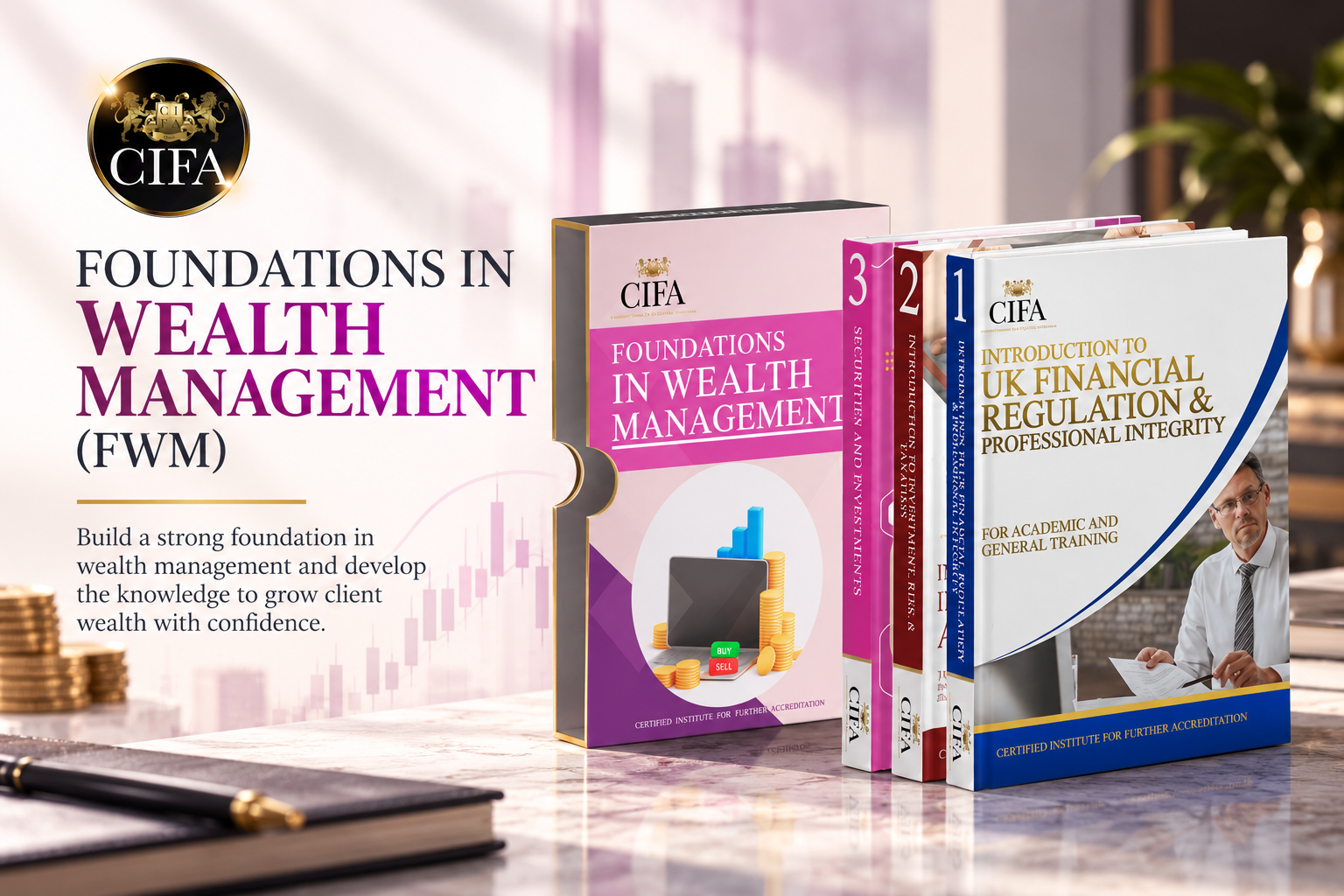
Foundations in Wealth Management (FWM): A Complete Introduction to Wealth Management
Wealth management is often associated with investments, portfolios and high-value financial decisions. But at its core, it is about something much broader: helping people make thoughtful decisions about their financial future.
Managing wealth effectively requires more than knowing which investments exist. It involves understanding financial objectives, assessing risk, considering different investment options and recognising how one decision can affect another over time.
For professionals entering the financial services industry, this wider perspective is essential. A strong foundation can make it easier to understand how investment, financial planning, risk management and client relationships fit together.
The Foundations in Wealth Management (FWM) offers a structured starting point for learners who want to develop their understanding of this important area of finance.
What Is Wealth Management?
Wealth management is a broad financial discipline focused on helping individuals and families manage, preserve and plan their financial resources.
It can involve several areas of financial decision-making, including investment planning, risk management, retirement considerations, tax awareness and longer-term financial goals.
The exact services involved can vary depending on the client's circumstances and the professional relationship. Someone building wealth may have very different priorities from someone preparing for retirement or managing assets accumulated over many years.
That is why wealth management is not simply about selecting investments.
It begins with understanding the person behind the financial numbers.
Looking Beyond the Investment Portfolio
Investment management is an important part of wealth management, but it is only one part of the wider picture.
Imagine a client who wants to increase their investment portfolio. On the surface, the objective seems straightforward. But before discussing investment options, a professional may need to understand the client's time horizon, financial commitments, attitude towards risk and broader objectives.
The same investment approach may not be appropriate for two people with completely different circumstances.
This is one of the central ideas behind professional wealth management: financial decisions need context.
A portfolio should not exist separately from the person's wider financial situation.
The Importance of Financial Goals
Good wealth management starts with clear objectives.
Clients may want to build long-term wealth, prepare for retirement, generate income, protect assets or plan for future family needs. Some goals may be several decades away, while others may require attention much sooner.
The professional challenge is turning these broad ambitions into realistic financial considerations.
For example, someone saving for a long-term objective may have more flexibility around short-term market movements than someone who expects to rely on their investments for income in the near future.
Understanding the purpose behind the money can therefore be just as important as understanding the money itself.
Risk Is Part of Every Financial Decision
There is no meaningful discussion of wealth management without considering risk.
Every financial decision involves uncertainty. Investments can rise and fall in value, economic conditions can change and personal circumstances can develop unexpectedly.
A professional approach to wealth management does not simply ask how much return an investment could generate. It also considers what level of risk may be appropriate and how that risk fits within the client's wider financial position.
This requires careful analysis and clear communication.
Clients need to understand that potential returns and potential risks are connected. A professional should be able to explain these relationships without making financial decisions sound unnecessarily complicated.
Building a Diversified Approach
Diversification is another important concept within wealth management.
Rather than relying heavily on a single investment or asset, diversification involves spreading exposure across different investments or asset classes. The underlying idea is that different investments may respond differently to changing market conditions.
However, diversification is not simply about owning as many investments as possible.
A large portfolio can still have concentrated exposure to particular risks. Effective portfolio construction therefore requires understanding what each investment contributes to the overall strategy.
For professionals, learning to look at a portfolio as a complete structure rather than a collection of individual products is an important step towards understanding wealth management.
Wealth Management Is Also About People
The technical side of finance is only part of the profession.
Wealth management is fundamentally a client-focused field. Professionals may work with people who have different financial backgrounds, priorities and levels of financial knowledge.
Communication therefore matters.
A client may understand very little about investment terminology, while another may have extensive financial experience. The professional needs to adapt the conversation without losing accuracy.
Listening is equally important.
Before discussing financial solutions, an adviser needs to understand what the client actually wants to achieve. Asking the right questions can reveal priorities that may not be obvious from a balance sheet or investment statement.
This combination of technical knowledge and interpersonal ability is one reason wealth management can be such a varied area of finance.
The Role of Financial Planning
Wealth management and financial planning are closely connected.
Financial planning looks at the wider direction of a person's finances and considers how different decisions may work together. Investment choices, savings, protection, retirement objectives and other financial considerations can all form part of the wider conversation.
This broader perspective helps prevent financial decisions from being made in isolation.
For example, investing aggressively may appear attractive when considered only from a return perspective. But if the same person has significant short-term financial commitments, the decision needs to be viewed differently.
Good planning creates context.
Why Professional Knowledge Matters
Financial professionals need a strong understanding of the principles behind the decisions they discuss with clients.
This includes understanding investment concepts, risk, portfolio construction, financial objectives and the relationship between different areas of personal finance.
Structured learning can help bring these subjects together.
CIFA provides online financial education across areas including financial planning, securities and investment, risk and taxation, derivatives and other specialist subjects. Its wider learning environment also includes professional development and employability tools.
For someone beginning to explore wealth management, building this foundation can make more advanced financial concepts easier to understand.
What Skills Does a Wealth Management Professional Need?
A career in wealth management requires a combination of technical and professional skills.
Financial knowledge is fundamental, but it needs to be supported by analytical thinking, communication, organisation and attention to detail.
Professionals also need to be comfortable working with information.
Client circumstances can involve multiple financial objectives and competing priorities. Being able to organise information, identify relevant issues and communicate conclusions clearly can make a significant difference.
Trust is another important element.
Clients are sharing sensitive financial information and relying on professionals to handle that information responsibly. Professional conduct, accuracy and clear communication are therefore central to the client relationship.
From Learning to Professional Development
Studying wealth management should not be viewed as simply learning a collection of financial terms.
The real value comes from understanding how those concepts connect.
Investment decisions influence risk. Risk affects planning. Planning depends on objectives. And objectives can change as a client's circumstances change.
Learning to see these connections helps develop a more complete understanding of wealth management.
For learners considering a career in finance, CIFA provides access to structured courses and professional learning opportunities across a range of financial subjects.
The next stage is then to combine formal learning with practical experience, continued development and a clear understanding of professional responsibilities.
Wealth Management in a Changing Financial Environment
The financial services industry continues to evolve, and wealth management professionals need to remain adaptable.
Clients have access to more financial information than ever before. Digital platforms have changed how people monitor investments and communicate with financial professionals. At the same time, the volume of available financial information can make it harder for individuals to distinguish useful guidance from general market commentary.
This increases the value of professionals who can interpret information and put it into context.
The role is not simply to provide more information. It is to help clients understand what information matters to their particular situation.
Why Foundations Matter
Advanced financial knowledge is difficult to build without a clear understanding of the fundamentals.
A professional who understands the basics of investment, risk, financial planning and client objectives has a stronger platform from which to explore more specialised areas.
That is the real value of foundations.
They create a framework for learning rather than isolated pieces of information.
For someone considering wealth management as a career, developing that framework can help clarify the responsibilities involved and the knowledge required to progress professionally.
Final Thoughts
Wealth management is much more than managing investments.
It brings together financial planning, investment knowledge, risk awareness, client communication and long-term thinking. At the centre of it all is the need to understand the client's objectives and consider financial decisions within the context of their wider circumstances.
The Foundations in Wealth Management (FWM) provides an opportunity to explore these core principles in a structured way and develop a clearer understanding of how modern wealth management works.
For aspiring finance professionals, the journey starts with the fundamentals. Learn how financial decisions connect, understand the role of risk, develop strong communication skills and continue building knowledge as your career progresses.
The stronger the foundation, the easier it becomes to understand the wider architecture of wealth management.

 English
 Arabic
 French
 Spanish
 Deutsch
 Turkish
 Dutch
Dutch
 Italiano
 Russian
 Romaian
 Portuguese (Brazil)
 Greek
Greek
