


Penalties for Skipping the Trakhees Approval Process
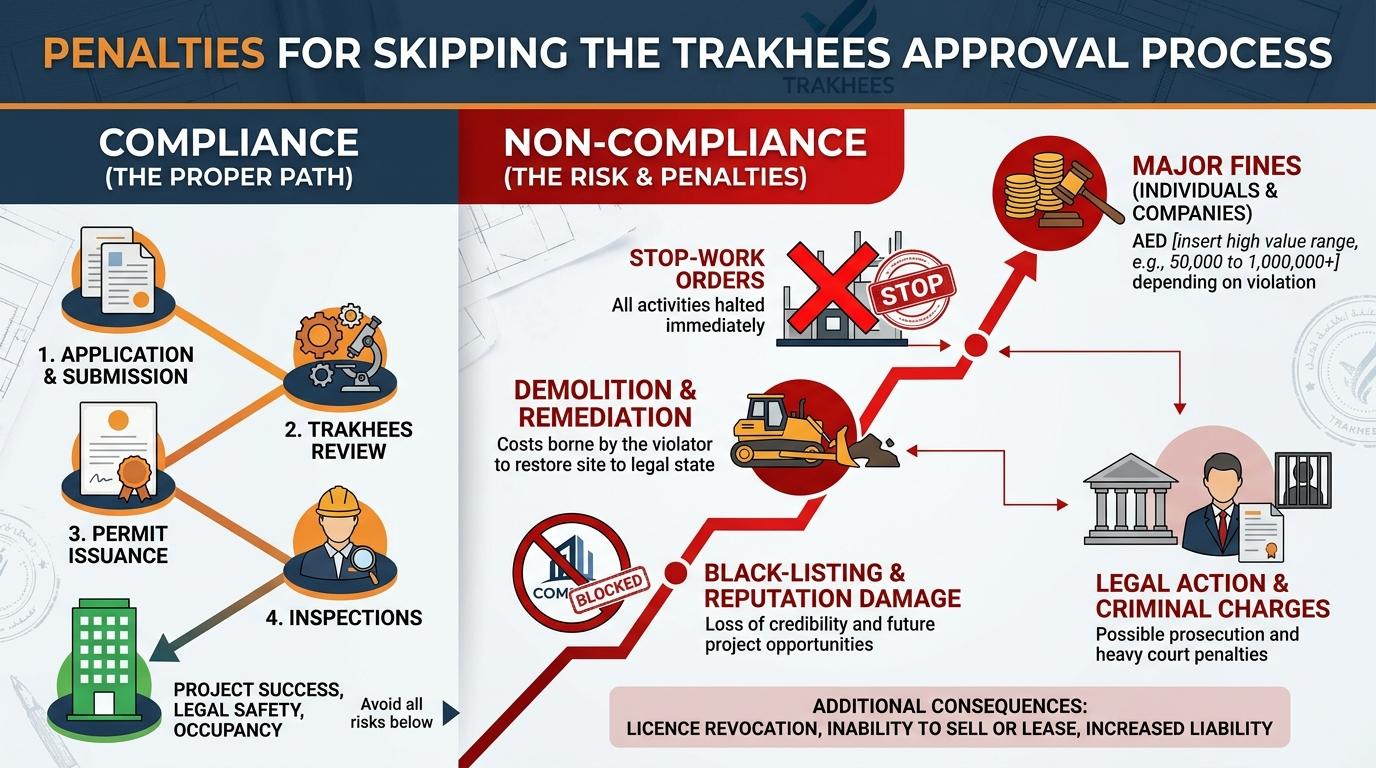
Some owners, eager to begin construction quickly or hoping to save on regulatory fees, consider skipping the Trakhees approval process entirely, treating formal approval as an optional formality rather than a legal requirement. This is a genuinely risky assumption, and the consequences of unauthorized construction within Trakhees jurisdiction extend well beyond a simple fine. This guide explains what actually happens when construction proceeds without proper approval, and why the risk consistently outweighs whatever time or cost savings owners hope to achieve by skipping the process.
Why Some Owners Consider Skipping Approval
Understanding why this temptation exists helps clarify why it is nonetheless a poor decision. The Trakhees approval process takes genuine time, often several weeks even for straightforward projects, and involves fees that, while individually modest, add up across a full project. Some owners, facing time pressure or wanting to minimize costs, view unauthorized construction as a way to avoid both this delay and this expense, reasoning that the work will likely go unnoticed or that any consequences, if discovered, would be manageable.
Financial Penalties for Unauthorized Construction
When unauthorized construction is discovered, whether through routine inspection, a neighbor's complaint, or during an unrelated interaction with Trakhees or another authority, financial penalties typically apply, and these are generally structured to meaningfully exceed whatever fees the owner attempted to avoid by skipping the Trakhees approval process in the first place. This penalty structure exists specifically to remove any financial incentive for choosing unauthorized construction over proper approval, meaning owners calculating potential savings from skipping approval consistently underestimate the actual financial risk involved.
Stop Work Orders
Beyond financial penalties, unauthorized construction discovered while still in progress typically results in an immediate stop work order, halting all construction activity until the situation is resolved, whether through retroactive approval, if the work can be brought into compliance, or removal of the unauthorized work if it cannot. This immediate work stoppage often causes significant additional delay and cost beyond the original penalty itself, since construction crews, equipment and material deliveries scheduled around continuous work suddenly face an indefinite pause while the compliance issue is addressed.
Forced Modification or Demolition
In cases where unauthorized work does not meet applicable structural, safety or planning requirements, and cannot be reasonably modified to achieve compliance, Trakhees can require the unauthorized construction to be removed entirely, effectively forcing the owner to demolish work that may have taken significant time and money to complete. This represents the most severe practical consequence of skipping the Trakhees approval process, since it means the original construction investment is entirely lost, in addition to whatever financial penalties applied and whatever cost demolition itself requires.
Complications With Property Transactions
Unauthorized construction creates lasting complications beyond the immediate penalty and work stoppage risk. Properties with unapproved modifications often face genuine difficulty during sale, since buyers and their legal representatives typically verify that a property's actual condition matches its approved, documented status, and discrepancies discovered during this process can derail or significantly delay a sale. Even years after unauthorized work was completed, this compliance gap can resurface as a genuine obstacle during an eventual property transaction, long after the original time or cost savings from skipping approval have been forgotten.
Insurance and Liability Complications
Unauthorized construction can also complicate insurance coverage, since many property insurance policies include provisions excluding coverage for damage related to unpermitted work. This means an owner who skipped the Trakhees approval process may discover, in the worst possible circumstances following an actual incident like a structural failure or fire, that their insurance coverage does not apply precisely because the relevant construction was never properly approved, leaving them financially exposed in a situation insurance was specifically meant to protect against.
Impact on Future Approval Requests
Owners or contractors with a history of unauthorized construction discovered by Trakhees may face increased scrutiny on future legitimate submissions, since this history reasonably affects how much trust a regulatory body extends to an applicant's future compliance. This reputational consequence, while less immediately quantifiable than a direct financial penalty, represents a genuine, lasting cost that extends well beyond the specific unauthorized project itself.
Why Proper Approval Remains the Only Sensible Choice
When weighed honestly against the genuine risks, financial penalties that exceed original fees, potential stop work orders and demolition, complications during future property sales, insurance coverage gaps, and lasting reputational impact on future approval requests, the time and cost savings some owners hope to achieve by skipping the Trakhees approval process simply do not justify the risk involved. Proper approval, while requiring genuine time and modest fees, protects owners from consequences that are considerably more costly, disruptive and lasting than the approval process itself.
Final Thought
Skipping the Trakhees approval process exposes owners to consequences that extend well beyond a simple, manageable fine: stop work orders disrupting active construction, potential forced demolition eliminating the original investment entirely, complications during future property sales, and possible insurance coverage gaps in the event of an actual incident. Understood honestly, these risks make proper approval not merely a legal formality but a genuinely sound practical decision that protects an owner's investment far more reliably than the modest time and cost savings unauthorized construction might seem to offer.

 English
 Arabic
 French
 Spanish
 Portuguese
 Turkish
 Dutch
Dutch
 Italiano
 Russian
 Romaian
 Portuguese (Brazil)
 Greek
Greek