


Inside a B.Tech in Lucknow: What IT and AI/ML Programs Actually Teach You
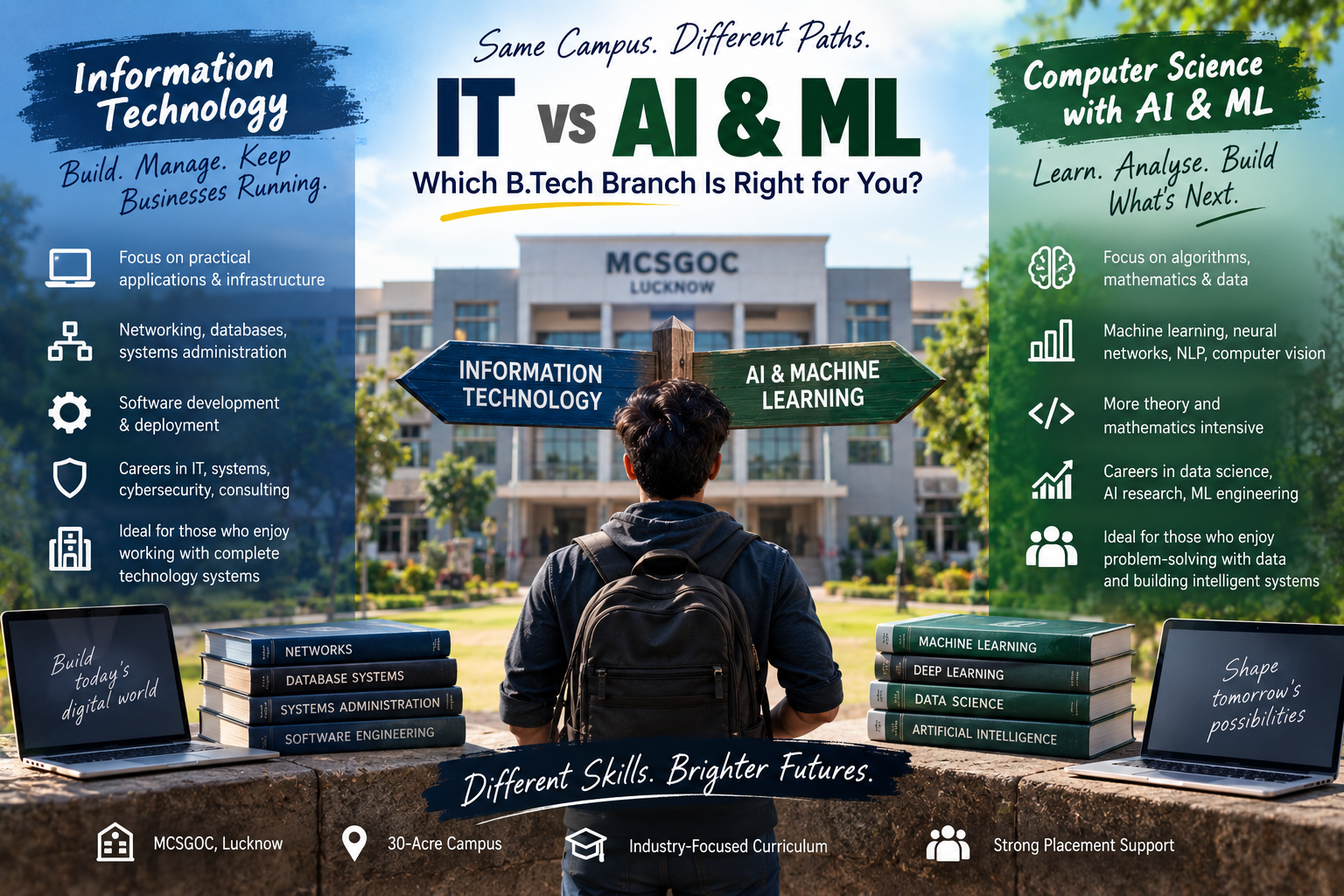
Four Years of Engineering in Lucknow: What Nobody Tells You Before You Enroll
The gap between what students expect when they join an engineering program and what they actually encounter in the first semester is one of the most consistent and least-discussed features of technical education in India. Students arrive with a vague sense that they'll be coding from day one, or building projects, or doing something that feels immediately connected to the career they're imagining. What they find instead is mathematics, physics, engineering drawing, and communication skills — a foundation semester that looks nothing like what they signed up for and everything like what they actually need.
This article is about what the four years genuinely look like on the inside — not the brochure version, not the placement statistics, but the actual semester-by-semester reality of studying IT or AI/ML as a B.Tech branch in Lucknow. If you're deciding between these programs, or you've already enrolled and want to understand what's coming, this is the honest picture that most counselling sessions don't give you.
The First Year: Why It Looks Nothing Like Engineering
Almost every B.Tech program affiliated with Dr. A.P.J. Abdul Kalam Technical University follows the same first-year structure regardless of branch. This surprises most students. You enrolled in computer science or IT or AI/ML, and now you're studying Engineering Mathematics, Engineering Physics, Basic Electrical Engineering, and something called Professional Communication. Where's the actual engineering?
The answer is that the first year is doing something more important than teaching you to code — it's building the cognitive foundation without which the technical coursework that comes later makes no sense. Engineering Mathematics in the first year covers calculus, differential equations, and linear algebra. For AI/ML students specifically, linear algebra is not preliminary material — it is the actual language in which machine learning works. Every neural network, every transformation of data, every gradient descent calculation is fundamentally a series of linear algebra operations. Students who dismiss this course as irrelevant to their actual branch are misunderstanding what their branch is built on.
Physics and basic electrical concepts serve a similar purpose — they establish physical intuition that becomes relevant when IT students later encounter networking fundamentals, signal processing, or hardware interfaces. The first year feels slow because it's building wide rather than deep. The depth comes later, and it requires the width.
Among b tech colleges in lucknow, the first-year structure is standardised across AKTU affiliation, which means the foundational coursework a student covers in Lucknow is directly comparable to what peers at other AKTU-affiliated colleges across UP are covering simultaneously. This matters for lateral transfers and for competitive examinations later.
The Second Year: When the Branch Starts to Feel Real
The second year is where IT and AI/ML programs begin to differentiate themselves meaningfully, and where most students experience their first genuine engagement with the subject they chose.
For IT students, the second year typically introduces Data Structures and Algorithms — arguably the most important course in the entire program, and the one that placement interviews test most consistently — alongside Object-Oriented Programming, Database Management Systems, and the beginning of Computer Networks. Data structures is where the abstract thinking that separates good programmers from average ones gets built. A student who genuinely masters arrays, linked lists, trees, graphs, and the algorithms that operate on them in second year will find almost every subsequent coursework module easier and almost every technical interview more manageable.
Database Management is the other second-year course that has immediate real-world relevance. Nearly every technology application that has ever been built relies on a database for something. Understanding how relational databases work, how queries get optimised, and how data integrity gets maintained is foundational knowledge for IT professionals in almost any role — not a specialisation, but a baseline competency.
For AI/ML students, the second year deepens the mathematical foundation before the applied work begins. Probability and Statistics — the mathematical language in which machine learning models express uncertainty and make predictions — typically appears in the second year, alongside Python programming, which has become the de facto language for machine learning work across the industry. A student who comes out of the second year genuinely comfortable with probability distributions, hypothesis testing, and Python scripting is well-positioned for the more demanding coursework ahead.
The Third Year: Where the Specialisation Gets Serious
The third year is where both programs make their most distinctive moves, and where the gap between the two branches becomes impossible to ignore.
Information technology in btech programs in their third year typically introduce Computer Networks in depth — not just the concept of networking but the actual protocols, architectures, and security considerations that determine how data moves reliably across the internet. This is the year when IT students begin to understand the infrastructure that the digital world runs on rather than just the applications that sit on top of it. Cloud Computing appears in many updated IT curricula in the third year, covering the virtualisation, containerisation, and distributed systems concepts that have become central to how technology gets built and deployed in industry. Cybersecurity increasingly features as a dedicated subject rather than a module within something else, reflecting how significantly the field has grown as a professional discipline.
For AI/ML students, the third year is where the branch earns its name. Machine Learning algorithms — linear regression, logistic regression, decision trees, support vector machines, ensemble methods, clustering algorithms — get covered in dedicated depth rather than as passing references. The mathematical machinery built in the first two years becomes immediately applicable: optimisation algorithms use calculus, model evaluation uses probability and statistics, feature transformations use linear algebra. Students who struggled with these foundational subjects in the first two years find the third year considerably harder than their peers who engaged with mathematics seriously from the start.
B tech artificial intelligence and machine learning curricula in their third year also typically introduce Neural Networks as a dedicated subject, covering the architecture of multi-layer perceptrons, backpropagation as a training mechanism, and activation functions that determine how individual neurons respond to input. This is the mathematical and conceptual foundation for Deep Learning — the technology that underpins image recognition, natural language processing, and most of the AI applications that have entered mainstream awareness over the last decade.
The Fourth Year: Projects, Placements, and What Actually Sticks
The fourth year serves multiple functions simultaneously, and students who understand this in advance navigate it considerably better than those who don't.
The major project is the most significant academic work of the entire program. It's also the most visible output to a prospective employer — not the degree itself, but what you built with it. A genuinely well-executed fourth-year project that solves a real problem, uses current tools and frameworks, and demonstrates independent thinking will do more for a student's placement prospects than almost anything else on their CV. A perfunctory project that fulfils the requirement but demonstrates minimal genuine effort does the opposite.
Placements run in parallel with the fourth year at most AKTU-affiliated colleges. The placement cycle for IT and AI/ML students follows a broadly similar structure — aptitude rounds, technical interviews covering data structures and algorithms or machine learning fundamentals depending on the branch, followed by HR rounds — but the preparation required differs significantly. IT students preparing for technical interviews need to be deeply solid on data structures, algorithms, SQL, and operating systems fundamentals. AI/ML students preparing for ML or data science roles need conceptual clarity on machine learning algorithms, statistical foundations, and practical Python and framework experience alongside data structures basics.
MCSGOC structures its fourth-year preparation around this distinction, with placement support calibrated to the specific interview patterns for each branch rather than a single generic preparation program applied uniformly.
The courses that genuinely stick — the ones students report using in their first job and beyond — are almost never the ones that seemed most exciting in the brochure. They're the unglamorous foundations: data structures from second year, database management, mathematics from first year, and whatever the student built in their major project. This is worth knowing before the program begins, because it changes how you allocate effort across the four years.
What the Four Years Produce That the Degree Certificate Doesn't Show
A B.Tech from an AKTU-affiliated college in Lucknow produces a graduate who has spent four years developing a specific kind of thinking — systematic, structured, and comfortable with abstraction — alongside a set of technical skills that are genuinely in demand. The degree certificate shows the credential. What it doesn't show, and what determines outcomes more than the credential does, is how deeply the student engaged with the material.
The honest reality of both IT and AI/ML programs is that the distance between a student who attended classes, submitted assignments, and cleared exams and a student who genuinely engaged with the coursework — built things outside class, debugged real problems, developed actual understanding rather than surface familiarity — is enormous. Both students hold the same degree. Their capabilities, confidence in interviews, and performance in first jobs are not comparable.
This is the thing nobody tells students clearly enough before they enroll, and it's more important than any comparison between the branches themselves.
Conclusion
Four years of engineering in Lucknow, whether in IT or AI/ML, follow a structure that makes more sense understood as a whole than experienced semester by semester. The first year builds the cognitive foundation. The second year begins the branch-specific technical work. The third year is where the specialisation gets serious and the branch's distinct identity becomes unmistakable. The fourth year is where everything comes together in a project and a placement process that determines, more than the degree itself, how the next chapter begins.
The difference between IT and AI/ML isn't primarily about which branch produces better outcomes — both produce strong outcomes at well-managed colleges. It's about which branch's coursework a specific student is more likely to engage with seriously, because serious engagement is what converts four years of enrollment into four years of genuine development. The student who chose IT and genuinely built their data structures, networking, and systems knowledge is considerably better positioned than the student who chose AI/ML and treated mathematics as an obstacle rather than a foundation.
Choose the branch whose material you'll actually respect enough to learn properly. That single decision, more than the branch name on the degree, determines what the four years produce.
Frequently Asked Questions
What is the first year of a B.Tech IT or AI/ML program actually like for students who enrolled expecting to code from day one?
The first year is consistently the most surprising for students who arrived expecting immediate coding immersion. The AKTU curriculum for first-year B.Tech students is substantially standardised across branches and covers Engineering Mathematics, Engineering Physics, Basic Electrical Engineering, Environmental Science, and Professional Communication alongside an introductory programming course. Most students find the mathematics and physics courses more demanding than they expected, while the programming course is often simpler than they anticipated. The key adjustment is understanding that this year is building foundational thinking rather than branch-specific skills — the return on this investment becomes clearer in the second and third years when the technical coursework assumes mathematical fluency as a baseline.
How much mathematics does a B.Tech AI/ML student actually use throughout the program?
Significantly more than most students expect at enrollment. Linear algebra is the language in which neural networks and most machine learning models are expressed — every weight matrix, every feature transformation, every gradient calculation is a linear algebra operation. Probability and statistics govern how models make predictions, express confidence, and get evaluated. Calculus drives the optimisation algorithms that train models. These aren't peripheral subjects that appear once and disappear — they recur throughout the program in increasingly applied forms. Students who build genuine mathematical fluency in the first two years find the applied AI/ML coursework in the third and fourth years considerably more accessible than those who passed the mathematics courses without deeply understanding the material.
What kind of projects do fourth-year IT and AI/ML students typically build at Lucknow colleges?
IT students typically build projects around web or mobile application development, database management systems, network security tools, or enterprise software solutions. AI/ML students typically build projects around image classification, sentiment analysis, predictive modelling, recommendation systems, or natural language processing applications. The quality range across both branches is wide — projects built with genuine investment in solving a real problem using current tools and frameworks produce substantially better portfolio outcomes than projects that fulfil the academic requirement but demonstrate minimal practical ambition. Strong final-year projects from both branches have led to pre-placement offers at companies that visited campus specifically because a student's project demonstrated initiative beyond standard coursework.
Is it possible to get a data science or AI/ML job after completing a B.Tech in Information Technology rather than AI/ML?
Yes, but it requires deliberate upskilling beyond the IT curriculum. IT programs develop strong programming, database, and systems foundations that are genuinely relevant to data roles, but they don't cover machine learning algorithms, statistical modelling, or deep learning in the depth that AI/ML programs do. IT graduates who want to move into data science or ML roles typically supplement their degree with structured coursework in machine learning, Python data science libraries, and statistical foundations — through online platforms, postgraduate programs, or self-directed study. The programming and database foundation from an IT degree provides a meaningful head start compared to a non-technical background, but the gap between an IT graduate and an AI/ML graduate in machine learning-specific technical interviews is real and requires genuine effort to close.
What do placement interviewers at technology companies typically test for IT vs AI/ML graduates?
For IT graduates, the most consistently tested areas across placement rounds are data structures and algorithms, SQL and database fundamentals, operating systems concepts, and object-oriented programming principles. Companies hiring for software development, IT consulting, and systems roles concentrate technical questioning in these areas because they reflect the day-to-day work of IT roles accurately. For AI/ML graduates applying to machine learning engineer or data science roles, interviewers test machine learning algorithm fundamentals, probability and statistics, Python programming with data science libraries, and increasingly system design for ML models. Both sets of roles also include aptitude rounds and HR interviews, but the technical substance is meaningfully different between them — preparing for IT placements and preparing for AI/ML placements require different study plans.
How does the AKTU affiliation affect what a student learns compared to an autonomous college offering the same branches?
AKTU affiliation means the core curriculum, examination pattern, and grading system are standardised by the university rather than determined by the individual college. This provides a baseline consistency — a student at one AKTU-affiliated college in Lucknow is covering broadly similar foundational material to a student at another AKTU-affiliated college in UP, which matters for competitive examinations, lateral transfers, and employer recognition of the degree. Autonomous colleges have more flexibility to update curriculum faster, introduce electives outside the standard framework, and design assessments differently. The trade-off is that autonomous college degrees carry the college's name rather than a university's, which can affect recognition in certain contexts. For most industry employers, both carry comparable weight — what matters more is the student's demonstrated ability in the interview than the specific affiliation of the degree.

 English
 Arabic
 French
 Spanish
 Portuguese
 Turkish
 Dutch
Dutch
 Italiano
 Russian
 Romaian
 Portuguese (Brazil)
 Greek
Greek