

Don’t Buy Every Machine on Day One: Build Your Commercial Laundry Setup in 3 Stages
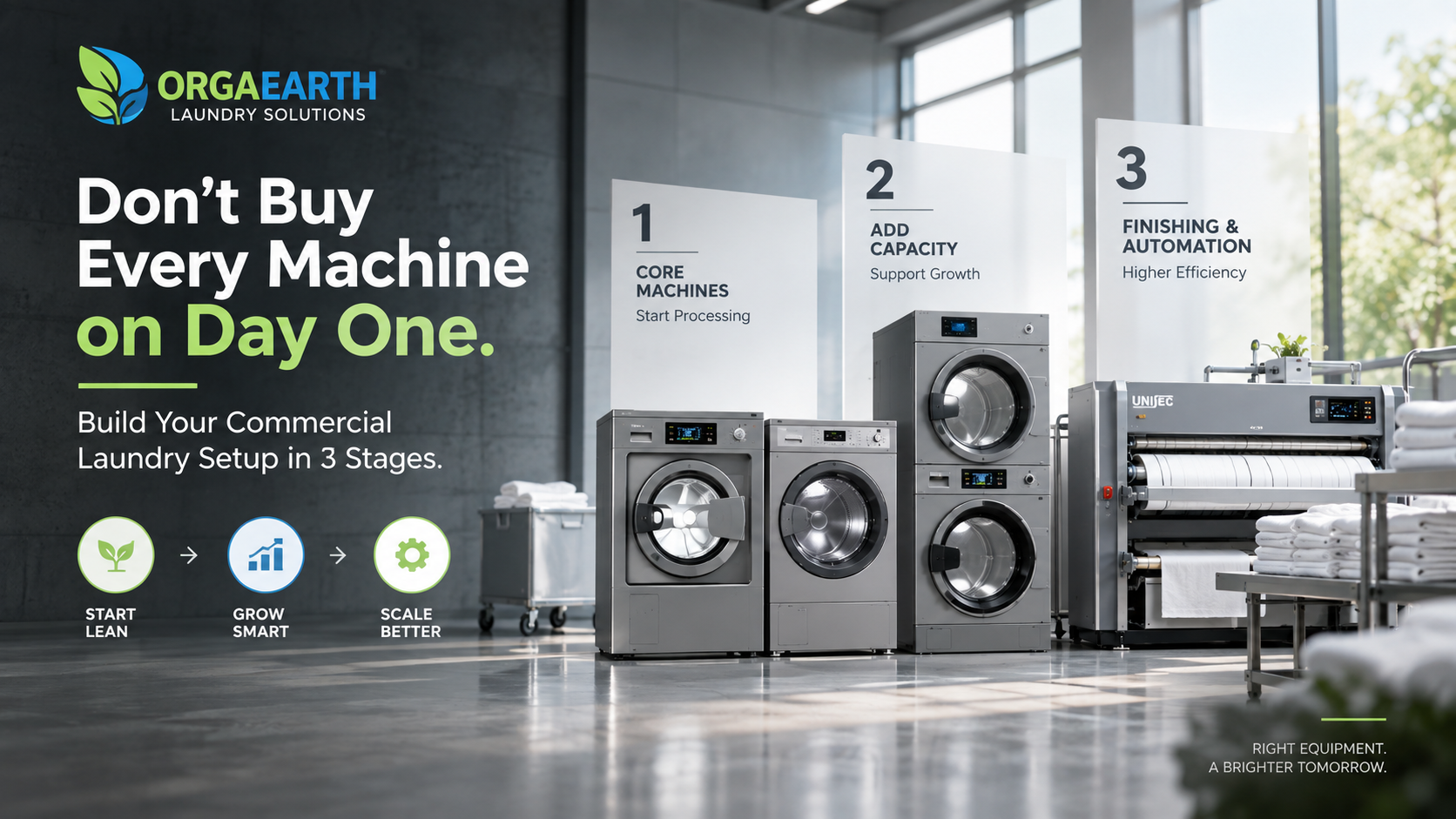
Starting a commercial laundry does not mean buying every available machine before receiving your first order. A better approach is to build the operation around the work you expect to process, then expand equipment as actual demand creates new capacity or workflow requirements.
Choosing the right commercial laundry machines for business is therefore less about creating the longest equipment list and more about deciding what your operation needs now, what can wait, and what should be added as volume grows.
A practical equipment journey looks like this:
Start Lean → Process Orders → Identify Bottlenecks → Add Capacity → Improve Finishing → Automate Where Needed
This staged approach can help a new laundry use its investment more purposefully while leaving room for future growth.
Which Commercial Laundry Machines Do You Actually Need to Start a Business?
The machines needed for a laundry business depend on what you plan to wash, how much you expect to process, and the service you intend to offer.
A laundry handling hotel linen, for example, may eventually need a different finishing workflow from a business processing garments or restaurant linen.
Before preparing a laundry business machine list, answer four questions:
-
Who will your customers be?
-
What textiles will you process?
-
How many kilograms do you expect per day?
-
What turnaround time will you offer?
From there, equipment can be divided into three categories:
Essential Equipment → Capacity/Workflow Equipment → Finishing & Automation
For many general commercial laundry operations, washing and drying form the core process. Additional commercial laundry equipment should then be selected according to actual operational requirements.
The objective is not to own more machines. It is to create a workflow in which each machine has a clear purpose.
Stage 1: Which Machines Should You Buy Before Taking Your First Laundry Orders?
Stage 1 should focus on equipment required to complete your core service.
Commercial Washing Machine or Washer Extractor
Washing is the starting point. Depending on the scale and application, this could involve a commercial washing machine or commercial washer extractor.
Do not choose capacity simply because a larger machine appears to provide more room for growth. Estimate expected daily volume and practical load size first.
A simple planning calculation is:
Required Loads Per Day = Expected Daily Laundry KG ÷ Practical Average Load
Suppose you expect 150 KG per day and your practical average load is approximately 15 KG. That would mean around 10 wash loads per day. This is only an illustrative example; actual loading depends on textile type, machine specifications and operating conditions.
Commercial Tumble Dryer
If your operation cannot depend on natural drying, a commercial tumble dryer becomes part of the essential workflow.
The washer and dryer should not be selected independently. A large washing capacity with insufficient drying capacity can simply move the bottleneck from washing to drying.
Think of the process as:
Washing Capacity → Extraction → Drying Capacity → Turnaround Time
Basic Handling and Finishing
Depending on the service, Stage 1 may also require basic ironing or pressing equipment, sorting areas, trolleys, tables, racks and packing arrangements.
Your first commercial laundry setup should therefore be capable of taking an order from receiving to dispatch—not just washing it.
Stage 2: Which Machines Should You Add When Daily Laundry Volume Starts Growing?
Growth does not necessarily mean replacing every existing machine.
First identify where work is accumulating.
Is washing constantly occupied while the dryer waits? Is washed linen waiting for drying? Are garments ready but delayed at pressing? Is one machine creating a queue during peak hours?
Your bottleneck tells you where the next investment should go.
Add Washing Capacity When Wash Loads Are Queuing
If the existing washer is consistently operating close to practical capacity and incoming work is waiting, additional washing capacity may be justified.
The choice might be between a larger washer and an additional machine. Two machines can also provide flexibility for separating different textile categories or running different programs, depending on the operation.
Add Drying Capacity When Wet Laundry Is Waiting
If washing is keeping pace but wet textiles are regularly waiting for the dryer, purchasing another washer will not solve the problem.
This is why a commercial washer and dryer for business should be planned as part of one processing system.
Let Real Orders Guide Expansion
Instead of buying equipment for imagined future demand, track:
Daily KG → Loads Per Day → Machine Hours → Waiting Time → Bottleneck
This provides a more practical basis for deciding which laundry machines for business should be added next.
Stage 2 is where equipment planning starts moving from assumptions to actual operating data.
Stage 3: When Should You Invest in Finishing Equipment and Automation?
As volume increases, washing and drying may no longer be the biggest problem. Handling and finishing can become the next constraint.
This is where laundry finishing equipment becomes important.
For operations processing larger quantities of flat linen, suitable finishing systems may help manage items such as bedsheets, table linen and similar textiles. Garment-focused operations may require different pressing and finishing equipment.
The decision should be driven by workflow.
Ask:
Where is work waiting after drying?
If finished laundry consistently waits for manual ironing, folding or other handling processes, the finishing stage may need attention.
Automation can also become relevant in areas such as chemical dosing and other repetitive processes, depending on the laundry's scale and equipment compatibility.
However, automation should solve a defined operational problem. Buying equipment simply because it is available can increase investment without addressing the real bottleneck.
A better sequence is:
Measure the Process → Find Repeated Delay → Identify Cause → Evaluate Equipment → Invest
That is how commercial laundry equipment for startup can gradually develop into a more complete production system as the business grows.
How Should You Plan Your Commercial Laundry Equipment Budget Across These 3 Stages?
Do not allocate the entire budget only to machine purchase prices.
Your total setup may also require expenditure on installation, electrical supply, water, drainage, ventilation, heating utilities where applicable, chemical systems, material handling and site preparation.
A useful planning framework is:
Total Setup Investment = Machines + Installation + Utilities + Site Preparation + Supporting Equipment
Then divide investment according to the stage of the business.
|
Stage |
Main Objective |
Equipment Focus |
|
Stage 1 |
Start processing |
Washing, drying, basic handling/finishing |
|
Stage 2 |
Remove bottlenecks |
Additional washing/drying capacity |
|
Stage 3 |
Improve workflow |
Finishing equipment and relevant automation |
Before spending more, ask whether the investment solves a current requirement or supports realistic near-term growth.
This is particularly important when selecting laundry equipment for small business operations where capital and space may both be limited.
Your equipment plan should ultimately follow:
Customer Type → Textile Mix → Daily KG → Workflow → Bottleneck → Equipment Requirement → Investment
How Orgaearth Can Help
Orgaearth helps businesses plan commercial laundry machines around their actual processing requirements rather than simply creating a long equipment list.
Whether you are planning a new laundry or expanding an existing facility, equipment selection can be evaluated according to daily volume, textile type, available space, utilities, washing and drying requirements, finishing needs and future expansion plans.
From commercial washer extractors and tumble dryers to finishing solutions and supporting laundry systems, the objective is to build a setup where equipment works together as part of one practical workflow.
Frequently Asked Questions
What commercial laundry machines do I need to start a laundry business?
The exact equipment depends on your service model. Washing and drying are usually core processes, while pressing, finishing, material handling and other equipment depend on the textiles and services you plan to handle.
Should I buy all my laundry business equipment before opening?
Not necessarily. A staged approach allows you to begin with equipment required for your core service and add capacity, finishing equipment or automation as real demand develops.
How do I choose the capacity of a commercial washing machine?
Start with expected daily laundry KG, textile type, practical load size, operating hours and the number of loads required each day. Do not select capacity only on expected future growth.
When should I buy another commercial washer extractor?
Consider additional capacity when your existing machine is consistently creating a washing bottleneck and the additional workload is regular enough to justify expansion.
What equipment should I add when my laundry business grows?
Identify where work is waiting. The next investment could be additional washing capacity, a commercial tumble dryer, finishing equipment or another workflow solution depending on the bottleneck.
Conclusion
A successful laundry business setup does not have to begin with every machine you might eventually need.
Start with the equipment necessary to process your initial orders. Once real work begins flowing through the laundry, measure where delays occur. Add capacity where demand requires it, then introduce finishing equipment and automation when they solve a clear operational problem.
The equipment roadmap is straightforward:
Start Lean → Process Orders → Find the Bottleneck → Expand Capacity → Improve Finishing → Automate Where Needed
Instead of asking, “How many machines can I buy?”, build your commercial laundry around a more useful question:
“Which machine does my business actually need next?”
Contact Us
Orgaearth Laundry Solutions
Plot no. 774, Udyog Vihar, Phase 5, Gurugram, Haryana, India-122016
Email: marketing@orgaearth.com
Contact No. +91 7042912777

 English
 Arabic
 French
 Spanish
 Portuguese
 Deutsch
 Turkish
 Dutch
Dutch
 Italiano
 Russian
 Romaian
 Greek
Greek