


5 Million Dollar Home Mortgage, See Your Monthly Payment | Free Mortgage Calculator
Buying at this level is a different game entirely. The lenders are different, the underwriting is different, and the numbers on the page carry a lot more zeros than most mortgage calculators are built to handle. You do not need a rough estimate here. You need a real, defensible number before you sit down with a private banker or a jumbo loan specialist.
A 5 million dollar home mortgage falls squarely into jumbo and super jumbo territory, and the monthly payment math works differently than a standard conforming loan once you factor in rate premiums, larger down payment requirements, and the reserves lenders expect to see. This guide walks through the real monthly payment at today's rates, what a purchase this size actually requires in cash and income, and how to check your exact figure before you make an offer.
The Direct Answer
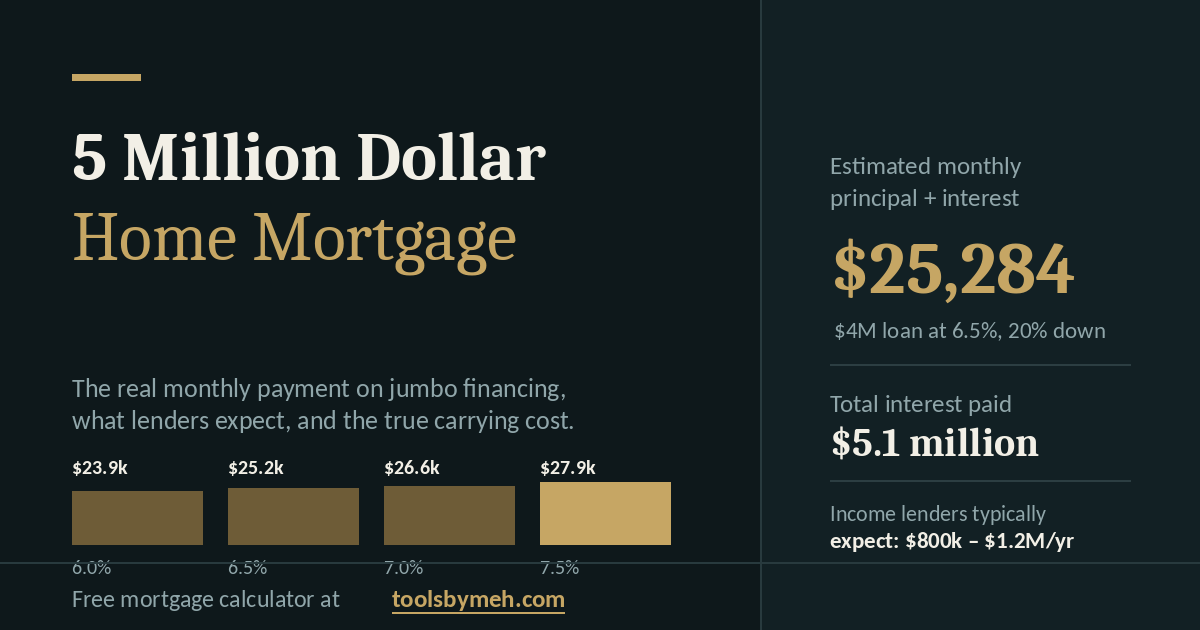
Assuming a 20% down payment, your loan amount on a $5 million home is $4 million. Spread over 30 years, here is what that payment looks like at common jumbo rates:
- At 6.0% you pay roughly $23,986 per month, with about $4,635,010 in total interest
- At 6.5% you pay roughly $25,284 per month, with about $5,102,336 in total interest
- At 7.0% you pay roughly $26,617 per month, with about $5,582,145 in total interest
- At 7.5% you pay roughly $27,979 per month, with about $6,072,489 in total interest
At this scale, every quarter point on your rate moves your monthly payment by several hundred dollars, and it moves your lifetime interest bill by hundreds of thousands. This is exactly why rate negotiation and relationship banking matter far more on a loan this size than they do on a typical conforming mortgage.
Why a $5 Million Home Requires Jumbo Financing
Conforming loan limits set by government-backed programs cap out well below this price point in most of the country. Once your loan amount exceeds that ceiling, you move into jumbo loan territory, and once it climbs even higher, you are in what lenders call super jumbo.
This matters because jumbo underwriting is stricter across the board. Lenders typically expect:
- A larger down payment, often 20% to 30% or more depending on the lender and loan size
- Higher credit score thresholds, frequently 720 and above, sometimes 740 or higher for the best pricing
- Significant cash reserves, often six to twelve months of mortgage payments held in liquid accounts after closing
- Detailed income and asset documentation, especially for self-employed or high-net-worth borrowers with non-traditional income
A 5 million dollar home mortgage is not something most retail lenders process the same way they handle a standard purchase. Private banks and jumbo specialists are often the better route, and they frequently offer relationship-based pricing if you move significant assets under their management.
How the Payment Is Actually Calculated
The math itself follows the same amortization formula used on any mortgage. The lender takes your loan amount, your monthly interest rate, and the number of payments, 360 for a 30-year term, and solves for the fixed payment that clears the balance exactly on schedule.
What changes at this scale is the sheer size of every component. In month one at 6.5% on a $4 million loan, roughly $21,667 of your payment goes to interest and only about $3,617 chips away at principal. That ratio shifts over time just like any mortgage, but on a balance this large, the early years represent an enormous amount of interest paid before meaningful equity starts building.
30 Years vs 15 Years on a $5 Million Home
This comparison matters even more at high loan amounts because the dollar gap between terms becomes massive.
Using the same $4 million loan at 6.5%:
- 30-year loan: about $25,284 per month, roughly $5,102,336 paid in interest
- 15-year loan: about $34,839 per month, roughly $2,271,020 paid in interest
The 15-year term costs about $9,555 more per month, but it saves nearly $2.9 million in interest over the life of the loan. For buyers with strong, stable cash flow, that is a genuinely compelling trade. For buyers who want maximum liquidity and flexibility, particularly those with significant assets tied up in investments or business interests, the 30-year term keeps more capital available for other opportunities.
There is no universally correct answer here. It comes down to how you want to deploy capital and whether the opportunity cost of a larger monthly payment outweighs the long-term interest savings.
What Actually Rides on Top of the Loan Payment
The figures above are principal and interest only. On a home this size, the additional monthly costs are substantial and deserve just as much attention as the loan itself.
Expect these additions:
- Property taxes. Often $30,000 to $100,000 or more annually depending on the state and local rate, frequently 1% to 2% of assessed value
- Homeowners insurance. High-value homes often require specialized coverage, commonly $1,000 to $3,000 or more per month depending on location, construction, and risk factors like flood or wildfire zones
- HOA or association fees. Can run into the thousands monthly in luxury developments or waterfront communities
- Umbrella liability coverage. Frequently recommended at this asset level, adding a modest monthly cost for significant additional protection
- Maintenance reserves. Property managers and advisors commonly recommend budgeting 1% to 2% of home value annually for upkeep on estates this size
Once all of this is layered on top, a $25,284 base payment can realistically become $30,000 to $35,000 or more per month depending on location and property type. Anyone shopping in this range should build a full carrying cost model, not just a loan payment estimate.
What Income and Assets Lenders Expect to See
Jumbo and super jumbo lenders generally still apply a debt-to-income framework, though private banking relationships can flex these guidelines for high-net-worth clients with substantial assets.
As a general benchmark, lenders often want to see gross annual income in the range of $800,000 to $1,200,000 or more to comfortably support a fully loaded payment near $30,000 a month, depending on other debts and the strength of liquid reserves. Asset-based lending programs are also common at this level, where a borrower's total investable assets substitute for or supplement traditional income documentation.
This is exactly why running the real numbers behind a 5 million dollar home mortgage matters before you start touring properties. Lenders at this tier evaluate the whole financial picture, not just a pay stub.
Ways to Improve Your Terms on a Loan This Size
Even at the top of the market, there is real room to negotiate and optimize.
- Consolidate assets with a private bank to access relationship pricing, which can meaningfully beat published rate sheets
- Increase your down payment beyond the minimum to reduce your loan-to-value ratio and unlock better rate tiers
- Consider an interest-only period if you have strong cash flow and want maximum flexibility in the early years
- Compare portfolio lenders against traditional jumbo programs, since portfolio lenders sometimes offer more flexible underwriting for complex income
- Lock your rate strategically, since jumbo rate movements can be more volatile than conforming rate movements during market shifts
- Work with a mortgage broker who specializes in jumbo and super jumbo loans, since not every lender competes aggressively at this loan size
Is Financing the Right Move at This Level
Plenty of buyers at this price point could pay cash but choose to finance anyway, and the reasoning is usually strategic rather than necessity-driven. Keeping capital deployed in investments that outperform the mortgage rate, maintaining liquidity for other opportunities, and preserving certain tax advantages are common reasons high-net-worth buyers still take on a mortgage even when they do not need to.
If you are financing out of necessity rather than strategy, it is worth having a candid conversation with a financial advisor about how a payment of this size fits into your broader wealth picture, not just whether you can technically qualify.
Conclusion
You now have a realistic picture of what a 5 million dollar home mortgage actually costs each month, from the base loan payment at today's jumbo rates to the substantial additional costs of taxes, insurance, and upkeep that come with owning a home at this level. A $4 million loan after a 20% down payment typically runs between $24,000 and $28,000 a month in principal and interest alone, and the fully loaded number is meaningfully higher once everything else is included.
No blog estimate can replace a real conversation with a jumbo lending specialist, but knowing your real numbers before that conversation puts you in a far stronger negotiating position.
Get your exact figure in minutes. Head over to ToolsByMeh and use the free mortgage calculator to enter your real loan amount, rate, and term. Compare 15-year and 30-year scenarios side by side, and walk into your next conversation with a private lender already knowing exactly what the numbers should say.
Frequently Asked Questions
What is the monthly payment on a 5 million dollar home mortgage?
Assuming a 20% down payment and a $4 million loan, the principal and interest payment is approximately $25,284 per month at a 6.5% rate over 30 years. Taxes, insurance, and other carrying costs will add significantly more on top.
Do I need a jumbo loan for a $5 million home?
Yes. A home at this price point requires a loan amount well above conforming limits in nearly every market, which places it firmly in jumbo or super jumbo loan territory with stricter underwriting requirements.
How much down payment is required for a $5 million home?
Most jumbo lenders require at least 20%, though many prefer 25% to 30% or more for loans of this size, particularly for super jumbo amounts or borrowers with complex income.
What credit score do I need for the best rate on a loan this large?
Most jumbo lenders reserve their best pricing for scores of 740 and above, with some super jumbo programs expecting 760 or higher given the size of the loan and the risk involved.
Is it better to finance or pay cash for a $5 million home?
It depends on your broader financial strategy. Many high-net-worth buyers finance even when they could pay cash, in order to keep capital deployed elsewhere. A financial advisor can help determine which approach fits your specific goals.
How much cash reserves do lenders expect for a mortgage this size?
Many jumbo and super jumbo lenders expect six to twelve months of mortgage payments held in liquid reserves after closing, though this varies by lender and overall borrower profile.

 Arabic
 French
 Spanish
 Portuguese
 Deutsch
 Turkish
 Dutch
Dutch
 Italiano
 Russian
 Romaian
 Portuguese (Brazil)
 Greek
Greek