


What Happens to a Dog's Body During a Car Journey — And How to Keep Them Safe
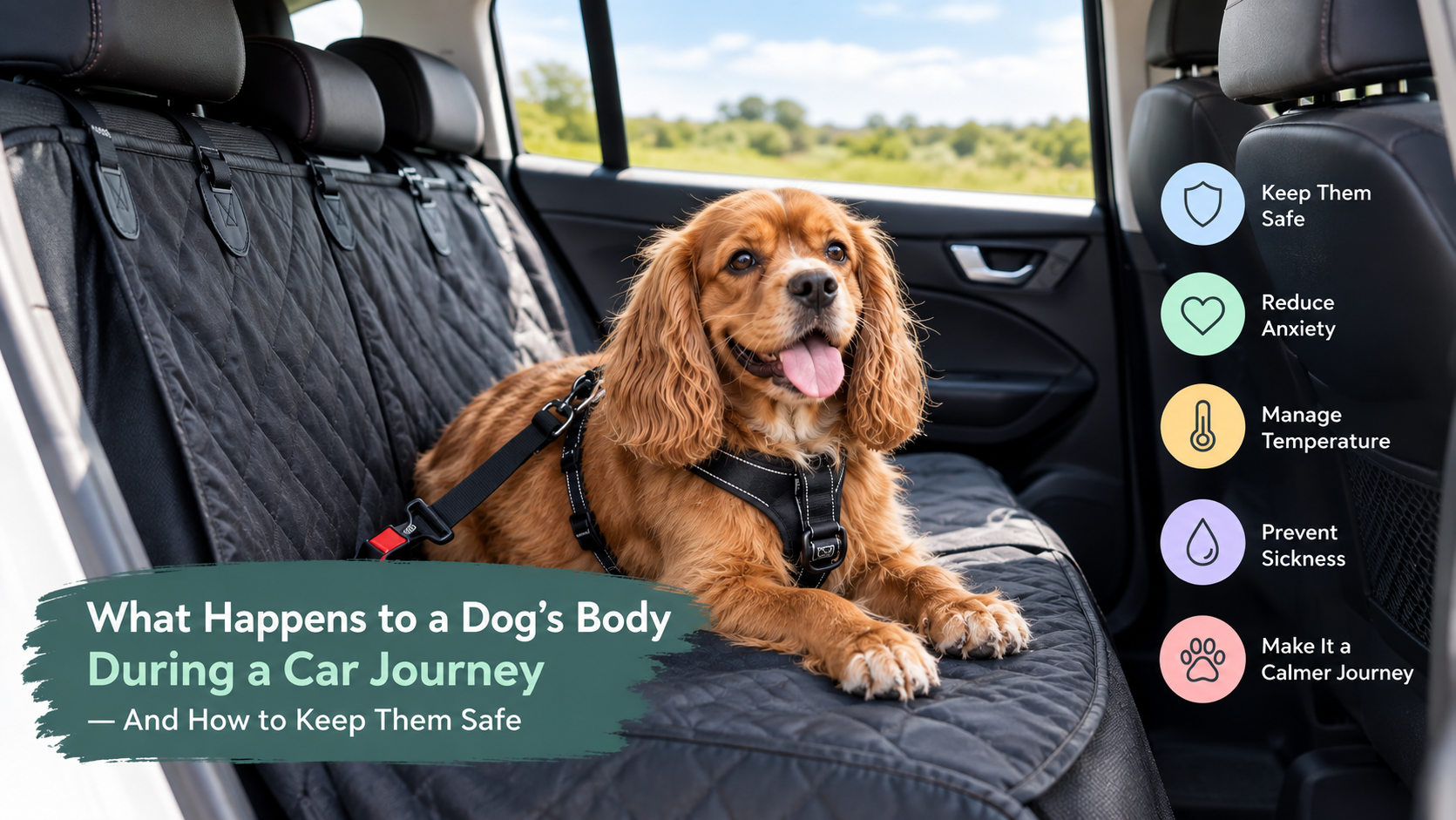
Most of us jump in the car, stick the dog in the back, and head off without thinking twice about it. But while you're focusing on the road, quite a lot is happening to your dog — and not all of it is comfortable.
Car travel puts a dog's body under a surprising amount of pressure. Even a short trip to the park can trigger stress responses, balance challenges and, in some dogs, genuine physical distress. Understanding what your dog is actually experiencing changes the way you approach every car journey — for the better.
Here's what's really going on, and what you can do to help.
1. Their Balance System Goes Into Overdrive
Dogs experience the physical sensation of movement very differently to humans. Their inner ear — the vestibular system — detects every turn, stop, acceleration and bump. In the car, this system is constantly working to process motion that the dog's body isn't generating itself.
This mismatch between what their body feels and what their eyes see is the root cause of dog car sickness. Some dogs grow out of it. Others — particularly puppies — are more susceptible because the vestibular system is still developing.
Signs of motion sickness in dogs include excessive drooling, yawning, lip-licking, lethargy and, in more severe cases, vomiting. If your dog regularly shows these signs, keeping journeys short initially and building up gradually can help their system adapt over time.
2. Stress Hormones Rise — Even in Calm Dogs
Even dogs who appear perfectly calm in the car are often experiencing elevated cortisol levels — the primary stress hormone. The unpredictability of road movement, unfamiliar smells coming through the vents, traffic noise and the inability to do anything but wait all contribute to a low-level stress response.
For dogs with dog anxiety in car situations, this is significantly amplified. Panting, pacing (if space allows), trembling and whining are all indicators that a dog's nervous system is in a heightened state. Over time, if not addressed, this can create a negative association with car travel that worsens with each journey.
One of the simplest ways to reduce this is to make the car environment feel more secure. A dog that is settled and can't slide around the back seat will naturally feel more in control of their environment.
3. Their Body Temperature Fluctuates More Than Yours
Dogs regulate their body temperature primarily through panting, not sweating. In a car — particularly in summer — temperatures in the back seat can rise faster than most owners realise, even with air conditioning running at the front.
On a warm day, always direct some airflow to the rear of the car and never leave a dog in a parked vehicle, even briefly. Having a portable dog water bottle for car journeys is not just convenient — it's a genuine safety measure. Dogs can dehydrate quickly during travel, and being able to offer water at a rest stop makes a real difference.
In colder months, dogs can also lose heat rapidly — particularly short-coated breeds and puppies — if sitting directly on a cold back seat for extended periods.
4. Their Posture Is Constantly Working
A dog standing or sitting unsecured on a back seat is using continuous muscular effort to balance. Every corner, every brake and every speed change requires them to adjust. On a longer journey, this is genuinely tiring — which is partly why dogs often sleep deeply after arriving somewhere by car.
Being dog restrained in car — whether through a harness attached to a seatbelt clip or a secured travel crate — actually reduces this effort significantly. A restrained dog can lean against the restraint rather than fight the forces of movement. It also keeps them from being thrown forward in sudden braking, which is a serious safety risk for both the dog and the driver.
Under UK Highway Code Rule 57, drivers are responsible for ensuring animals are suitably restrained during travel. An unrestrained dog in the back of a car can become a projectile in a collision — with potentially fatal consequences for both the animal and passengers.
5. The Back Seat Surface Matters More Than You'd Think
A dog on a slippery or uncovered back seat is constantly micro-adjusting to avoid sliding. This adds to the muscle fatigue mentioned above and can also scratch the seat surface — something many owners discover too late.
A good waterproof dog car seat cover gives your dog a non-slip, comfortable surface while protecting your upholstery. Look for one that anchors securely and covers the full bench, so there's no risk of your dog slipping down into the footwell.
The difference between a dog on a bare leather seat and a dog on a properly fitted seat cover is significant — less sliding means less stress, less effort and a noticeably calmer journey for both of you.
Practical Dog Car Journey Safety Tips
|
✅ Restrain your dog using a harness clip or travel crate — required under UK Highway Code Rule 57 ✅ Offer water at every rest stop using a portable bottle or travel bowl ✅ Allow your dog to toilet before any journey over 30 minutes ✅ Keep temperature balanced — direct airflow to the rear of the car ✅ Use a non-slip seat cover to reduce physical effort and protect upholstery ✅ Build up to longer journeys gradually in puppies or anxious dogs ✅ Never leave a dog in a parked car — even for a few minutes in warm weather ✅ Bring a familiar blanket or toy to reduce unfamiliar-environment stress |
When to Speak to Your Vet
If your dog consistently vomits, trembles severely or shows signs of extreme distress during car travel, it's worth speaking to your vet before the next long journey. There are anti-nausea medications and behavioural interventions that can make a genuine difference for dogs with significant travel anxiety or motion sickness.
Most dogs, with the right setup and gradual exposure, learn to tolerate — and many even enjoy — car travel. The key is understanding what their body is going through and removing as many sources of unnecessary stress as possible.
The Bottom Line
Car travel asks more of a dog's body than most owners realise. From their vestibular system to their stress hormones, posture muscles to body temperature — a lot is happening behind those ears on every journey.
Getting the basics right — proper restraint, a non-slip surface, regular water stops and a calm, consistent environment — doesn't just make the journey more comfortable. It makes it genuinely safer for your dog, your passengers and you.


 English
 Arabic
 French
 Spanish
 Portuguese
 Deutsch
 Turkish
 Dutch
Dutch
 Italiano
 Russian
 Romaian
 Portuguese (Brazil)
