


STP vs ETP: Understanding the Difference Between STP and ETP
Water is an important resource for homes, businesses, institutions, and industries. With increasing water consumption and wastewater generation, proper wastewater management has become essential. Two commonly used solutions for wastewater treatment are Sewage Treatment Plants (STP) and Effluent Treatment Plants (ETP).
Although both systems are designed to treat wastewater and reduce pollution, they are used for different types of wastewater. Understanding the difference between an STP and ETP can help organizations choose the right wastewater treatment plant for their requirements.
What is a Sewage Treatment Plant (STP)?
A Sewage Treatment Plant (STP) is a system designed to treat sewage generated from residential and commercial sources. Apartments, housing societies, hotels, offices, schools, hospitals, and other institutions can generate domestic sewage that needs proper treatment before discharge or reuse.
The sewage water treatment plant removes suspended solids, organic matter, and other contaminants from sewage. Depending on the plant design, the STP process may include screening, equalization, biological treatment, settling, filtration, and disinfection.
After proper treatment, the water can be reused for suitable non-potable applications such as gardening, toilet flushing, landscaping, and other purposes. This helps reduce freshwater consumption and supports water conservation.
What is an Effluent Treatment Plant (ETP)?
An Effluent Treatment Plant (ETP) is mainly designed for industries that generate wastewater during manufacturing or production processes. Industrial wastewater can contain different pollutants depending on the type of industry and the raw materials used.
An effluent water treatment plant can be designed to remove suspended solids, oils, grease, chemicals, organic pollutants, and other contaminants. The treatment process may involve physical, chemical, and biological treatment stages.
Industries may use ETP systems to treat wastewater before it is reused within the facility or discharged according to applicable environmental requirements. The exact treatment process depends on the quality and characteristics of the industrial effluent.
STP vs ETP: What is the Main Difference?
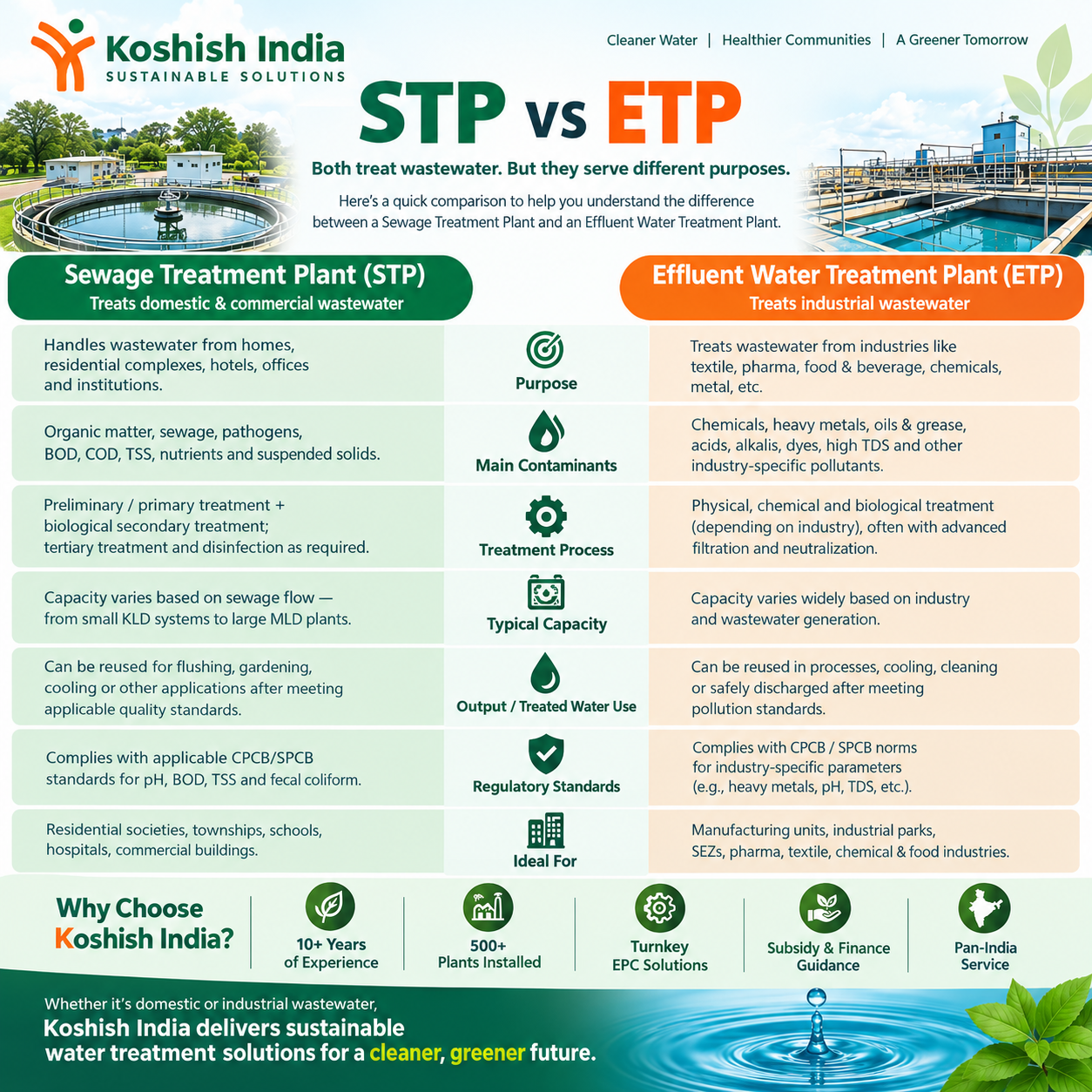
The biggest difference between an STP and an ETP is the source of wastewater they are designed to handle. An STP generally treats domestic sewage generated from homes, commercial buildings, institutions, and similar sources. In comparison, an ETP is designed for industrial effluent produced through manufacturing and other industrial activities.
The nature of pollutants is also different. Sewage generally contains organic waste, human waste, detergents, suspended solids, and biodegradable matter. Industrial wastewater may contain chemicals, oils, grease, heavy pollutants, or other substances depending on the industry. Because of this, an ETP often requires a treatment process specifically designed according to the industrial wastewater characteristics.
Another difference is the treatment objective. An STP focuses mainly on reducing pollutants present in domestic sewage and making the treated water suitable for safe disposal or non-potable reuse. An ETP focuses on treating industrial effluent and controlling pollutants generated during industrial processes.
5 Key Points to Understand STP vs ETP
1. Source of Wastewater:
STP is mainly used for domestic and commercial sewage, while ETP is generally used for industrial wastewater generated from manufacturing and production processes.
2. Type of Pollutants:
Sewage mainly contains organic matter, suspended solids, and biodegradable waste. Industrial effluent can contain chemicals, oils, grease, and industry-specific pollutants.
3. Treatment Process:
An STP commonly uses physical and biological treatment along with filtration and disinfection. An ETP may require physical, chemical, and biological treatment depending on the characteristics of the industrial effluent.
4. Water Reuse:
Both systems can support water recycling and wastewater reuse. STP-treated water may be reused for gardening and flushing, while treated industrial wastewater can be reused for suitable industrial applications.
5. Application:
STPs are commonly required for residential societies, hotels, offices, institutions, and commercial buildings. ETPs are more commonly associated with factories, manufacturing units, and other industries producing process wastewater.
Which One is Suitable for Your Requirement?
Selecting between an STP and ETP depends on the source, quantity, and quality of wastewater. If the wastewater is mainly domestic sewage from a residential or commercial property, an STP may be the appropriate solution. If wastewater is generated through an industrial production process, an ETP may be required.
Before selecting a water treatment plant, it is important to understand the wastewater characteristics and treatment requirements. Proper assessment can help determine the suitable technology, capacity, and treatment stages.
Conclusion
STP and ETP both play an important role in modern wastewater treatment and water management, but they are designed for different purposes. A Sewage Treatment Plant (STP) mainly treats domestic and commercial sewage, whereas an Effluent Treatment Plant (ETP) is designed for industrial wastewater.
With the right treatment solution, organizations can improve wastewater management, support water recycling, reduce environmental pollution, and make better use of available water resources. Koshish India provides STP and ETP solutions for different wastewater treatment requirements, supporting businesses and organizations in adopting more sustainable water management practices.
Domestic Biogas , Commercial Biogas , BioGas , Sewage Water Treatment Plant , Effluent Water Treatment Plant , Zero Liquid Discharge Water Treatment Plant

 English
 Arabic
 French
 Spanish
 Portuguese
 Deutsch
 Turkish
 Italiano
 Russian
 Romaian
 Portuguese (Brazil)
 Greek
Greek
