


Biosensors Market Expansion Across Medical Applications
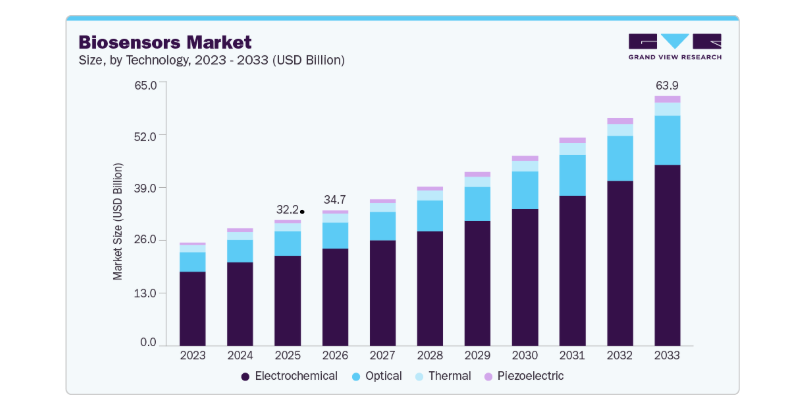
The biosensors market is no longer confined to traditional diagnostic laboratories. Sensors that interact with biological signals are appearing in wearable devices, point-of-care systems, research platforms, food analysis, agriculture, environmental monitoring, and other specialized applications. This diversification is giving the industry a wider commercial base while healthcare continues to generate the majority of demand.
The global Biosensors Market reached USD 32.2 billion in 2025 and is expected to rise to USD 64.0 billion by 2033, representing a 9.1% CAGR between 2026 and 2033. North America held a 42.6% revenue share in 2025, while Asia Pacific is projected to record the highest growth rate during the forecast period.
Key Highlights
Technology: Electrochemical biosensors accounted for 71.6% of revenue in 2025.
Application: Medical uses represented 66.84% of market revenue.
End use: Point-of-care testing held 47.93% of the market.
Growth area: Agriculture is projected to be the fastest-growing application.
Regional momentum: Asia Pacific is expected to record the fastest CAGR.
One Technology, Many Environments
What makes biosensors commercially interesting is their adaptability. The same fundamental principle—recognizing a biological or biochemical signal and converting it into a measurable output—can be adapted to very different environments. In a hospital, a biosensor may monitor glucose or another biomarker. In a wearable device, it may capture physiological signals continuously. In agriculture, it can help identify pathogens or assess nutrient conditions. In food applications, sensing technologies can support contaminant detection.
The underlying model remains similar: recognize → measure → interpret → respond.
This versatility is helping biosensors move from a specialized diagnostic category toward a broader sensing platform.
Download a free sample report or claim your copy of this full market intelligence report
Healthcare Is Still the Main Commercial Anchor
Medical applications held the largest share of the market in 2025. Biosensors are already used in glucose monitoring, cholesterol testing, pregnancy testing, blood gas analysis, infectious disease applications, and drug-discovery research. The increasing prevalence of chronic diseases is reinforcing demand for systems that can monitor patients more frequently. Diabetes is particularly relevant because glucose biosensing has become a leading example of how biological measurements can be integrated into compact wearable technology.
Continuous glucose monitoring has also helped establish a new expectation for diagnostics: information can be available throughout the day rather than only during a scheduled test. Wearable biosensing research is now extending this concept toward other analytes and biological fluids, including sweat, saliva, tears, and interstitial fluid.
Wearables Are Giving Biosensors a New Identity
The market is increasingly influenced by how comfortably a sensor can fit into everyday life. Smart rings, patches, fitness bands, and other wearables are creating new settings for continuous data collection. Miniaturization matters because the smaller and more comfortable a device becomes, the easier it is to imagine long-duration use. This is helping shift biosensors from specialized equipment toward everyday health technology.
Research into next-generation wearable systems is also exploring non-invasive and minimally invasive approaches. However, scientific and commercial development continues to face issues including calibration, signal interference, durability, and clinical validation, particularly for measurements derived from alternative biofluids.
Why Electrochemical Biosensors Remain So Important
Electrochemical technology accounted for 71.59% of market revenue in 2025, reflecting its established use in biological measurement. Its strength is particularly visible in glucose sensing, where electrochemical approaches can produce repeated readings in wearable configurations. At the same time, the expansion of optical biosensors demonstrates that the market remains technologically diverse.
Optical sensing is expected to grow at the fastest rate among the technologies covered by the report. Its suitability for real-time and point-of-care applications creates opportunities where fast and accurate measurements are important.
The result is a technology landscape where established electrochemical platforms continue to dominate, while optical and other approaches create additional routes for future growth.
Point-of-Care Is Turning the Laboratory Into a Smaller Space
Point-of-care testing accounted for 47.93% of market revenue in 2025 and is projected to remain a major growth area. The market opportunity comes from decentralization. A biosensor does not necessarily need to sit inside a large laboratory. Miniaturized devices can bring selected testing capabilities closer to hospitals, clinics, pharmacies, homes, and field environments.
This is particularly relevant where rapid results can influence immediate decisions. Instead of sample collection → transportation → centralized analysis → result, biosensor-enabled platforms can increasingly support sample → local measurement → immediate result.
Agriculture Opens a Second Growth Engine
Healthcare dominates the industry today, but agriculture represents a different kind of opportunity. Biosensors can help identify pathogens, assess soil conditions, monitor nutrients, support irrigation decisions, and detect contaminants in agricultural environments. The agricultural application segment is projected to register the fastest CAGR through 2033. Grand View Research links this growth to precision farming, sustainable agriculture, real-time monitoring, and the integration of biosensors with IoT and smart-farming systems.
This creates a particularly interesting expansion path because biosensors are no longer being evaluated only by their medical utility. Their value can also come from improving resource efficiency and decision-making outside healthcare.
Research Is Pushing the Technology Forward
Research laboratories are another important part of the ecosystem. Biosensors can support biomarker research, drug discovery, high-throughput screening, cell studies, and assay development. These environments are important because laboratory researchers often test sensing concepts before they become commercial products. Advances in materials science, nanotechnology, biorecognition chemistry, electronics, and AI can therefore move from research platforms toward clinical or industrial applications over time.
The industry remains fragmented, with a significant level of innovation and partnership activity.
Regional Expansion Is Adding New Demand Centers
North America held the leading regional share in 2025, supported by established healthcare infrastructure and strong adoption of advanced medical technologies. The U.S. represented a substantial portion of this market and is expected to continue growing through 2033. Asia Pacific is expected to grow faster, supported by improvements in healthcare infrastructure, medical-device development, chronic disease monitoring, biotechnology investment, and digital health adoption.
India's biosensors market is projected to reach USD 2.68 billion by 2033, compared with USD 1.19 billion in 2025, reflecting a projected CAGR of about 10.9%.
Key Companies
Important companies in the biosensors market include Abbott Laboratories, Medtronic, Biosensors International Group, Pinnacle Technology, DuPont, Sensirion, Thermo Fisher Scientific, F. Hoffmann-La Roche, Siemens Healthineers, DexCom, Universal Biosensors, Johnson & Johnson, Metrohm, LifeScan, and Zimmer & Peacock.
Their activities cover medical sensing, glucose monitoring, analytical platforms, wearable devices, research instrumentation, and other specialized biosensing technologies.
The Broader Opportunity
The long-term potential of biosensors comes from their ability to fit into different information systems. A wearable can connect to a smartphone. A point-of-care device can feed data into a clinical workflow. An agricultural sensor can connect to an IoT platform. That means the future of the market is not only about improving the sensor itself. It is about creating a complete ecosystem in which detection → connectivity → interpretation → action becomes easier, faster, and more useful.
With the global market projected to double from its 2025 level by 2033, that wider ecosystem is likely to remain central to industry development.
About us:
Grand View Research, a market research and consulting company, provides syndicated research reports, customized research reports, and consulting services. Grand View Research database is used by the world's renowned academic institutions and Fortune 500 companies to understand the global and regional business environment. Our database features thousands of statistics and in-depth analysis on 46 industries in 25 major countries worldwide.

 English
 Arabic
 French
 Spanish
 Portuguese
 Deutsch
 Turkish
 Dutch
Dutch
 Italiano
 Russian
 Romaian
 Greek
Greek
