


How Music Education Is Supporting Musical Instrument Market Growth
Buying a musical instrument is increasingly becoming a decision about what happens after the purchase rather than simply what is placed in the shopping cart. A guitar, violin, keyboard, drum kit, or traditional instrument is being evaluated according to how well it supports learning, practice, performance, and long-term improvement. This change in purchasing behavior is giving the Musical Instrument Market a more durable growth foundation, because consumers are increasingly treating instruments as tools for skill development and creative expression instead of short-lived entertainment products.
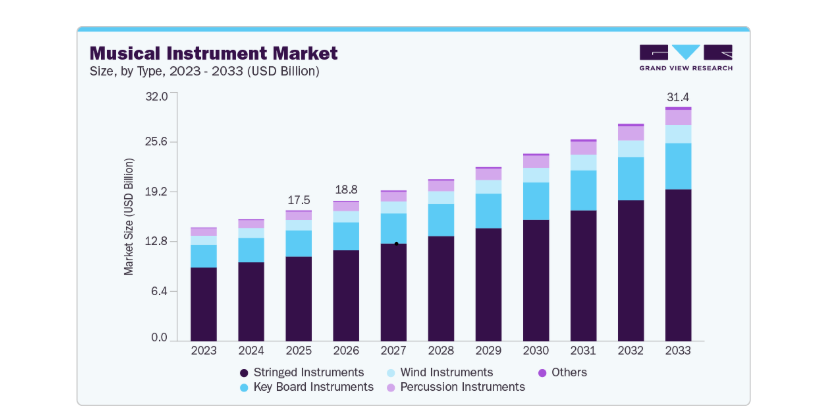
The global musical instrument market was valued at USD 17.5 billion in 2025 and is projected to reach USD 31.4 billion by 2033, advancing at a 7.6% CAGR from 2026 to 2033. Asia Pacific accounted for 42.2% of global revenue in 2025, while stringed instruments and offline distribution remained the dominant segments.
The New Buyer Is Purchasing a Learning Journey
The strongest change taking place in the industry is behavioral. Consumers are not simply asking whether an instrument looks attractive or sounds good. They increasingly want to know whether it can support their progression from beginner to intermediate and, eventually, advanced levels.
Download a free sample report or claim your copy of this full market intelligence report
That changes the purchasing decision considerably. A beginner may care about comfortable handling, simple tuning, and affordability, while an experienced musician is more likely to evaluate tonal accuracy, construction, responsiveness, durability, and the instrument's suitability for live or studio use. Parents and adult learners are also influenced by whether an instrument fits an established instructional pathway, such as private lessons, graded learning, certification, or school-based music education.
Product Design Is Following the Player
Manufacturers are responding to this behavior by developing instruments around progression rather than one-time ownership. Products increasingly need to perform well for beginners without becoming obsolete as the user improves. That is encouraging greater attention to playability, sound consistency, ergonomics, durability, and upgrade potential.
Technology is strengthening this shift, particularly in electronic and hybrid instruments. Digital keyboards, electronic drums, connected practice systems, and app-enabled instruments can make the learning experience more interactive, while advanced players can use the same products for recording, performance, and experimentation.
Yamaha's redesign of its SILENT Cello lineup illustrates how established manufacturers are combining traditional instrument expectations with modern technology. The SVC300 Series was introduced in September 2025 with Yamaha's SRT Powered System, aiming to deliver a more realistic acoustic cello experience while retaining the advantages of quiet practice and flexible performance.
The significance is broader than one product launch. It shows how the industry is trying to solve multiple user needs within the same instrument: authentic sound, practical home use, advanced playability, and continued relevance as the musician develops.
Stringed Instruments Still Have the Broadest Appeal
Stringed instruments accounted for 64.9% of market revenue in 2025, making them the dominant type segment. Their strength comes from versatility. Guitars, violins, basses, and related instruments can be used across multiple musical genres and levels of experience, creating a very broad consumer base.
The learning ecosystem around these instruments also reinforces their position. Beginners can find an enormous volume of structured and informal content online, while advanced players can move into specialized genres, professional performance, studio work, or instrument collecting. This continuity reduces the likelihood that the product is viewed as disposable.
Offline Stores Remain Relevant in a Digital World
The growth of digital discovery has not eliminated the importance of physical music stores. Offline channels accounted for 69.5% of market revenue in 2025, reflecting the fact that musical instruments are unusually experiential products.
A buyer can read specifications online, but specifications cannot fully communicate how a guitar feels in the hands, how a piano responds to touch, how a violin projects sound, or how a drum kit behaves during actual playing. Weight, balance, finish, tonal character, key response, neck shape, and overall comfort often become clear only through direct experience.
That explains why physical retailers continue to play an important role even as e-commerce expands. Demonstrations, expert advice, tuning, setup, servicing, maintenance, repairs, and direct comparisons between models all add value that a standard online listing cannot easily reproduce.
At the same time, online sales are expected to grow at a 8.9% CAGR from 2026 to 2033, supported by product reviews, demonstration videos, specifications, social commerce, and the increasing confidence of consumers purchasing electronic and hybrid instruments online.
Traditional Instruments Are Not Being Left Behind
The digitalization of music retail and instruction might suggest that traditional instruments are losing relevance. In many markets, the opposite is taking place. Instruments connected to cultural identity, classical education, religious performance, and regional musical traditions continue to benefit from structured learning systems and established teacher networks.
The example of the mridangam market is particularly relevant. Demand for traditional percussion instruments can be closely connected with formal classical training, examinations, certification programs, and performance-based learning. In such categories, authenticity and craftsmanship become almost as important as basic functionality.
Regional Growth Is Being Driven by Different Cultural Factors
Asia Pacific led the global market with a 42.2% revenue share in 2025, supported by strong participation in music education, growing exposure to international music, expanding digital content platforms, and large consumer markets. China accounted for 43.1% of Asia Pacific revenue in 2025, while India is projected to be one of the fastest-growing markets in the region.
India's opportunity is particularly connected with the combination of traditional and contemporary music consumption. Classical instruction, temple and event performances, local live music, social-media-led music creation, and digital learning platforms are creating multiple entry points into the market.
North America has a mature environment supported by live venues, schools, recording studios, home-studio users, independent musicians, and premium instrument demand. Europe maintains strong demand for craftsmanship, acoustic quality, orchestral participation, and high-quality traditional instruments, while also developing its electronic and home-recording ecosystem. Latin America and the Middle East and Africa are benefiting from live performance cultures, community-based music, entertainment activity, and expanding digital discovery.
The result is a global industry where consumer motivations vary by region, but the broader emphasis on sustained musical participation remains consistent.
About us:
Grand View Research, a market research and consulting company, provides syndicated research reports, customized research reports, and consulting services. Grand View Research database is used by the world's renowned academic institutions and Fortune 500 companies to understand the global and regional business environment. Our database features thousands of statistics and in-depth analysis on 46 industries in 25 major countries worldwide.
 Arabic
 English
 French
 Spanish
 Portuguese
 Deutsch
 Turkish
 Dutch
Dutch
 Italiano
 Russian
 Romaian
 Portuguese (Brazil)
 Greek
Greek