
Todor3D for Manufacturers: 3D Configurators Built Around Production Rules in Europe
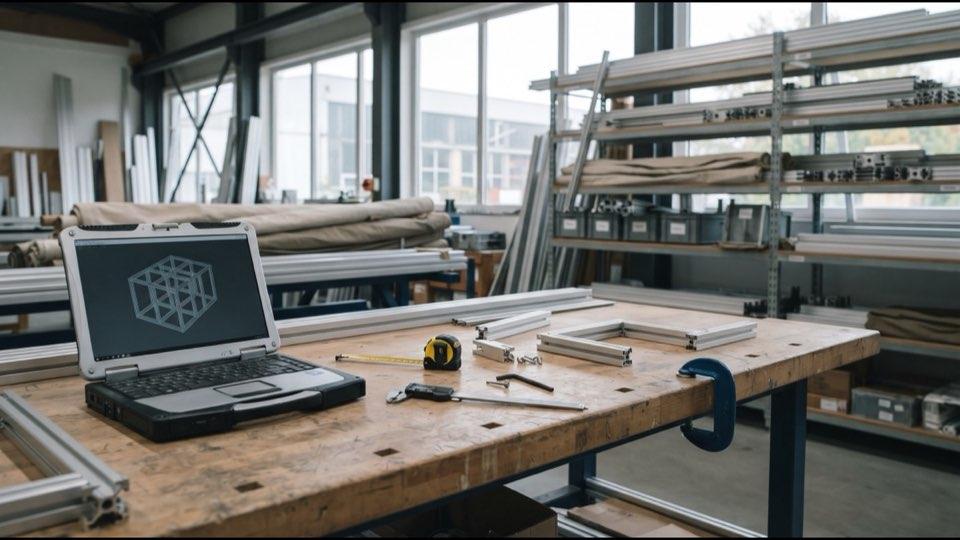
For manufacturers, Todor3D builds 3D configurators that encode what the factory can actually make: module sizes within real limits, the print area on a product, prices pulled from the ERP. Its two main European examples are a logo-preview configurator for Austria's Schirmmacher, developed over 33 months until late 2025, and a patio cover configurator for Switzerland's Thermogreen, in production since 2023 and still growing.
| At a glance | Schirmmacher | Thermogreen AG |
|---|---|---|
| Country | Austria | Switzerland |
| Product | Branded umbrellas, parasols, tents, deckchairs | Glass-roof and louver-roof patio covers |
| What the configurator does | Places the customer's logo on a 3D model, exports a PDF proof | Builds a cover from modules within manufacturing limits, prices it live from the ERP |
| Stack | Three.js, Blender, TypeScript, Webpack, Node.js, Fabric.js, pdf.js | React, Three.js, WebGL |
| Team | Project manager, 3D developer, 3D designer | 2 full-stack developers, 2 3D designers, QA engineer, project manager and business analyst |
| Budget | $10,000–50,000 | $50,000–100,000 |
| Duration | 33 months, nine batches, February 2023 to late 2025 | Ongoing, live since 2023 |
Todor3D is based at 6101 W Centinela Ave #110 in Culver City, California, with a 40+ person team in several countries. It was founded in 2020 and holds a 5.0 rating across 25 Clutch reviews.
A Configurator Is Only Useful If It Refuses Impossible Orders
A consumer configurator can let a buyer pick any color. A manufacturer's configurator cannot, because every choice turns into a production order with tolerances, print areas and component limits.
If the tool accepts a cover two centimeters wider than the factory can build, someone in sales has to catch it, call the customer and start again. The configurator has saved nothing.
Both projects in this article solve the same problem from different ends. One makes the printed result visible before an order is confirmed, and the other keeps every size, accessory and price inside what the factory and its ERP allow.
| Production rule | How it appears in the interface | Project |
|---|---|---|
| Minimum and maximum module sizes | Resizing stops at the manufacturer's real limits | Thermogreen |
| Accessory dimensions depend on the gap | ZIP screens, glass walls and LED strips size themselves to the available side | Thermogreen |
| Price depends on every component | Configurator requests the price from the ERP after each change | Thermogreen |
| Logo must fit the product's real shape | Logo is placed on a true-to-scale Blender model and wraps onto it | Schirmmacher |
| Customer must approve the print | pdf.js generates a proof before the order is confirmed | Schirmmacher |
Schirmmacher: Customers Saw Their Logo on the Real Product Shape
Schirmmacher sells custom branded umbrellas, parasols, tents and deckchairs to businesses across Europe through its own web shop. Most orders involve printing a client's logo or photo, and before the configurator customers had to judge the result from a flat product photo.
That gap slowed decisions and added rounds of back and forth before an order could be confirmed, right at the point where customers were deciding whether to buy. For a business selling printed products, the print preview was the rule that mattered most.
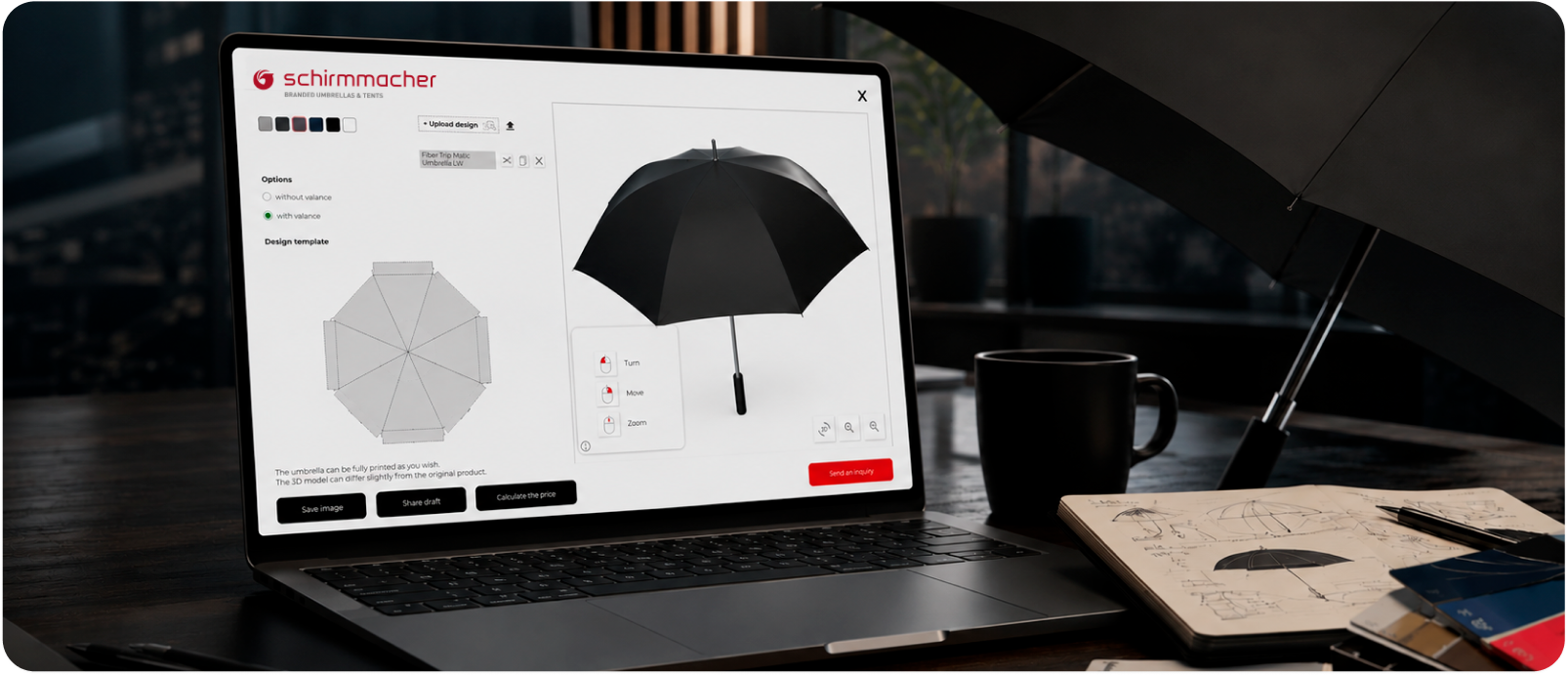
Among Todor3D manufacturing configurators, the Schirmmacher build ran the longest: 33 months and nine work batches from February 2023, with 30 new 3D models added in its final year alone. Customers placed their own logo on a Blender-modeled umbrella, tent or deckchair and downloaded a PDF proof before confirming the order.
Technically, Three.js rendered the products in the browser inside the existing web shop, while a separate 2D canvas built with Fabric.js sat on top of the 3D viewer for logo placement. HDR environment maps gave metal frames and fabric canopies realistic reflections.
Nine Work Batches, 30 New Models in the Final Year
The project did not stop at launch. Each batch added new products to the catalog and refined models already live, so the configurator kept pace with what Schirmmacher actually sold.
Features added after launch included:
- two-color umbrellas and a rainbow color option;
- frame and valance customization;
- repeated rounds of lighting and material refinement;
- a move to a new server and GitHub-based version control.
By the end, the configurator covered all four of Schirmmacher's customizable product categories. The last batch closed in late 2025 without disrupting the live website, and a rotating team of 3D developers coordinated with the client directly over Telegram throughout.
Thermogreen: Sizes, Accessories and Prices Come From Manufacturing Data
Thermogreen's patio covers are a harder rules problem. Modules come as glass-roof or louver-roof types, sized to the millimeter, with more than 20 colors and textures and side accessories that can go on any side.
Before the configurator, all of that lived in the heads of sales staff. Every quote meant a salesperson configuring modules by hand, looking up prices and preparing an offer, which was slow and easy to get wrong.
In Todor3D's React and Three.js configurator, customers start from predefined modules and snap new ones onto existing sides. Each module resizes only within the manufacturer's real minimum and maximum limits, height is handled across the whole structure, and accessories calculate their own dimensions from the available gap.
Price comes from Thermogreen's ERP, requested again after each change and shown live. On submission, a bill of materials with every module, accessory, position and dimension, plus top-down and perspective snapshots, goes into the company's sales systems.
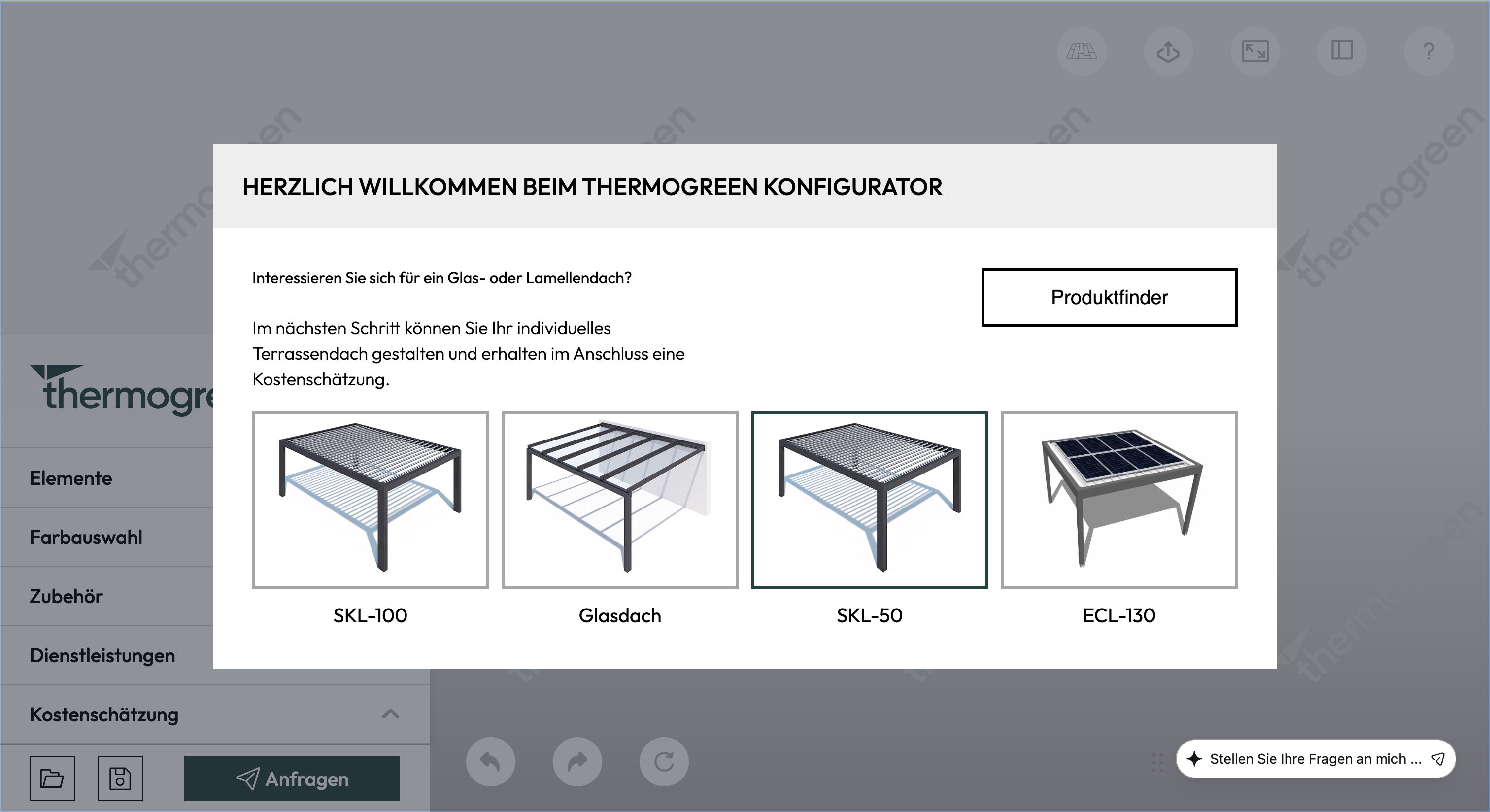
The tool has kept changing since 2023. Later work added a wider catalog, better color accuracy, a full rebranding and an expert mode in which a salesperson reviews a configuration and pushes it into the CRM, where the quote is generated.
Strict Rules Still Need a Forgiving Interface
The case page calls the interaction the hard part. A product bound by dozens of manufacturing rules had to feel like a simple, visual design tool that anyone could use without fear of breaking it.
Todor3D backed the 3D scene with a full state model that supports undo, redo and scene history, so customers can experiment and step back. The viewer runs in WebGL with a true full-screen mode.
Two smaller features serve the same goal. Customers can hide the floor, supports and walls to place a cover onto their own background photo, and they can register, save configurations and return later, with automated emails confirming each submission.
What Manufacturers Should Prepare Before a Build
Both projects suggest the same preparation list. Having these ready shortens discovery and keeps the first release honest about what the factory can make.
- 3D source material. CAD files or reference drawings for every product, so models can be built true to scale in Blender.
- A rules table. Minimum and maximum dimensions, allowed combinations, print areas and accessories that depend on other parts.
- A price source. Decide whether prices come from an ERP or pricing API, as with Thermogreen, or from a table inside the configurator.
- The output sales needs. A PDF proof, a bill of materials, snapshots or a CRM entry, defined before design starts.
- A plan for catalog changes. Who adds new products after launch, and how often, since both tools grew long after their first release.
FAQ
What does a rule-based 3D configurator for a manufacturer cost?
The two cases here sit at $10,000–50,000 for Schirmmacher and $50,000–100,000 for Thermogreen. Thermogreen's scope is wider, with module logic, live ERP pricing, a CRM handoff and a six-role team, against a three-person team for the logo preview tool.
Can a configurator pull prices from our ERP?
Yes. Thermogreen's configurator requests updated pricing from the company's ERP after each change and shows it live, then sends the bill of materials and snapshots into the sales systems.
Is the Schirmmacher configurator still being developed?
No. The engagement ran 33 months in nine batches and the final batch closed in late 2025. Todor3D's ongoing long-term manufacturing project is Thermogreen, in development since 2023.
Which technologies are used?
Three.js and WebGL render the products in the browser, Blender is used for modeling, React or TypeScript for the application, Fabric.js for logo placement and pdf.js for proofs.

 English
 Arabic
 Spanish
 Portuguese
 Deutsch
 Turkish
 Dutch
 Italiano
 Russian
 Romaian
 Portuguese (Brazil)
 Greek