


Ecommerce AI Chatbot: 7 Ways to Improve Online Sales
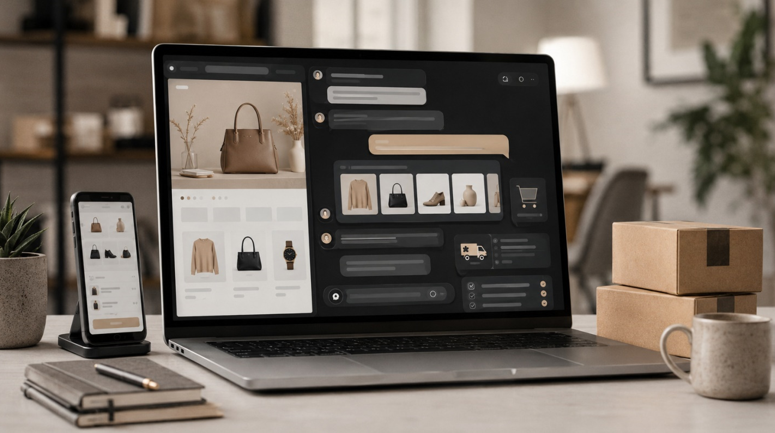
An ecommerce AI chatbot can help an online store answer product questions, guide shoppers toward suitable products, capture leads, provide support, and connect customers with a person when needed. Its main value is simple: it gives shoppers useful information while they are still deciding what to buy.
That timing matters in ecommerce. A shopper may already like a product but still have one question about sizing, delivery, compatibility, returns, or availability. If finding the answer requires opening several pages or waiting for an email reply, the buying journey can stop.
Baymard Institute currently puts the average documented online cart abandonment rate at 70.19%. Not every abandoned cart can be recovered, but its research also shows that avoidable friction remains a major part of the problem.
The right chatbot helps remove some of that friction before it becomes a lost order.
How Does an Ecommerce AI Chatbot Help Shoppers Buy?
An ecommerce AI chatbot improves the buying journey by giving shoppers a conversational way to find information. Instead of searching product pages, policies, FAQs, and category filters separately, a visitor can explain what they need and receive a relevant answer.
That makes chat useful at several points in the customer journey.
A shopper might ask:
- “Which model works with my existing system?”
- “Do you have this in a smaller size?”
- “Which option is best under $100?”
- “How long will delivery take?”
- “Can I return this if it does not fit?”
The chatbot can then respond from approved store information and direct the shopper toward the next useful step.
This type of product discovery is becoming more familiar to online customers. Shopify reported in August 2026 that NielsenIQ research found 42% of consumers had used at least one AI tool for shopping during the previous month. That included 17% who used AI for product recommendations and 10% who used an AI shopping assistant.
For retailers, the lesson is not that every shopper wants AI. It is that conversational product discovery is becoming another normal way to shop.
1. Answer Product Questions While Interest Is High
One of the simplest uses of AI chat is answering questions that sit between product discovery and checkout.
Traditional product pages work well when shoppers already know what they want. They become less effective when a customer needs help comparing several choices or understanding technical details.
A trained chatbot can explain:
- Product features
- Sizes and options
- Materials
- Compatibility
- Shipping information
- Return policies
- Promotions
- Differences between products
This can be especially useful for stores with detailed catalogs. A customer buying lighting, electronics, furniture, tools, skincare, or specialist equipment may have questions that are difficult to answer with filters alone.
Speed matters here. Zendesk's 2026 Customer Experience Trends research found that 88% of customers expect faster response times than they did a year earlier, while 74% say AI has led them to expect customer service to be available 24/7.
That does not mean every conversation should stay automated. It means stores need a way to respond while buying intent is still active.
2. Turn Product Search Into Guided Shopping
Search bars work best when shoppers know the right words to type. AI chat can be more useful when the request is less precise.
Consider someone looking for:
a birthday gift for a runner under $75
A normal search engine may treat each word as a filter. A conversational assistant can ask follow-up questions about the recipient, preferred product type, budget, or other requirements before suggesting suitable choices.
That creates a guided shopping experience closer to speaking with a sales associate.
Modern ecommerce chatbot content commonly focuses on product discovery, recommendations, post-purchase support, and FAQ automation because each solves a different stage of the shopping journey. Algolia's 2026 guide to conversational commerce similarly identifies product discovery and personalized recommendations among the highest-impact ecommerce applications.
Stores should still keep recommendations grounded in real product information. The chatbot should not guess about specifications, stock, policies, or compatibility when the business has not provided that information.
Good AI shopping assistance reduces searching. Bad AI shopping assistance creates another place for customers to receive uncertain answers.
3. Reduce Friction Around the Cart and Checkout
Chatbots cannot fix every reason customers abandon carts, but they can help when hesitation comes from an unanswered question.
Baymard's research found that 17% of U.S. online shoppers who had recently abandoned an order cited a checkout process that was too long or complicated. Its wider research also documents customer concerns around shipping, returns, and checkout design.
A chatbot can support this part of the journey by quickly explaining:
- Shipping policies
- Delivery expectations
- Returns
- Product differences
- Current promotions
- Purchase requirements
- Frequently asked checkout questions
The goal should not be to interrupt every visitor with a sales message.
Proactive chat works better when there is a reason for the conversation. A shopper spending time comparing two products may need help. Someone reading the return policy may have a specific concern. A visitor returning to the same product page may still be considering the purchase.
Helpful timing matters more than aggressive pop-ups.
For stores exploring this strategy in more depth, this guide to an ecommerce AI chatbot looks at how conversational support can fit across sales and customer service.
4. Capture Leads From Shoppers Who Are Not Ready Yet
Not every valuable visitor completes a purchase during the first session.
Some are researching. Others are comparing products, waiting for stock, planning a large order, or deciding whether a higher-priced product is right for them.
A chatbot can capture that interest without forcing the shopper immediately toward checkout.
Useful lead information might include:
- Name
- Email address
- Phone number
- Product of interest
- Purchase requirements
- Questions that still need answering
This is particularly valuable for high-ticket ecommerce, B2B stores, custom products, home improvement, wholesale products, and purchases that involve consultation.
The conversation itself also gives the business context. A sales team receiving “interested in Product A” has limited information. A lead accompanied by the shopper's questions and page source gives the team a clearer starting point.
PerfectCSR reports that its platform can capture names, emails, phone numbers, and custom lead fields during website conversations. It also records the source page when a conversation moves to a human team member.
5. Handle Routine Support Without Hiding the Human Team
Post-purchase support has a direct effect on whether customers feel comfortable buying again.
Questions about delivery, product care, return policies, order details, or general support often repeat. AI can handle straightforward questions quickly while a human team focuses on conversations that need judgment.
The important part is the handoff.
A customer should not have to fight through an automated conversation when the chatbot cannot confidently help. The system should make it easy to transfer the conversation and preserve the context already collected.
This matters because customers still care about transparency. Salesforce's State of the AI Connected Customer reports that 72% of customers say it is important to know whether they are communicating with an AI agent. The same research found that 71% feel increasingly protective of their personal information.
A good ecommerce setup therefore needs three things: useful automation, clear boundaries, and access to a person.
6. Use Customer Questions to Improve the Store
Chatbot conversations can reveal information that ordinary traffic reports miss.
Analytics may show that a product page receives traffic but converts poorly. Conversations can reveal why.
Perhaps customers repeatedly ask whether two products are compatible. Maybe sizing information is unclear. Perhaps shipping expectations are difficult to find. Or customers keep asking for a feature that is buried near the bottom of the page.
These questions can improve more than the chatbot. They can help teams update:
- Product descriptions
- FAQs
- Shipping pages
- Category copy
- Comparison content
- Buying guides
- Help documentation
This creates a useful feedback loop. Customer questions improve the knowledge base, and better information can then improve both the website and future chatbot answers.
PerfectCSR includes an unresolved-question log that records questions the AI could not confidently answer. Businesses can use those gaps to identify information that should be added to their training content.
7. Give Smaller Ecommerce Teams More Coverage
A small online store may face the same customer expectations as a much larger retailer without having the same staffing budget.
That is where AI assistance can be practical. It can handle predictable conversations while employees work on inventory, fulfilment, difficult support cases, merchandising, supplier relationships, and growth.
PerfectCSR is one example of this approach. It is a horizontal AI customer service platform rather than a tool built only for ecommerce. For online stores, its Sales Rep persona is designed around product education and conversion.
According to PerfectCSR, the platform answers 97% of questions instantly across its business conversations. It reports an average setup time of 3 minutes and 48 seconds, with deployment in under 10 minutes. These are first-party figures and should be treated as PerfectCSR's own platform data rather than industry benchmarks.
The platform can train from website URLs, documents, pasted text, YouTube content, and voice notes. Ecommerce teams can also use product cards, promotions, comparison lists, lead capture, proactive chat, human handoff, and Shopify integration.
AQL Lighting Group provides one real example. PerfectCSR reports that the lighting and home decor business handled 486 customer conversations without adding another support hire.
Cynthia, President of AQL Lighting Group, described the result this way:
“It just did its job and the bounce rate drop was amazing.”
That is a more useful way to judge ecommerce automation than simply asking whether a platform has AI. The question is whether it can handle real conversations without creating more work for the team.
Businesses that want a more ecommerce-focused overview can also explore PerfectCSR's ai chatbot for e-commerce page.
What Should You Check Before Choosing an Ecommerce Chatbot?
The best chatbot is the one that matches the store's actual customer journey.
A large Shopify operation with complex ticket routing may have different requirements from a small retailer that mainly wants product guidance and lead capture.
Use a practical checklist:
|
Question |
What to check |
|
Can it learn from your real business content? |
Product pages, policies, documents, FAQs, and approved information |
|
Can it help before checkout? |
Product education, comparisons, recommendations, promotions |
|
Can it capture demand? |
Lead forms and relevant customer details |
|
Can a person take over? |
Human handoff with the previous conversation preserved |
|
Does it fit your store platform? |
Relevant ecommerce integration or API support |
|
Can you see what it misses? |
Analytics and unresolved-question reporting |
|
Is customer data protected? |
Clear security and data-use policies |
|
Can you test it first? |
Preview or trial before wider deployment |
PerfectCSR, for example, encrypts customer data in transit and at rest and states that customer data is never sold or used to train other businesses' models. It offers a 30-day free trial with no credit card required.
It also has a limitation worth considering. PerfectCSR is a newer horizontal platform. Businesses that need highly complex ticket management, very large internal knowledge bases, or deep specialist integrations may prefer to combine it with dedicated software.
That type of trade-off should be part of any chatbot buying decision.
The Best Chatbot Removes a Real Shopping Obstacle
An ecommerce AI chatbot is most useful when it solves specific moments of customer friction.
That might mean helping someone choose between products, explaining a return policy, answering a technical question, collecting a high-value lead, or moving a difficult conversation to a person.
Online retailers should therefore start with customer questions rather than technology features. Look at where shoppers hesitate, what the support team repeatedly answers, and which enquiries arrive when nobody is available.
Then automate those conversations first.
A chatbot does not need to replace the shopping experience. It should make that experience easier to continue.
FAQs
Can an ecommerce AI chatbot help increase sales?
It can support sales by answering buying questions, helping customers compare products, capturing leads, and directing shoppers toward suitable next steps. Actual sales impact varies by store, traffic quality, products, chatbot training, and implementation.
Can AI chatbots recommend ecommerce products?
Yes, when the chatbot has access to accurate product information and the platform supports product recommendations. The best results come from grounding recommendations in the store's actual catalog rather than allowing the AI to guess.
Should an online store use AI chat instead of live chat?
The two can work together. AI can handle frequent and straightforward questions, while live staff take over complex, sensitive, or high-value conversations that need human judgment.
What information should an ecommerce chatbot learn from?
Useful sources include product pages, shipping policies, return information, FAQs, buying guides, product documentation, and other approved store content. The information should be reviewed regularly so customers do not receive outdated answers.
How quickly can PerfectCSR be added to an ecommerce website?
PerfectCSR reports an average setup time of 3 minutes and 48 seconds and says businesses can deploy it in under 10 minutes. Setup requires no coding, and the chatbot can be tested with desktop and mobile previews before launch.

 English
 Arabic
 French
 Spanish
 Portuguese
 Deutsch
 Turkish
 Dutch
Dutch
 Italiano
 Russian
 Romaian
 Greek
Greek
