


Industrial 3D Printing Germany: Advanced Manufacturing Solutions
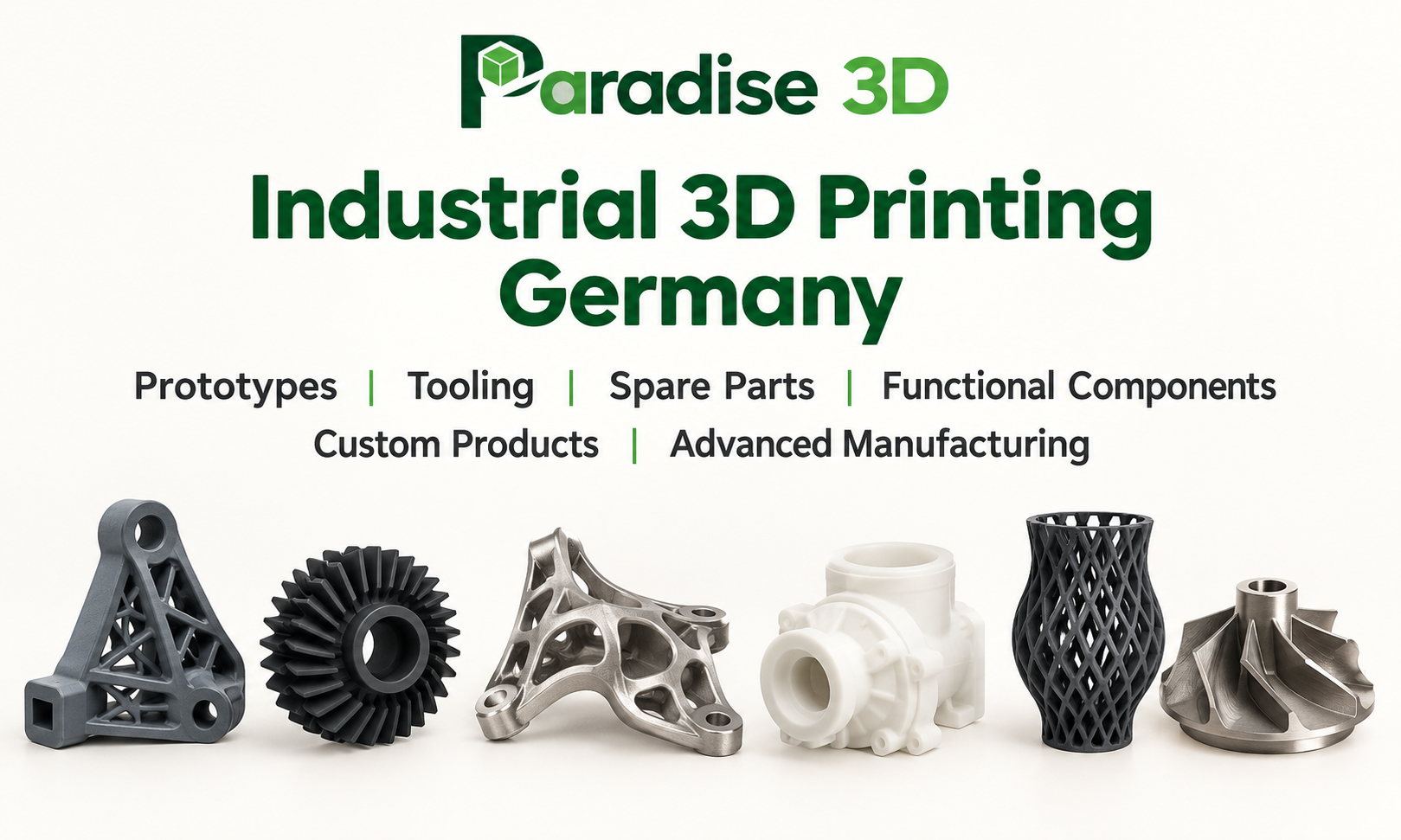
Industrial 3D printing Germany has become an important part of modern manufacturing, helping companies produce prototypes, tooling, spare parts, functional components, and customized products with greater flexibility. Germany is one of Europe's leading additive manufacturing markets, supported by strong engineering capabilities, industrial research, skilled professionals, and established manufacturing industries. Government-backed industry information states that around four out of ten German industrial companies use 3D printing, while Germany has a particularly strong position in industrial metal additive manufacturing.
For manufacturers looking to reduce development time, simplify complex production requirements, and create parts without traditional molds or tooling, industrial 3D printing Germany offers an increasingly practical manufacturing solution.
What Is Industrial 3D Printing?
Industrial 3D printing is an additive manufacturing process in which a component is created layer by layer from digital CAD data. Unlike conventional subtractive manufacturing, where material is removed from a block, additive manufacturing builds the required geometry directly.
Industrial systems can process polymers, engineering plastics, resins, metals, and other specialized materials. Depending on the application, manufacturers can use technologies such as FDM or FFF, SLA, SLS, DLP, MJF, and metal powder-bed processes.
The flexibility of industrial 3D printing makes it suitable for prototypes as well as selected production applications. Siemens highlights reduced material waste, reduced tooling requirements, customized production, and shorter lead times among the major advantages of industrial additive manufacturing.
Why Industrial 3D Printing Is Growing in Germany
Germany has a strong industrial base in automotive, aerospace, mechanical engineering, medical technology, electronics, and industrial equipment. These sectors frequently require complex components, rapid prototypes, customized tooling, and low-volume production.
According to Germany Trade & Invest, Germany ranks first in Europe for manufacturers of industrial additive manufacturing systems, with 37 companies producing and selling industrial AM systems. The country is also particularly strong in metal additive manufacturing, with German manufacturers representing a significant share of the installed global metal AM base.
This established ecosystem makes industrial 3D printing Germany an important area for companies exploring advanced production.
Applications of Industrial 3D Printing Germany
1. Automotive Manufacturing
Automotive manufacturers can use 3D printing for prototypes, jigs, fixtures, tooling, replacement parts, production aids, and selected end-use components.
The technology allows engineers to test different designs before committing to expensive conventional tooling. Complex shapes can also be manufactured without requiring multiple machining operations.
Germany's automotive sector has already demonstrated the potential for industrial-scale additive manufacturing. BMW, for example, is working to expand additive manufacturing toward scalable production applications, including additional systems and wire arc additive manufacturing for future series production.
2. Aerospace and Aviation
Aerospace manufacturers require lightweight, strong, and geometrically complex components. Industrial 3D printing can help engineers consolidate several components into a single optimized design.
It can also be useful for producing low-volume aircraft parts where conventional tooling would be expensive. Lufthansa Technik reports that more than 2,200 aircraft parts have been developed, approved, and installed through its additive manufacturing activities.
3. Mechanical Engineering
Mechanical engineering companies can use industrial 3D printing Germany for machine components, prototypes, assembly aids, fixtures, replacement parts, and customized equipment.
The ability to manufacture complex geometries can help engineers redesign components around their actual functional requirements rather than traditional manufacturing limitations.
4. Medical and Dental Manufacturing
Medical and dental applications can benefit from customized geometries and small production quantities. Depending on regulatory requirements and the specific application, additive manufacturing can be used for models, tooling, guides, customized components, and other specialized products.
Germany also has a strong research ecosystem supporting additive manufacturing technologies and materials.
5. Industrial Spare Parts
One of the practical benefits of industrial 3D printing Germany is on-demand spare-part production.
Instead of maintaining large inventories of every low-volume component, companies can maintain qualified digital files and manufacture certain parts when required. This can help reduce storage requirements and support faster replacement of obsolete or difficult-to-source components.
Materials Used in Industrial 3D Printing
The appropriate material depends on the application's mechanical, thermal, chemical, and dimensional requirements.
Common polymer materials include PLA, ABS, PETG, nylon, polyamide, TPU, PEEK, PPS, and high-performance engineering polymers. Industrial systems can also process materials designed for flame resistance, chemical resistance, strength, or high-temperature applications.
Metal additive manufacturing can use materials such as aluminum, stainless steel, titanium, tool steels, and specialized alloys.
Fraunhofer IFAM highlights work across additive processes, materials development, component production, testing, heat treatment, and process integration, demonstrating the breadth of industrial AM development in Germany.
Benefits of Industrial 3D Printing Germany
The major advantages include:
- Faster product development
- Rapid prototyping
- Reduced tooling requirements
- Customized production
- Low-volume manufacturing
- Complex geometric freedom
- Lightweight component design
- On-demand spare parts
- Reduced material waste
- Digital manufacturing workflows
- Easier design iteration
- Potentially shorter production lead times
Fraunhofer's production research also emphasizes process stability, quality control, post-processing, and reproducibility as important factors when moving additive manufacturing from individual applications toward industrial production.
Industrial 3D Printing for Prototypes and Small-Batch Production
Prototyping remains one of the most valuable applications of industrial 3D printing Germany. Engineers can create a physical version of a CAD design quickly, evaluate its fit and functionality, and make changes before moving toward conventional production.
Small-batch production is another important opportunity. When production quantities are relatively low, the cost of molds and tooling can make traditional manufacturing less attractive. Additive manufacturing can produce components directly from digital files without requiring dedicated tooling.
German industrial projects have also demonstrated that additive manufacturing can move beyond prototyping. Fraunhofer ILT reported automated, digitally connected production lines capable of manufacturing automotive components using laser powder-bed fusion technology.
Choosing the Right Industrial 3D Printing Process
Selecting the right process depends on the component and its requirements.
FDM/FFF is suitable for many functional prototypes, fixtures, tooling, and larger polymer components.
SLA and DLP are useful where detailed surfaces and fine features are important.
SLS is suitable for complex polymer parts because it does not require conventional support structures for many geometries.
MJF can be effective for functional polymer components and production-oriented applications.
Metal additive manufacturing is appropriate for applications requiring metal properties, complex geometries, lightweight structures, or specialized components.
A professional evaluation should consider material, accuracy, surface finish, strength, production quantity, post-processing, certification, and overall cost.
Quality and Industrial Production
Industrial 3D printing is not simply about producing a part. For production applications, companies also need repeatability, process monitoring, inspection, documentation, and quality assurance.
Germany's industrial ecosystem increasingly focuses on these requirements. TÜV NORD notes that additive manufacturing for industrial and safety-relevant components can involve digital traceability, advanced inspection methods, and standards such as DIN EN ISO/ASTM 52920.
This makes process qualification particularly important when printed components are intended for demanding industrial environments.
The Future of Industrial 3D Printing Germany
The future of industrial 3D printing Germany is likely to involve greater automation, process monitoring, digital production management, advanced materials, and integration with conventional manufacturing.
Instead of treating 3D printing only as a prototyping technology, manufacturers are increasingly evaluating it as part of complete production workflows. Robotics, automated post-processing, digital twins, quality inspection, and connected manufacturing systems can further improve production efficiency.
Germany's combination of industrial expertise, research institutions, engineering companies, and additive manufacturing system manufacturers provides a strong foundation for continued development.
Conclusion
Industrial 3D printing Germany is transforming how manufacturers approach product development, tooling, customized components, spare parts, and selected production applications. Its ability to manufacture complex designs directly from digital data gives companies greater flexibility while reducing dependence on traditional tooling for many applications.
With strong capabilities across automotive, aerospace, mechanical engineering, healthcare, electronics, and other sectors, Germany remains a major center for industrial additive manufacturing. For companies evaluating 3D printing, the key is to select the appropriate technology, material, design strategy, and quality process for the intended application.
FAQs About Industrial 3D Printing Germany
1. What is industrial 3D printing Germany?
Industrial 3D printing Germany refers to the use of professional additive manufacturing technologies for industrial applications such as prototyping, tooling, spare parts, functional components, and production parts.
2. Which industries use industrial 3D printing in Germany?
Major industries include automotive, aerospace, mechanical engineering, medical technology, electronics, railway, shipbuilding, and industrial manufacturing.
3. What materials can be used for industrial 3D printing?
Depending on the technology, industrial printers can process polymers, engineering plastics, resins, nylon, high-performance polymers, aluminum, stainless steel, titanium, tool steels, and other specialized materials.
4. Is industrial 3D printing suitable for production?
Yes. Industrial 3D printing can be used for selected production applications, particularly customized components, complex geometries, spare parts, and low- to medium-volume manufacturing. The suitability depends on the part, material, quantity, quality requirements, and production economics.
5. What are the benefits of industrial 3D printing?
Key benefits include faster prototyping, design freedom, reduced tooling requirements, customization, digital production, on-demand manufacturing, and the ability to create complex components.
6. How do I choose an industrial 3D printing technology?
The choice depends on the required material, strength, accuracy, surface finish, component size, production volume, geometry, certification requirements, and budget.
7. Is metal 3D printing available for industrial applications in Germany?
Yes. Germany has a particularly strong industrial ecosystem for metal additive manufacturing, including laser-based powder-bed processes and other metal AM technologies.
8. What is the future of industrial 3D printing in Germany?
The technology is moving toward greater automation, scalable production, digital process monitoring, advanced materials, quality assurance, and integration with conventional manufacturing systems.

 English
 Arabic
 French
 Portuguese
 Deutsch
 Turkish
 Dutch
Dutch
 Italiano
 Russian
 Romaian
 Portuguese (Brazil)
 Greek
Greek
