


Why Smart Businesses Are Ditching Templates for Custom Software
There was a time when buying a ready-made software package was the obvious choice for most businesses. It was quick to install, relatively easy to understand and offered a collection of features that appeared to cover everyday requirements. But as businesses become more specialised, those same advantages can quickly turn into limitations.
A growing number of companies are now questioning whether their software should dictate how they work. Instead, they are looking for technology that fits their processes, supports their teams and can evolve as the business grows. This shift is one of the reasons custom software development is becoming an increasingly important business decision.
For organisations that have outgrown generic tools, custom software development offers a different approach: rather than changing the business to suit the software, the software is developed around the business.
The Problem With One-Size-Fits-All Software
Off-the-shelf software is designed to serve a broad market. That makes it useful for businesses with straightforward and relatively standard processes, but it can become restrictive when an organisation has specific operational requirements.
A business may have a particular approval process, reporting structure, customer journey or internal workflow that does not match the way a generic application has been designed.
The result is often a collection of workarounds.
Employees may export information into spreadsheets, duplicate data between systems, rely on manual updates or use additional applications to fill gaps in the main platform. Over time, these small inefficiencies can become part of the daily routine.
The software may technically work, but the business is working around the software.
Custom Software Starts With the Business
The biggest difference between generic software and a custom solution is the starting point.
Instead of beginning with a list of existing features, custom development begins by understanding the organisation's objectives, workflows and challenges.
This allows developers to consider questions such as how information moves between departments, where repetitive work occurs, which tasks require approval and what information managers need to make decisions.
For a growing company, this approach can create a much closer relationship between technology and operations.
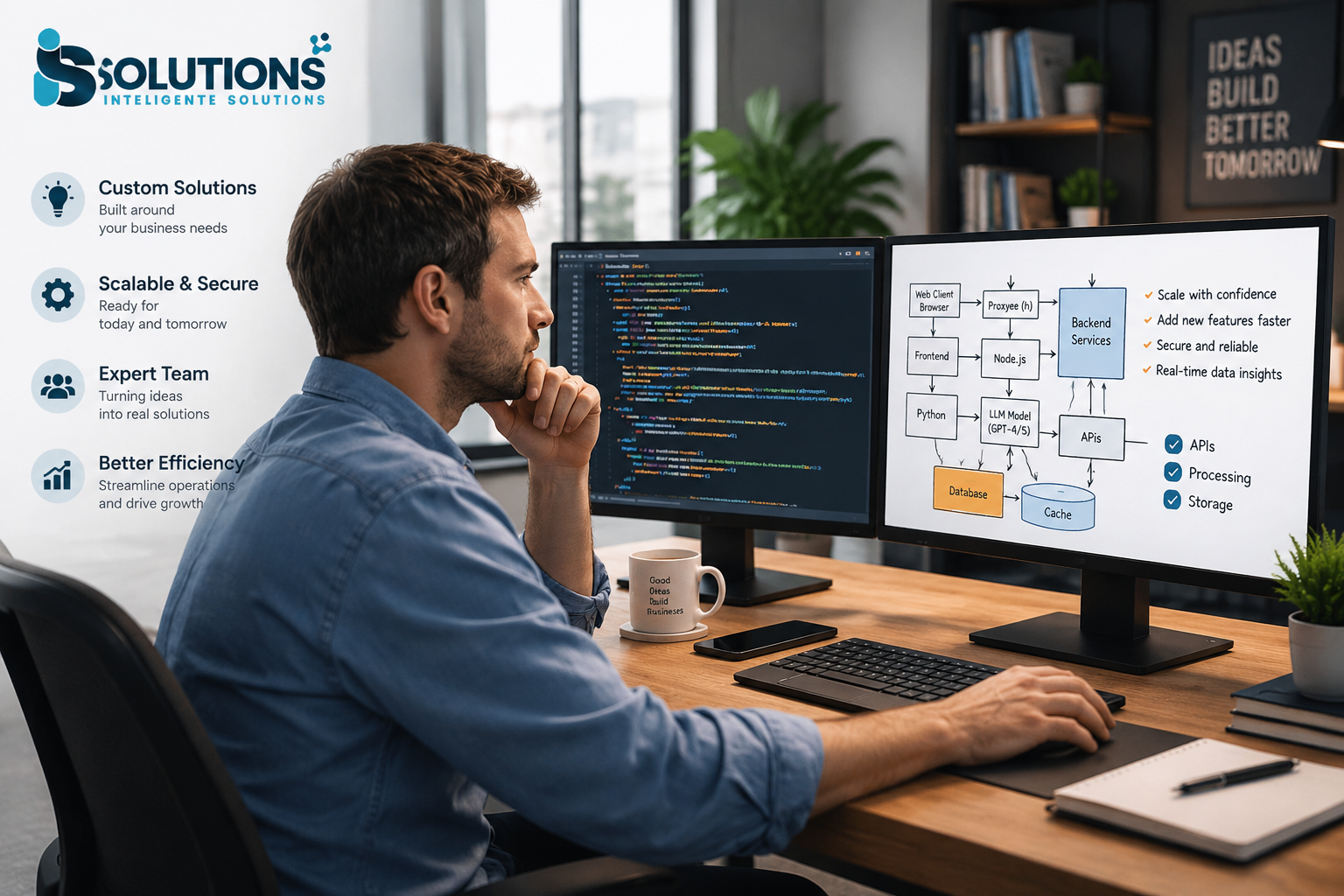
Inteligente Solutions describes its approach as building software around specific business goals rather than relying on one-size-fits-all templates. Its custom software services include tailored platforms, workflow automation, centralised dashboards and legacy system modernisation.
Better Workflows Instead of More Features
A common misconception is that better software simply means having more features.
In reality, a business may benefit more from having fewer features that are specifically designed around how its employees work.
Imagine a company where every new customer needs to pass through several internal stages. A generic system might require employees to update multiple records manually. A custom platform could be designed around that exact workflow, allowing information to move between relevant stages without unnecessary duplication.
The objective is not to create complicated technology.
It is to remove unnecessary complexity from the business.
Automation Can Remove Repetitive Work
Repetitive administrative tasks are another reason businesses consider custom software.
Employees may spend significant amounts of time entering the same information, transferring data between systems, preparing routine reports or checking whether certain tasks have been completed.
Where a process follows consistent rules, software can potentially automate parts of that workflow.
Custom software can be designed around these specific requirements rather than forcing the organisation to adopt the automation options offered by a generic platform.
Inteligente Solutions specifically highlights enterprise workflow automation, proprietary automation processes and integrations with third-party software as part of its custom development offering.
Integration Becomes Easier
Businesses rarely operate with one software system.
A typical organisation may use accounting software, customer management tools, payment platforms, communication systems and internal databases.
The challenge begins when these systems do not communicate effectively.
Employees may need to transfer information manually, increasing the possibility of delays or inconsistencies.
Custom software can be designed with integrations in mind from the beginning. APIs and other technical connections can allow different platforms to exchange relevant information, creating a more connected digital environment.
This can be particularly valuable for businesses that have developed their technology stack over several years.
Custom Software Can Grow With the Business
Growth often exposes the limitations of generic systems.
A platform that works well for a small team may become difficult to manage when the organisation adds employees, branches, products or customers.
Businesses may then find themselves paying for larger software plans or adding multiple applications to compensate for missing functionality.
Custom software can be developed with future requirements in mind.
The architecture can allow additional modules, users, integrations or functionality to be introduced as the organisation's needs change.
This does not mean every custom platform should be built with every possible future feature. Good development focuses on creating a sensible foundation that can be extended when there is a genuine business requirement.
Greater Control Over the User Experience
User experience matters inside business software as much as it does in customer-facing applications.
If employees struggle to find information or understand how a system works, productivity can suffer.
Custom development provides greater control over the interface, navigation and user journeys.
Screens can be designed around the tasks employees actually perform. Different users can also be given access to the information and functions relevant to their responsibilities.
The result can be a system that feels more natural to the people using it every day.
Better Visibility Across the Organisation
Data becomes increasingly valuable as a business grows.
However, data spread across disconnected spreadsheets and applications can make it difficult to obtain a clear view of operations.
A centralised custom system can bring relevant information together and provide dashboards or reporting tools based on the organisation's actual requirements.
Managers can then focus on the information that matters rather than working through unnecessary reports.
Inteligente Solutions also provides CRM, ERP and industry-specific management systems designed to centralise business operations and reporting.
Custom Does Not Mean Complicated
Some businesses hesitate when they hear the term "custom software" because they assume it means a large, expensive enterprise project.
That is not necessarily the case.
Custom software can range from a focused internal tool to a complete business management platform. The appropriate scope depends on the problem being solved.
A business might only need a specialised dashboard, workflow system or integration rather than a completely new ecosystem.
The strongest projects begin with the business problem and determine the technology required to solve it.
The Importance of a Structured Development Process
Successful custom software depends on more than writing code.
A professional development process should begin with discovery and planning. Requirements need to be understood before development starts, while user journeys and technical architecture should be considered carefully.
A typical process may involve discovery, planning, UI/UX design, development, testing, deployment and ongoing support.
Inteligente Solutions follows a structured workflow covering discovery, planning, UI/UX design, development, testing and launch support.
This approach helps reduce the risk of building a technically impressive product that does not actually solve the original business problem.
When Should a Business Consider Custom Software?
Not every company needs bespoke software.
If an existing application genuinely meets the organisation's requirements, replacing it may not make commercial sense.
Custom development becomes more attractive when software limitations begin affecting operations.
Warning signs can include excessive manual data entry, disconnected systems, complicated workarounds, limited reporting, inefficient approval processes or difficulty adapting software to new business requirements.
When these problems become persistent, the cost of continuing with unsuitable software should be considered alongside the cost of developing a better solution.
Custom Software as a Long-Term Business Asset
One of the most important differences is that custom software can become part of the organisation's own digital infrastructure.
Instead of simply subscribing to a platform designed for a general market, a company can develop technology around its own processes and objectives.
That can create greater control over how the system evolves.
It also means the business can make technology decisions based on its own priorities rather than waiting for a software provider to introduce a particular feature.
Security and Reliability Still Matter
Customisation should never come at the expense of security.
Business software can contain sensitive operational, financial and customer information, so security needs to be considered throughout development.
Testing, access controls, secure architecture, maintenance and regular updates all have an important role.
A professional software development partner should therefore treat security and reliability as part of the development process rather than as an afterthought.
Why the Right Development Partner Matters
Choosing custom software is only the first decision. Choosing the right development partner can be equally important.
Businesses should look for a team that takes time to understand their processes rather than simply presenting a pre-existing product.
Communication also matters. Requirements can change during development, and businesses need visibility into progress, testing and deployment.
Inteligente Solutions positions itself as a technology partner for startups, SMEs and established businesses, with services spanning custom software, CRM, ERP, websites, mobile applications and industry-specific management systems.
The Business Case for Moving Beyond Templates
The strongest argument for custom software is not that generic software is always bad.
It is that businesses should not allow their technology to become a barrier to the way they operate.
A company with unique workflows may eventually spend more time adapting its processes to a generic platform than it would have spent developing a system around its actual requirements.
Custom software offers another option.
It allows technology to become an extension of the business rather than another constraint placed upon it.
Final Thoughts
Smart businesses are not necessarily abandoning templates simply because custom software sounds more advanced. They are moving beyond one-size-fits-all technology when it no longer supports the way their organisation operates.
For businesses dealing with repetitive processes, disconnected systems, complex workflows or growing operational requirements, a tailored software solution can provide a more practical foundation for the future.
The real value of custom software lies in its ability to reflect the organisation behind it. Workflows can be designed around real employees, integrations can be built around existing systems, reporting can reflect actual management needs and future development can follow the direction of the business.
Inteligente Solutions takes a business-focused approach to technology, developing custom software and wider digital solutions around specific organisational goals.
The future of business technology is unlikely to be defined by having the most software. It will be defined by having the right software, built around the right problems and capable of adapting when the business changes.

 English
 Arabic
 French
 Portuguese
 Deutsch
 Turkish
 Dutch
Dutch
 Italiano
 Russian
 Romaian
 Portuguese (Brazil)
 Greek
Greek
