


Mini-splits and Florida humidity: the problem nobody quotes for
Mini-splits and Florida humidity: the problem nobody quotes for
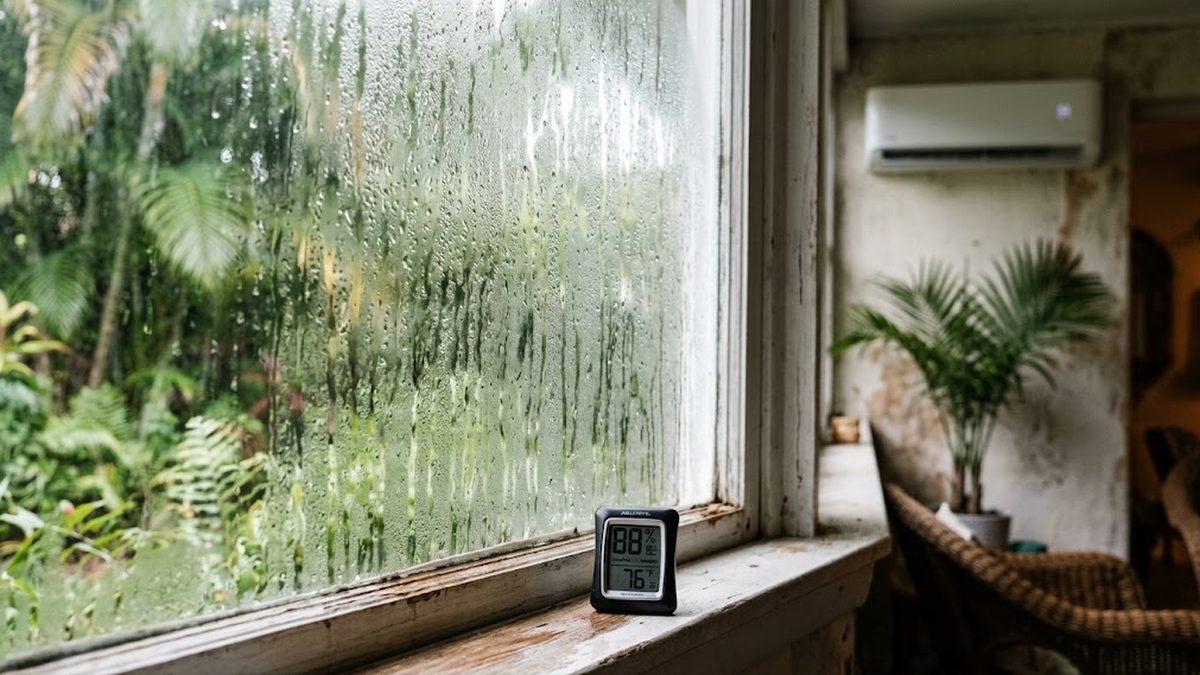
A room can sit exactly at its setpoint and still feel wrong. The thermostat reads 74, the equipment is new, and the air is heavy, the floor is tacky and something is growing in the corner of the bathroom ceiling. Temperature was never the whole job, and in this climate it is not even the harder half.
Two loads, and only one of them is on the thermostat
Cooling equipment does two separate things. It removes heat, which lowers the temperature, and it removes water vapour, which lowers the humidity. The industry calls these the sensible and latent loads, and the ratio between them varies enormously by climate.
In Phoenix the load is almost entirely sensible. In Southwest Florida a large share is latent: outdoor air carries a great deal of moisture, it enters the house continuously through every leak and every opened door, and people, showers and cooking add more. Equipment designed and rated primarily around sensible capacity can satisfy a thermostat here while doing very little about the water.
The mechanism is worth understanding because it explains everything that follows. Moisture is removed when humid air contacts a coil cold enough for water to condense on it, and that condensate drains away. That process is gradual. A system needs sustained run time at a cold coil to move meaningful quantities of water, and anything that shortens run time reduces dehumidification more than it reduces cooling.
Why oversizing causes it
Give a room more capacity than it needs and the sequence is predictable. The head starts, blows hard, drops the air temperature quickly, satisfies the thermostat within a few minutes and stops. The coil got cold, condensation had barely begun, and the water that did form on the fins now evaporates back into the room from the wet coil once the compressor stops.
Repeat that a dozen times an hour and the net moisture removal approaches nothing. The room is cold and damp, which is the specific complaint people describe as feeling like a basement.
Inverter-driven ductless equipment is genuinely better at this than fixed-speed central systems, because it modulates output down and runs longer at lower capacity. That is a real advantage and it is why ductless often outperforms central air on humidity. But modulation has a floor. Below its minimum output the unit cycles like anything else, and a head sized generously for a small bedroom spends mild days below that floor.
Multi-zone systems reach the floor sooner still, because the shared outdoor unit has a minimum for the whole system. One small bedroom calling alone at night is the classic case.
| What you observe | What is happening | Direction of the fix |
|---|---|---|
| Cold room, humidity above 60% | Short cycling, little latent removal | Sizing, fan speed, setpoint strategy |
| Runs a few minutes, stops, repeats | Capacity above the room's load | Right-size, or use a lower fan speed |
| Musty smell on start-up | Growth on the indoor coil or blower wheel | Professional cleaning of the head |
| Humidity fine when occupied, bad when away | Setback too high to trigger run time | Modest setback, or a dehumidifier |
| Water dripping from the head | Blocked drain, or condensation on an uninsulated line | Service, and check the insulation |
| Whole house damp, one zone fine | Untreated rooms with no head | Air movement, or another zone |
What actually helps
Correct sizing, decided before purchase. This is the whole ballgame and it cannot be retrofitted. A room-by-room load calculation, and resisting the urge to round every head up, is what prevents the problem rather than managing it.
Lower fan speed. Counterintuitive and effective. Slower air across the coil means the air spends longer in contact with a colder surface, so more water condenses out per unit of cooling. Many people set the fan to high for maximum cooling and unknowingly reduce dehumidification. On a humid day, medium or low often makes a room feel better at the same temperature.
A slightly higher setpoint, held constantly. Running at 76 continuously removes more moisture than cycling hard to 72 and stopping. The room feels better at the higher temperature because the air is drier, which is the whole point.
Dry mode, with realistic expectations. Most ductless heads have one. It reduces fan speed and runs the compressor in a pattern favouring moisture removal. It is useful on a rainy mild day when there is little sensible load, and it is not a dehumidifier: it works by cooling, so it will overcool a room if left running.
A standalone dehumidifier. Sometimes the correct answer, particularly for a space with a large latent load and a small sensible one, such as a room with a damp slab or one that sits empty most of the week. A dehumidifier removes water without overcooling, which is exactly what those spaces need.
Reduce the moisture at source. Bathroom fans that vent outside and run long enough, a kitchen hood that exhausts rather than recirculates, and a house sealed against infiltration all lower the load before the equipment has to deal with it.
The blower wheel problem
The consequence of all this humidity is a maintenance issue specific to ductless heads. The indoor coil is wet whenever the unit runs, the blower wheel sits inches away in that damp air, and the small filters catch dust but not much else. Biological growth on the wheel and the coil is common in Florida, and it produces the musty smell that appears in the first thirty seconds after start-up.
The filters you can rinse yourself do not reach any of it. Cleaning a head properly means removing the cover, bagging the unit, and washing the coil and blower wheel with the right chemistry, which is a service task rather than a weekend one. Annually is a reasonable interval here; heads in kitchens and bathrooms need it more often.
Two habits reduce how fast it comes back. Rinse the filters monthly, since dust is the food supply. And use the head's fan-only or self-drying function after cooling if it has one, which runs the blower briefly to dry the coil before shutting down. It is often disabled by default, and it is worth turning on.
If a head has never been cleaned and the house smells of it, that is a service call rather than a purchase. What is involved, and how it fits alongside the rest of the work on a ductless system, is set out at https://acromanservice.com/ductless-mini-split-systems.
Where the moisture ends up when it is not removed
Humidity that stays in the air is uncomfortable. Humidity that condenses on a cold surface is damage, and the difference is a matter of a few degrees.
Air holds a maximum amount of water vapour at a given temperature, and cooling it below that point forces the excess out as liquid. That is how the equipment dehumidifies deliberately. It is also what happens accidentally on any surface cooler than the surrounding air's dew point: a bare refrigerant line, an uninsulated section inside a wall penetration, a metal window frame, the back of a bookcase pushed against an exterior wall in a room held very cold.
The two failures that show up repeatedly in Florida ductless installations are both condensation rather than leaks. The first is an inadequately insulated line set inside the wall, dripping into the cavity. Nothing is visible for a season or two, then a stain appears on the drywall below the penetration and the wall has been damp the whole time. The second is a room chilled to 68 or 70 in a humid house, where cold surfaces sit below the dew point of the air arriving from the rest of the building.
The general rule follows from the mechanism: it is safer to keep a house drier than to keep it colder. A drier house is comfortable at a higher temperature, its surfaces are further from the dew point, and its equipment runs less. A house held very cold in humid air is fighting physics in every wall cavity.
Measuring instead of guessing
A hygrometer costs very little and it converts an argument into a number. Put one in the room that feels wrong and one in a room that feels fine, and read them at the same time of day for a week.
The target is 45 to 55 percent relative humidity. Above 60 percent sustained is where dust mites thrive and mould becomes plausible on cool surfaces. Below 40 percent is unusual here and generally means something is overcooling.
Take the readings before calling anyone. "The bedroom holds 74 degrees but sits at 64 percent humidity all afternoon" describes a diagnosable condition. "It feels clammy" describes a sensation, and the technician's first job becomes reproducing it.
Frequently asked questions
My mini-split is new. Why is the humidity worse than with the old window unit?
Most likely it is oversized for the room, so it satisfies the thermostat quickly and stops. The old unit was probably underpowered, ran continuously, and dehumidified well as a side effect of struggling.
Should I run the fan continuously?
No. Running the blower over a wet coil while the compressor is off evaporates collected condensate back into the room. Continuous fan operation raises indoor humidity in a climate like this one.
Is dry mode expensive to run?
Not especially, but it can overcool a room because it works by cooling. It is a tool for a specific condition, mild and humid, rather than a setting to leave on.
Can a dehumidifier be added to a ductless system?
Not into the head, which has no ductwork to connect to. A standalone or whole-house dehumidifier operates as a separate system, and in houses with a persistent latent problem that is often the cleanest solution.
Current as of September 2026.

 English
 Arabic
 French
 Spanish
 Portuguese
 Deutsch
 Turkish
 Dutch
Dutch
 Italiano
 Russian
 Portuguese (Brazil)
 Greek
Greek
