


Can a Blood Test Replace a Liver Biopsy?
Introduction
If your doctor recommends a liver biopsy, you may naturally wonder, “Do I really need an invasive procedure, or can a blood test tell me the same thing?” It is an important question.
Blood tests have transformed the way doctors evaluate liver health. Tests such as liver enzymes, platelet counts, FIB-4, and APRI can provide useful information about liver damage and scarring. In many people, these tests can help doctors assess the risk of advanced fibrosis without immediately performing a biopsy.
But can a blood test completely replace a liver biopsy? Not always. The right answer depends on the suspected liver condition, the results of other tests, and what your doctor needs to find out.
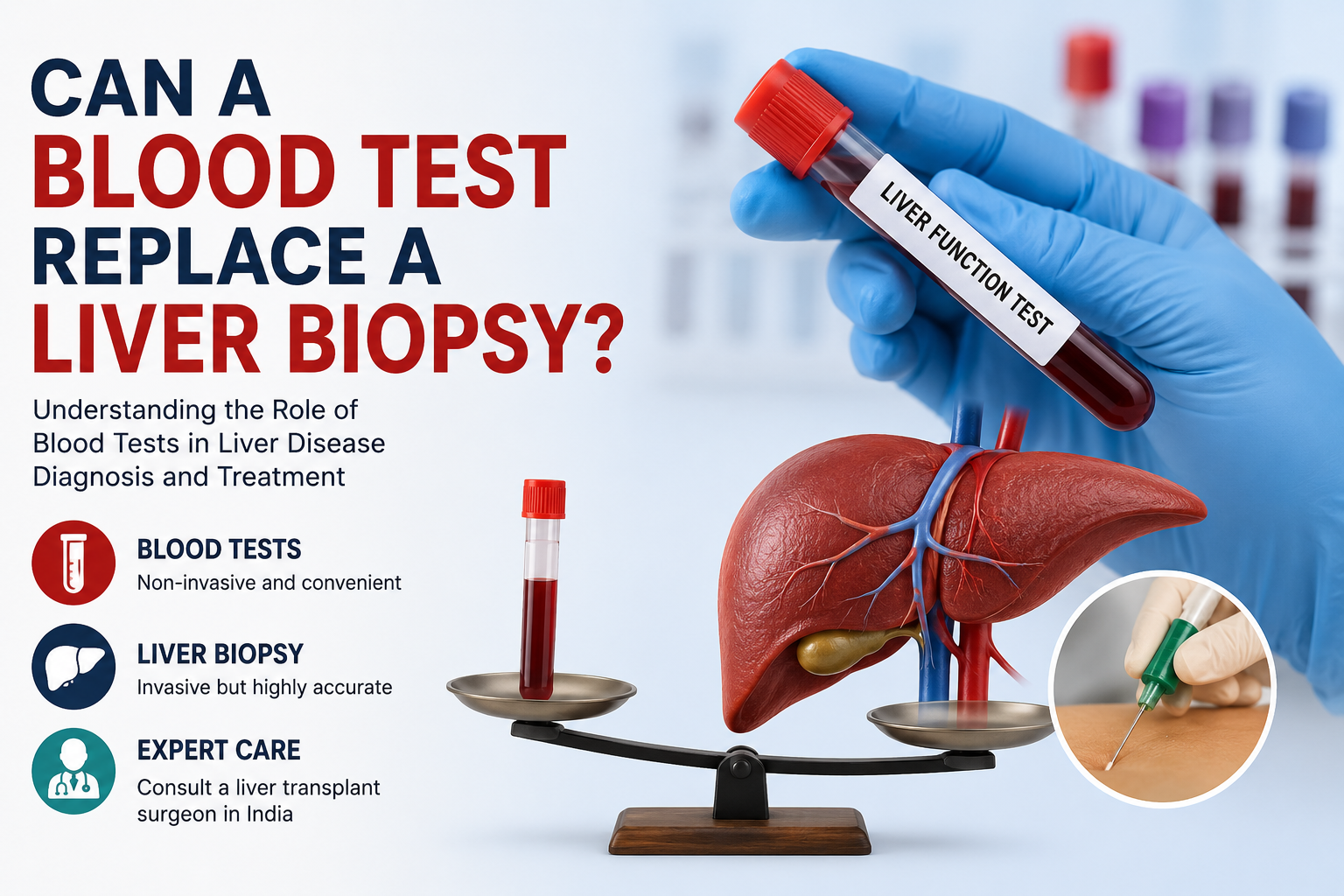
Think of blood tests as looking at clues left behind by a problem, while a biopsy allows doctors to examine a tiny piece of the liver itself. Both can be valuable, but they answer slightly different questions.
Learn whether blood tests can replace liver biopsy and how a liver transplant surgeon in India evaluates advanced liver disease.
1. What Is a Liver Biopsy?
A liver biopsy is a procedure in which a doctor removes a small sample of liver tissue, usually with a needle. The sample is then examined under a microscope by a pathologist.
This allows doctors to directly examine liver tissue for signs of inflammation, scarring, certain diseases, and other abnormalities. The procedure may be recommended when blood tests and imaging do not provide enough information to establish a diagnosis or determine the extent of liver damage.
A biopsy can provide detailed information, but it is invasive. Although serious complications are uncommon, bleeding, pain, and other complications can occur.
That is one reason modern liver care increasingly uses non-invasive tests whenever they can answer the clinical question reliably.
2. Why Are Liver Biopsies Performed?
Doctors do not recommend liver biopsy simply because someone has an abnormal liver enzyme result.
Instead, biopsy may be considered when the diagnosis remains uncertain, when different liver conditions need to be distinguished, or when knowing the microscopic characteristics of the liver would change treatment.
For example, a person may have abnormal blood tests, but those results can have several possible causes. A biopsy can sometimes provide information that cannot be obtained from routine blood testing alone.
According to the National Institute of Diabetes and Digestive and Kidney Diseases, doctors may use liver biopsy to diagnose liver disease when other tests cannot confirm the diagnosis, assess the severity of liver damage, help determine treatment, or evaluate how treatment is working.
So, while technology has reduced the need for biopsy in many situations, biopsy has not become obsolete.
3. What Can Blood Tests Tell You About Your Liver?
Blood tests are often the first step in evaluating liver health.
Common tests include ALT, AST, alkaline phosphatase, bilirubin, albumin, platelet count, and clotting-related measurements. Doctors may also order tests for viral hepatitis, autoimmune liver diseases, iron overload, and other conditions depending on the person's history.
These tests can provide clues about:
- Liver cell injury
- Bile duct problems
- Liver function
- Possible viral hepatitis
- Autoimmune liver conditions
- Changes associated with cirrhosis
- The possibility of significant liver fibrosis
For example, higher ALT and AST levels can indicate liver-cell injury, while bilirubin and albumin can provide information about liver function. Platelet levels may also contribute to assessments of advanced liver disease.
However, there is an important point: an abnormal liver enzyme result does not automatically tell you how much scarring your liver has.
That is where specialized non-invasive tests become useful.
4. What Is FIB-4 and How Does It Work?
FIB-4 is a commonly used non-invasive score that estimates the likelihood of liver fibrosis.
It uses information that is generally available from routine blood tests, including:
- Age
- AST
- ALT
- Platelet count
Doctors can use the score as an initial assessment to help identify people who may have a higher risk of advanced liver fibrosis.
This approach is particularly useful because it does not require a needle to enter the liver. Current AASLD guidance highlights blood-based non-invasive assessments as important tools in evaluating liver fibrosis and steatosis.
However, FIB-4 is a risk-assessment tool, not a direct photograph of liver tissue. A result should therefore be interpreted in the context of age, medical history, other test results, and the specific liver disease being considered.
5. What Is the APRI Test?
Another non-invasive assessment is the AST to Platelet Ratio Index, commonly called APRI.
Like FIB-4, APRI uses blood-test information to estimate the likelihood of significant liver fibrosis.
These types of scores are attractive because they are:
- Simple
- Relatively inexpensive
- Widely accessible
- Non-invasive
- Repeatable over time
They can help doctors determine whether a patient is likely to have advanced fibrosis and whether additional testing is necessary.
Still, no blood-based score should be interpreted as a definitive replacement for every liver biopsy. Intermediate or unclear results often require additional evaluation.
6. Can Blood Tests Detect Liver Fibrosis?
Yes, blood tests can help identify the likelihood of liver fibrosis, particularly advanced fibrosis, but they do not always provide the same information as a biopsy.
Fibrosis occurs when repeated liver injury causes scar tissue to build up in the liver.
Doctors can combine routine blood tests into validated scores such as FIB-4 and APRI. Additional blood-based markers may also be used in selected settings.
The European Association for the Study of the Liver recognizes blood-based tests as an important category of non-invasive tests for evaluating chronic liver disease. However, it also emphasizes that non-invasive tests, biopsy, and clinical judgment may need to be integrated depending on the situation.
This is an important distinction. A blood test can sometimes tell your doctor, “This person is unlikely to have advanced fibrosis,” or “This person needs further investigation.”
It does not necessarily provide the same microscopic detail as a tissue sample.
7. Blood Tests vs Liver Biopsy
So, which is better?
The answer depends on what doctors are trying to discover.
| Feature | Blood Tests | Liver Biopsy |
|---|---|---|
| Invasive? | No | Yes |
| Requires needle into liver? | No | Usually yes |
| Can assess liver injury? | Yes | Yes |
| Can estimate fibrosis risk? | Yes | Yes |
| Provides microscopic tissue information? | No | Yes |
| Easy to repeat? | Yes | No |
| Can help diagnose certain specific diseases? | Yes | Yes |
| Risk of procedure-related complications | Very low | Present |
Blood tests are therefore excellent screening and monitoring tools, while biopsy remains valuable when detailed tissue information is needed.
Modern liver medicine increasingly aims to avoid unnecessary invasive procedures without sacrificing diagnostic accuracy.
8. When Can Blood Tests Reduce the Need for Biopsy?
Blood tests may significantly reduce the need for biopsy when the clinical picture is clear and non-invasive tests consistently point in the same direction.
For example, if a person has a low-risk fibrosis score and other investigations do not suggest advanced liver disease, a doctor may decide that an invasive biopsy is unnecessary.
This approach can be especially useful for long-term monitoring.
Why repeat an invasive procedure if reliable non-invasive tests can safely track the patient's condition?
Non-invasive testing is also useful because liver fibrosis is not necessarily permanent or static. It can change over time, so repeatable tests can be valuable for monitoring disease progression or improvement.
However, a doctor may recommend biopsy when non-invasive tests disagree, remain inconclusive, or fail to answer the specific diagnostic question.
9. When Is a Liver Biopsy Still Necessary?
There are situations where a biopsy may still be important.
One example is uncertain diagnosis. If blood tests and imaging cannot distinguish between possible liver diseases, examining tissue may provide additional information.
Biopsy may also be considered when doctors need to understand a specific type or pattern of liver injury.
For example, NIDDK notes that in suspected metabolic dysfunction-associated steatotic liver disease, biopsy can distinguish certain forms of disease and can provide detailed information about inflammation and fibrosis. It is not recommended for everyone with suspected disease, however.
Similarly, some autoimmune liver conditions require a combination of blood tests and, in many cases, biopsy to establish the diagnosis.
Therefore, a blood test should not be viewed as a universal substitute for biopsy.
The goal is not to choose one test over another. The goal is to choose the least invasive testing strategy that still provides enough reliable information to make the right medical decision.
10. The Role of Elastography and Imaging
There is another important piece of the puzzle: imaging-based non-invasive testing.
Ultrasound, CT, MRI, and specialized techniques such as elastography can provide information about the liver.
Transient elastography, sometimes known by the brand name FibroScan, measures liver stiffness. Increased stiffness can be associated with fibrosis.
Magnetic resonance elastography is another technique that can assess liver stiffness.
NIDDK notes that elastography can help doctors evaluate advanced fibrosis and cirrhosis without taking a tissue sample.
This means that modern liver assessment is often more than simply “blood test versus biopsy.”
Instead, doctors may combine:
Blood tests + fibrosis scores + elastography + ultrasound or other imaging + medical history + physical examination.
Together, these pieces can create a much clearer picture of liver health.
11. Advantages of Non-Invasive Liver Testing
There is a good reason non-invasive testing has become increasingly important.
First, it avoids an invasive procedure. A blood sample is much simpler for most patients than having a needle placed through the abdominal wall into the liver.
Second, it is easier to repeat. Doctors can monitor changes over months or years without repeatedly performing biopsies.
Third, it can be widely accessible. Routine blood tests are available in many healthcare settings.
Fourth, it can help identify people who need specialist evaluation. A low-risk result may help reassure doctors, while a high-risk result can trigger additional testing.
EASL describes non-invasive tests as useful because they can be repeatable and can contribute to the assessment and monitoring of chronic liver disease.
For many patients, this represents a major improvement in comfort and convenience.
12. Limitations of Blood Tests
Despite their benefits, blood tests are not perfect.
A blood-based fibrosis score can be influenced by factors unrelated to liver scarring. Age, inflammation, platelet levels, and other medical conditions can affect test results.
Blood tests may also be less useful for distinguishing between certain intermediate stages of fibrosis.
That is why doctors sometimes combine several non-invasive tests rather than relying on one number.
The EASL guidelines emphasize that the accuracy of non-invasive tests depends on the clinical setting and that different testing approaches may need to be combined.
Think of it like checking the weather. One cloud does not tell you whether there will be a storm. But when you combine the clouds, wind, pressure, radar, and forecast, you get a much more reliable picture.
The same principle applies to liver disease.
13. What Should You Discuss With Your Liver Specialist?
If your doctor has recommended a biopsy, don't be afraid to ask questions.
You can ask:
“What are you trying to find out from the biopsy?”
“Can blood tests and elastography answer this question?”
“Are my non-invasive test results conclusive or uncertain?”
“Would the biopsy result change my treatment?”
“What are the benefits and risks of doing the biopsy in my situation?”
These questions can help you understand why the procedure has been recommended.
If you have advanced liver disease or are being evaluated for possible transplantation, specialist assessment becomes particularly important. A liver transplant surgeon in India may work as part of a multidisciplinary transplant team alongside hepatologists, radiologists, pathologists, anesthetists, and other specialists when advanced liver disease requires comprehensive evaluation.
The important thing is not to avoid a biopsy simply because a blood test exists. Instead, the decision should be based on whether the available non-invasive information is sufficient for your particular situation.
14. When Should You Seek Specialist Care?
You should consider medical evaluation if blood tests repeatedly show abnormal liver results or if you have risk factors for chronic liver disease.
Specialist assessment may be particularly important when there are signs suggesting significant liver disease, such as persistent abnormal liver tests, evidence of advanced fibrosis, jaundice, abdominal swelling, unexplained changes in platelet counts, or imaging abnormalities.
Doctors may use blood tests and imaging to investigate the cause and severity of liver disease. In some cases, a biopsy may still be required when the diagnosis remains uncertain.
If you have already been told that you may have advanced liver disease, do not delay specialist evaluation simply because you feel well. Liver disease can sometimes progress without obvious symptoms.
15. Conclusion
Can a blood test replace a liver biopsy? Sometimes—but not in every case.
Modern blood-based scores such as FIB-4 and APRI, together with elastography and imaging, have reduced the need for biopsy in many patients. They can provide valuable information about liver injury and the likelihood of significant or advanced fibrosis.
However, a biopsy remains an important diagnostic tool when doctors need direct information from liver tissue or when other tests are inconclusive.
The best approach is individualized. Your doctor may use several non-invasive tests first and reserve biopsy for situations where it can provide information that those tests cannot.
FAQs
1. Can a blood test show liver fibrosis?
Yes. Blood tests can be used in validated scores such as FIB-4 and APRI to estimate the likelihood of significant or advanced liver fibrosis. However, they do not directly examine liver tissue and may need to be combined with elastography or other tests.
2. Is a liver biopsy still necessary if my blood tests are normal?
Not necessarily. If your clinical history, blood tests, and other non-invasive assessments do not suggest significant liver disease, your doctor may decide that biopsy is unnecessary. However, normal blood tests do not automatically rule out every liver condition.
3. Is FibroScan better than a liver biopsy?
FibroScan is a non-invasive method that measures liver stiffness and can be very useful for assessing fibrosis. However, it does not provide microscopic tissue information, so it cannot replace biopsy in every clinical situation.
4. Why would a doctor recommend a liver biopsy after blood tests?
A biopsy may be recommended when blood tests and imaging cannot provide a clear diagnosis, when different liver diseases need to be distinguished, or when detailed information about liver tissue could change treatment.
5. Should I avoid a liver biopsy if non-invasive tests are available?
You should not make that decision on your own. Non-invasive tests can reduce the need for biopsy, but biopsy remains useful in selected patients. Ask your liver specialist what specific information the biopsy is expected to provide and whether that information could be obtained reliably through other tests.

 English
 Arabic
 French
 Spanish
 Portuguese
 Turkish
 Dutch
Dutch
 Italiano
 Russian
 Romaian
 Portuguese (Brazil)
 Greek
Greek