


What Are the Legal and Regulatory Considerations for RWA Tokenization?
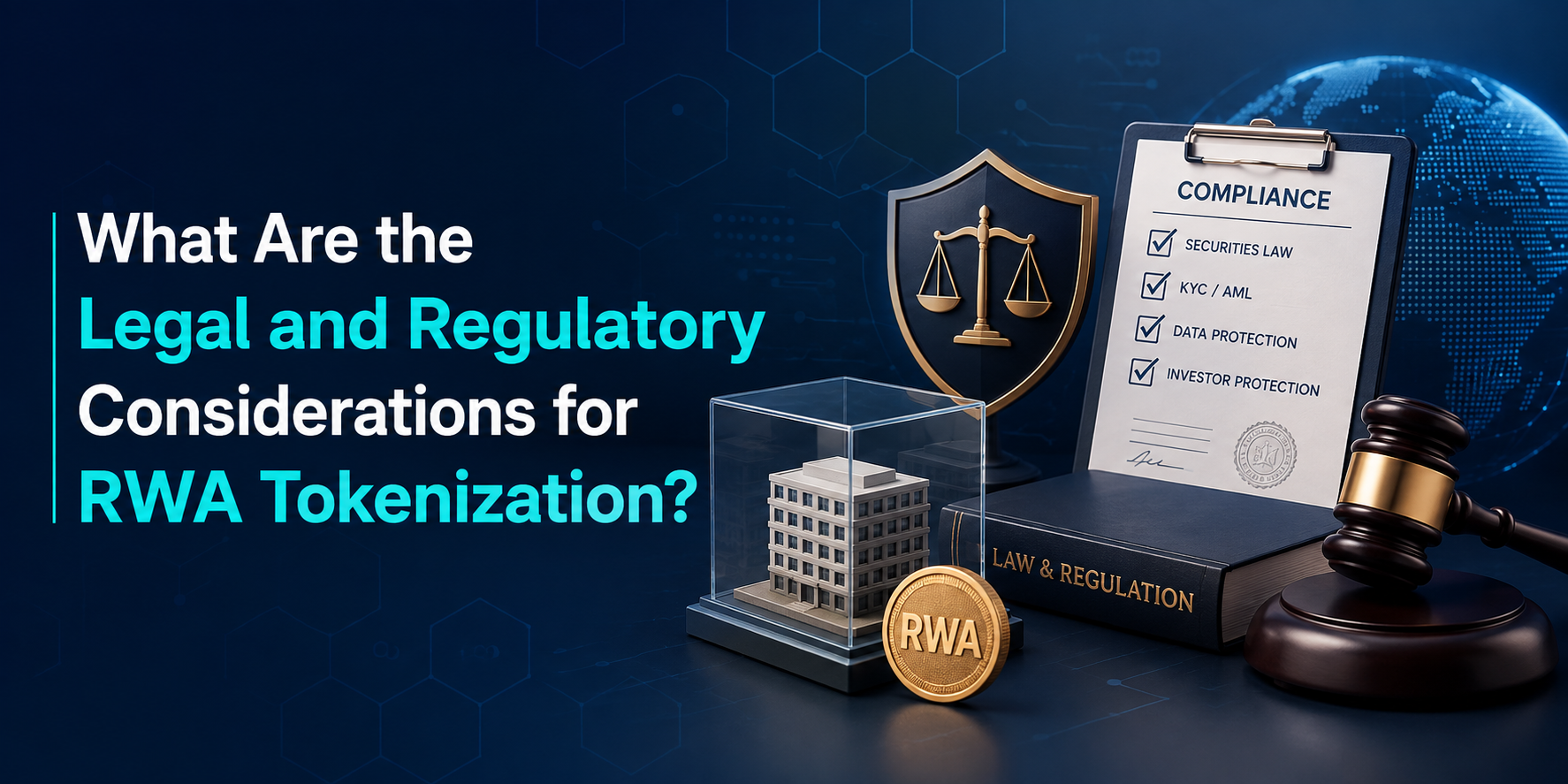
Real-world asset (RWA) tokenization is transforming how ownership and economic rights associated with assets such as real estate, private credit, commodities, securities, funds, and intellectual property can be represented digitally on blockchain networks. Instead of relying entirely on traditional paper-based records and centralized databases, tokenization can create blockchain-based representations of rights connected to an underlying asset. This can potentially improve transferability, transparency, settlement efficiency, and fractional participation.
However, putting an asset on a blockchain does not remove the legal framework surrounding that asset. In fact, tokenization often introduces additional regulatory questions because a project can simultaneously involve securities laws, property law, financial-services regulation, anti-money-laundering requirements, tax rules, data protection, custody obligations, and cross-border restrictions.
The Financial Stability Board (FSB) has noted that tokenization may improve efficiency and transparency but can also introduce vulnerabilities involving liquidity, leverage, asset quality, interconnectedness, and operational resilience as adoption expands. Therefore, regulatory planning needs to be treated as a core part of RWA infrastructure rather than an administrative step added after development.
Understanding the Legal Nature of an RWA Token
The first and arguably most important legal question is: What exactly does the token represent?
An RWA token might represent direct ownership of an asset, an interest in a legal entity that owns the asset, a claim against an issuer, a debt instrument, a fund interest, a contractual right to revenue, or merely an economic exposure to an asset. These structures can have completely different legal consequences.
For example, suppose a company wants to tokenize a commercial building. It could issue tokens representing shares in a special-purpose vehicle (SPV) that owns the building. In that structure, investors may legally own securities in the SPV rather than directly owning portions of the building. Alternatively, a token could represent a contractual claim on rental income. These are economically related but legally distinct arrangements.
This distinction matters because regulators generally focus on the substance and rights attached to an instrument, rather than simply the technology used to issue it. In the United States, the SEC stated in 2025 that tokenized securities remain securities and therefore remain subject to federal securities laws. In January 2026, the SEC further described tokenized securities as financial instruments represented or recorded through crypto networks and recognized that different tokenization structures can provide different rights to holders.
Consequently, businesses should establish the legal classification of an RWA token before designing the token contract, marketplace, investor onboarding process, or distribution strategy.
Securities Laws and Investment Regulations
For many RWA projects, securities regulation represents the most significant compliance consideration.
Tokenized shares, bonds, private credit instruments, investment-fund interests, and fractional interests in certain investment structures may fall within securities regulation depending on the jurisdiction and structure. If the token is treated as a security, the issuer may need to comply with registration requirements or qualify for an applicable exemption.
In the United States, for example, a project may need to evaluate securities-law pathways such as private offerings, Regulation A, Regulation Crowdfunding, or other applicable exemptions. The specific requirements depend on the offering structure, investor type, amount raised, marketing activities, transfer restrictions, and other factors.
Tokenization does not automatically convert a regulated security into an unregulated cryptocurrency. SEC Commissioner Hester Peirce emphasized this point in 2025, noting that blockchain technology does not change the fundamental nature of an underlying security.
This principle has major practical implications. If a property-backed token represents an interest in a company that owns real estate and investors expect returns from the company's efforts, securities considerations may arise even though the underlying asset is physical property.
A compliant RWA project therefore needs legal analysis at the asset level, issuer level, token level, and distribution level.
Real Estate Tokenization and Property Law
Real estate presents an especially complicated regulatory environment because property ownership is governed primarily by national and, in some countries, state or provincial laws.
A blockchain transaction cannot automatically transfer legal title to real estate unless the relevant legal system recognizes the blockchain record and the transaction satisfies applicable property-transfer requirements. This creates an important distinction between token ownership and legal ownership of the underlying property.
One common approach is to establish an SPV or other legal entity that owns the property. Tokens can then represent ownership interests or economic rights associated with that entity. This can simplify certain aspects of fractionalization, but it does not eliminate requirements relating to corporate law, securities regulation, property taxes, registration, financing, or investor rights.
A legally robust structure should clearly answer questions such as:
- Who legally owns the underlying asset?
- What rights does each token holder receive?
- How are income and expenses distributed?
- What happens if the underlying asset is sold?
- What happens if the issuer becomes insolvent?
- Can tokens be transferred freely?
- How are disputes resolved?
- Which jurisdiction's property and contract laws apply?
These questions become especially important when tokenized assets are marketed to investors in multiple countries.
Asset Ownership, Custody, and Legal Enforceability
Another fundamental consideration is whether the issuer actually owns or controls the asset being tokenized.
An RWA platform should establish a verifiable relationship between the physical or traditional asset and the digital token. Otherwise, there is a risk of creating tokens that have unclear, duplicated, or unenforceable claims.
For example, tokenizing gold requires more than creating blockchain tokens with the word "gold" in their name. Investors need clarity about where the gold is stored, who legally owns it, whether it is segregated, how reserves are verified, and how redemption works.
The same principle applies to real estate, invoices, private loans, artwork, commodities, and other assets. Legal documentation, custody arrangements, independent verification, audits, valuation procedures, and clearly defined redemption mechanisms can help establish confidence between the blockchain representation and the underlying asset.
The legal agreement connecting the token to the asset is therefore just as important as the smart contract that records token transfers.
AML, KYC, and Financial Crime Compliance
RWA tokenization can create new channels for transferring financial interests, which makes anti-money-laundering (AML) and know-your-customer (KYC) controls particularly important.
Where an RWA platform falls within the relevant financial-services or virtual-asset regulatory framework, operators may need procedures for identifying customers, assessing risk, monitoring transactions, maintaining records, and reporting suspicious activity.
The Financial Action Task Force (FATF) states that countries should license or register relevant virtual-asset service providers and supervise them similarly to other financial institutions. FATF standards also include customer due diligence, record keeping, suspicious-transaction reporting, and the transmission of originator and beneficiary information under the Travel Rule.
For RWA platforms, this means compliance cannot stop at account creation. A comprehensive framework may need to monitor token transfers, wallet addresses, investor eligibility, geographic restrictions, sanctions exposure, transaction patterns, and secondary-market activity.
The challenge becomes greater when a token can move between multiple blockchain networks. Compliance controls need to account for the actual architecture of the ecosystem rather than assuming that blockchain transparency alone constitutes regulatory compliance.
European Union: MiCA and Existing Financial Regulation
The European Union provides an important example of why token classification is critical.
The Markets in Crypto-Assets Regulation (MiCA) establishes a harmonized framework for certain crypto-assets that are not already covered by existing financial-services legislation. Its framework includes requirements related to transparency, disclosure, authorization, supervision, and market integrity.
However, businesses should not assume that every RWA token falls under MiCA simply because it uses blockchain technology. If a token qualifies as a financial instrument under existing EU financial-services legislation, other regulatory frameworks may apply instead.
MiCA also distinguishes categories such as asset-referenced tokens and e-money tokens. For asset-referenced tokens, the regulation establishes requirements including authorization and reserve arrangements. EU rules require relevant issuers to maintain reserves and segregate those reserves legally and operationally from the issuer's estate.
This illustrates a broader regulatory principle: classification comes before compliance design.
Investor Protection and Disclosure
Investor protection is another central consideration for RWA projects.
Tokenization can make complex investments appear simple because an investor may only need to purchase a digital token. But the underlying economic arrangement may involve property debt, rental income, private credit, development risk, valuation uncertainty, or liquidity constraints.
Investors should therefore receive accurate information about:
- The underlying asset and its valuation
- Ownership and legal structure
- Issuer identity and responsibilities
- Token-holder rights
- Fees and expenses
- Distribution and redemption mechanisms
- Transfer restrictions
- Liquidity limitations
- Material risks
- Conflicts of interest
- Default and insolvency scenarios
- Relevant tax considerations
Marketing materials also need careful review. Claims such as "guaranteed returns," "risk-free real estate," or "instant liquidity" can create significant regulatory and reputational risks if they are unsupported.
The objective should be to ensure that blockchain-based presentation does not obscure the actual investment risks.
Smart Contracts and Technology Governance
Smart contracts are an essential component of many RWA platforms, but code does not replace legal agreements.
A smart contract may automatically transfer tokens, calculate distributions, enforce whitelisting, restrict transfers, or execute corporate actions. However, the legal agreement should establish what happens if the smart contract behaves incorrectly, the underlying asset changes ownership, an oracle supplies inaccurate information, or a blockchain network becomes unavailable.
This creates the need for strong technology governance.
Smart-contract audits, access controls, upgrade mechanisms, oracle security, wallet management, key recovery, transaction monitoring, and incident-response procedures should be considered alongside legal documentation.
The SEC's recent discussion of tokenized securities also highlights that tokenization can be structured in different ways, including issuer-led and third-party models. This makes technical architecture and legal responsibility closely connected.
Data Protection and Privacy
RWA platforms may collect substantial personal and financial information during KYC and investor onboarding. Although blockchain is transparent by design, storing personal information directly on an immutable ledger can create privacy and data-protection challenges.
Businesses should carefully determine what information belongs on-chain and what should remain off-chain.
A common architectural principle is to keep sensitive personal information in compliant off-chain systems while using blockchain for necessary proofs, transaction records, permissions, or references. This can reduce the risk of exposing sensitive information permanently on a public ledger.
The legal requirements will depend on the jurisdictions involved, but privacy should be incorporated into the platform architecture from the beginning rather than addressed after deployment.
Taxation and Accounting Considerations
Tokenization can also create tax and accounting questions.
The tax treatment of token issuance, token transfers, rental income, interest payments, capital gains, dividends, redemption, and secondary-market transactions can vary significantly by jurisdiction. The issuer may also need to determine how the underlying asset and tokenized interests are reflected in financial statements.
For cross-border projects, withholding taxes and reporting requirements can become particularly complicated.
Businesses should therefore obtain jurisdiction-specific tax advice before launching an RWA offering. A technically successful tokenization platform can still face serious financial and compliance problems if its tax structure is poorly designed.
Cross-Border Regulation Is a Major Challenge
One of the most difficult aspects of RWA tokenization is that blockchain networks are inherently global.
An issuer may be based in one country, the underlying asset may be located in another, the blockchain may have globally distributed validators, and investors may live across several jurisdictions. Each jurisdiction may impose different requirements for securities, AML, taxation, consumer protection, and financial licensing.
The FSB has specifically identified cross-border issues and differences in regulatory implementation as ongoing challenges in crypto-asset regulation.
For this reason, an RWA platform should define its geographic target market before launch. Geographic restrictions, investor eligibility rules, wallet whitelisting, transfer controls, and jurisdiction-specific disclosures may be necessary to prevent tokens from being distributed where the issuer is not legally permitted to offer them.
A Practical Compliance Framework for RWA Projects
A well-designed RWA tokenization project should approach compliance as a lifecycle rather than a one-time legal review.
A practical framework can include:
- Identify the underlying asset and verify ownership, valuation, and legal status.
- Determine the token's legal classification in every target jurisdiction.
- Choose an appropriate legal structure, such as an SPV, fund, trust, or other entity where appropriate.
- Define investor rights through legally enforceable agreements.
- Determine securities and licensing requirements before offering or marketing tokens.
- Implement KYC, AML, sanctions, and transaction-monitoring controls where applicable.
- Design smart contracts around legal requirements, including transfer restrictions and compliance rules.
- Secure custody and asset verification arrangements for the underlying assets.
- Create appropriate disclosures and risk statements for investors.
- Establish ongoing monitoring and reporting procedures after launch.
This approach helps prevent a common mistake: building the blockchain platform first and attempting to fit regulatory requirements around it afterward.
The Future of RWA Regulation
RWA tokenization is still developing, and regulatory frameworks are evolving alongside technological adoption. The FSB has observed that current tokenization activity remains relatively small but is growing, while warning that financial-stability implications could become more significant as tokenization scales.
This suggests that future regulation is likely to focus increasingly on interoperability, investor protection, custody, operational resilience, transparency, systemic risk, and cross-border supervision.
For businesses entering the market, regulatory uncertainty should not necessarily be viewed as a barrier. Instead, it can become a competitive differentiator. Projects that establish transparent ownership structures, strong compliance procedures, reliable asset verification, and enforceable investor rights can build substantially more trust than platforms that treat regulation as an afterthought.
Conclusion
RWA tokenization offers a powerful way to connect traditional assets with blockchain infrastructure, but its success depends on much more than smart contracts and digital tokens. Businesses must carefully address securities classification, property rights, ownership verification, investor protection, AML/KYC, taxation, privacy, custody, smart-contract governance, and cross-border regulation. Because the regulatory treatment depends heavily on the asset, token structure, investor base, and jurisdiction, professional legal and compliance advice should be obtained before launching an offering. For businesses planning to enter this market, working with an experienced technology provider can also help translate regulatory requirements into practical platform features. Blockchain App Factory provides best RWA tokenization services and can support businesses in developing secure, scalable, and compliance-oriented tokenization platforms tailored to their project requirements.

 English
 Arabic
 French
 Spanish
 Portuguese
 Deutsch
 Turkish
 Dutch
Dutch
 Italiano
 Russian
 Portuguese (Brazil)
 Greek
Greek