

Multi-Pickup, Multi-Drop Route Planning and How It Can Help You Scale
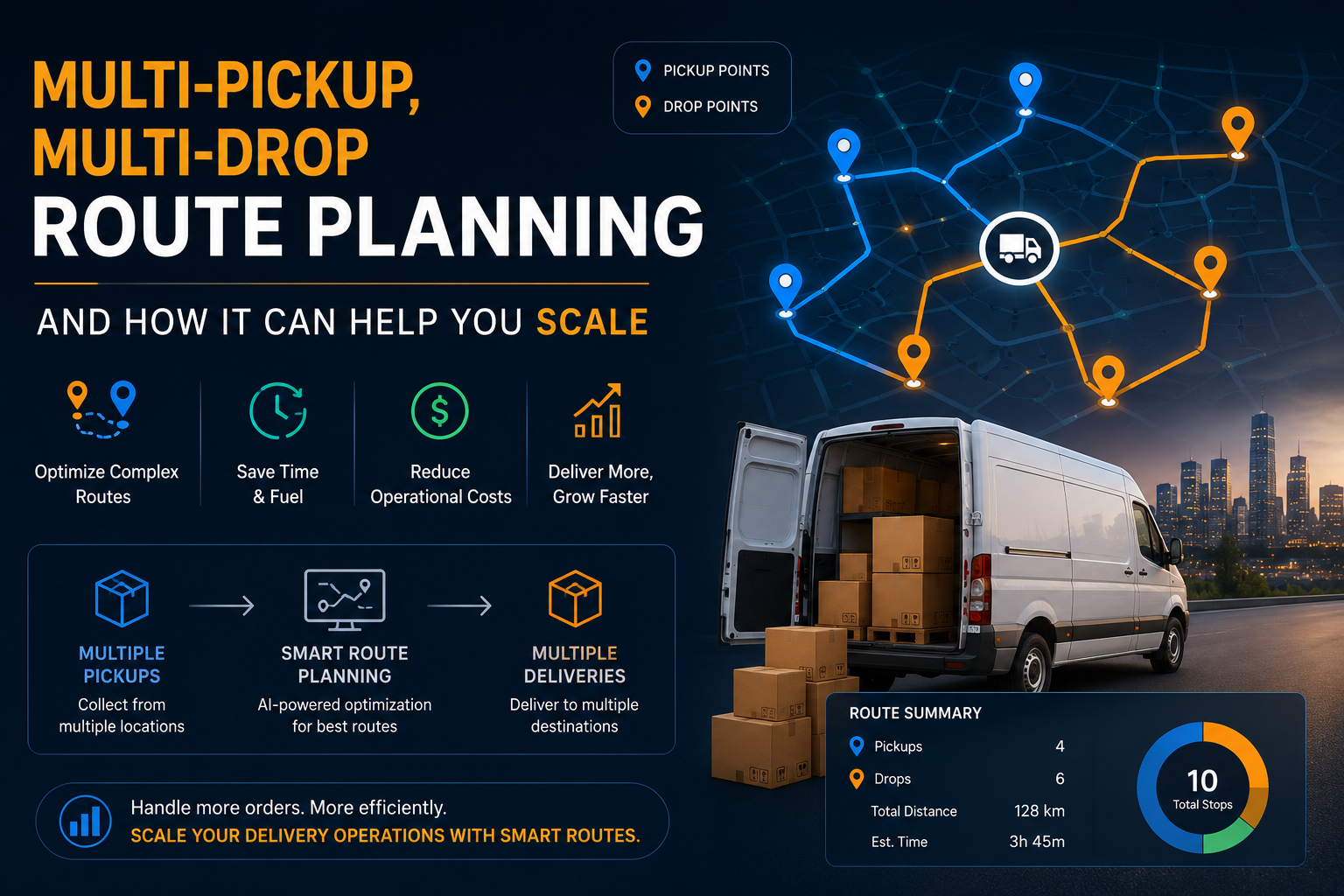
Multi-Pickup, Multi-Drop Route Planning and How It Can Help You Scale
When your delivery service only has to make a couple of stops, it is not difficult to plan out your weekly routes. But when orders begin piling up, you might find yourself making multiple pickups and drops along complex itineraries
Multi-pickup, multi-drop route planning can solve many of these issues, streamlining your operations so you can dedicate more resources to growing your business.
But how do the mechanics of multi-stop route planning actually work?
We review what it is and how your business can benefit from using a delivery tracking app for multi-drop planning and execution.
What Is Multi-Pickup, Multi-Drop Delivery
Multi-pickup, multi-drop delivery refers to a set of orders that involve multiple pickups and multiple drops in the same route
For instance, a local bakery could have several branches that place an order with the main office and then require delivery to various customers. Instead of having to send out different drivers or making several tiny itineraries, a dispatcher could use a delivery tracking app to consolidate pickups and drops into one seamless delivery plan
The complexity of such itineraries is difficult to overstate.
Your application will need to plan out the most efficient pickups and delivery order based on addresses, traffic patterns, delivery windows, customer preferences, and other considerations. In short, you will need to make several complicated trade-offs in order to arrive at your destination on time.
Why Can’t You Just Plan These Itineraries Manually
If you only had to make a few deliveries each day, using an imaginary map or even spreadsheet to track your stops would not be out of reason.
But as soon as you acquire more customers and orders begin stacking up, managing these itineraries becomes a full-time task in and of itself.
For instance, as a dispatcher, you might need to make numerous decisions throughout the day, including
- which driver gets which order,
- which pickups need to occur first in order to avoid wasting gas,
- if drivers can combine certain deliveries to reduce overall mileage,
- whether your drivers will arrive at their destination within the specified window
Manual planning also means an increased chance of human error. If one of your drivers misses a stop or has to double back because of a poorly-planned itinerary
In short, manual planning becomes an operation in and of itself, sapping your time and resources. A delivery tracking app can free you up to focus on your core competency: running your delivery business.
A delivery tracking app could help plan these itineraries intelligently based on vehicle location, pickup and drop-off addresses, traffic, capacity constraints, delivery time windows, driver availability, and other considerations
How Can a Delivery Tracking App Help You Consolidate Stops and Drops
One of the primary benefits of multi-stop delivery planning is that you can combine several small itineraries into one large one, drastically reducing wasted time and resources. Say there are three customers in the same neighborhood.
You could dedicate one driver to making all three stops, instead of having to spend time and money hiring three drivers altogether
This would reduce fuel consumption and other expenses, such as time spent waiting at traffic lights or between pickups. It can be especially helpful for a delivery tracking app for small business ,where you have fewer vehicles at your disposal.
In other words, a delivery tracking app can help you get more bang for your buck by using existing assets in a more optimal manner.
But how can you expect to plan these itineraries in an efficient manner?
The next section will explore how you can use the best practices of delivery route optimization to create useful, effective itineraries that all your drivers can understand.
The Challenges of Multi-Stop Route Planning Explained
Even with the best planning, it is difficult to account for all of life’s uncertainties.
Road closures, weather delays, customer rescheduling, mechanical failures, or missed pickups can all throw even your most carefully-crafted itineraries out the window
This is why it is important to have contingency planning procedures in place. This is especially true when using automation in your operations: having an easy override option is always going to be more useful than a rigid, unchangeable plan.
A delivery tracking app can help your drivers and planners visualize their progress throughout the day as it happens, so they can make adjustments as needed.
How Can Dispatchers and Drivers Stay in the Loop
Good multi-stop route planning is not solely a boon to managers and owners; drivers are also likely to appreciate a streamlined, consolidated itinerary that does not involve doubling back or meandering through the streets searching for a curb.
Many delivery tracking applications also allow drivers to access their routes through a mobile application
This lets managers, planners, and drivers collaborate in the same space, helping to reduce misunderstandings and wasted time. Furthermore, drivers can submit reports to update their status and modify the itineraries in real-time.
For drivers who make multiple pickups and drops, this feature could be a lifesaver
It removes any confusion regarding the customer instructions, delivery orders, and navigation directions all in one place.
But what about consumers? How does a route planning software serve to benefit them?
Without a crystal ball, it is difficult to plan out absolutely every contingency. Even the best-laid plans can be thwarted by road closures, weather delays, customer rescheduling, and driver or vehicle malfunctions. These are all valid reasons for late deliveries, but customers are far more likely to be forgiving if they can see exactly where their product is and when it is expected to reach their doorstep
A delivery tracking application can help you relay this kind of information to your customers in real-time.
Why Your Small-Scale Business Can't Wait to Adopt Route Optimization
The truth is, there really is no good time to adopt new technologies. But when it comes to multi-drop planning and execution, the sooner, the better.
You may not think that route optimization is necessary for your small-scale logistics venture, but this is a prime opportunity to gain an edge on the competition by adopting emerging technologies before they become commonplace
A delivery tracking app for small business is even more important than for larger concerns, since you are likely to have fewer drivers and less administrative support to plan out your itineraries
In short, route optimization can reduce the amount of busywork you have to deal with for growing businesses. A delivery tracking app can also help you scale more easily as you invest more money and resources into your enterprise.
Before making the leap, it is important to examine the fine print of whatever application you are considering. Things to ask yourself include
- Whether the application can execute multi-pickup, multi-drop route planning
- If dispatchers can track drivers in real-time
- If it has tools for automating dispatches,
- Driver mobile apps,
- Customer notifications or proof of delivery,
analyzing delivery performance data,
or modifying existing plans.
Your software application needs to do more than just fulfill your logistical needs; it should help your business grow in a sustainable manner rather than introducing a new set of artificial constraints.
In Summary
Multi-pickup, multi-drop delivery is a complicated set of itineraries that can consume your planners and dispatchers, tying their resources in knots.
A delivery tracking application can streamline your operations, allowing you to reduce overhead while continuing to grow steadily. Route planning applications can do this by optimizing delivery routes, providing drivers with a real-time view of the road, delivering updates and notifications to customers, and streamlining logistical concerns so that managers and owners can focus on running their enterprises.
A delivery tracking app for small business is just as viable as one for a larger enterprise, since both need to reduce their overhead as much as possible in order to make a profit. As your workload increases, multi-stop route planning and execution become even more important. It becomes difficult to keep up with demand while also keeping to your delivery constraints and making a profit.
After all, your delivery business is not only about getting from point A to point B.
It is about connecting all of those As and Bs in the most optimal way possible.

 English
 Arabic
 French
 Portuguese
 Deutsch
 Turkish
 Dutch
Dutch
 Italiano
 Russian
 Romaian
 Portuguese (Brazil)
 Greek
Greek