Introduction
A Labour Delivery Recovery Room should provide a safe and organized environment for monitoring mothers and, where required, supporting immediate newborn care after labour, delivery, or related procedures. The arrangement needs to account for maternal observation, vital-sign monitoring, pain management, emergency preparedness, infection control, privacy, staff movement, and access to essential medical infrastructure. When newborn care is also required, appropriate equipment and space should be incorporated without compromising the mother's recovery or clinical access.
Maternal Bed Arrangement
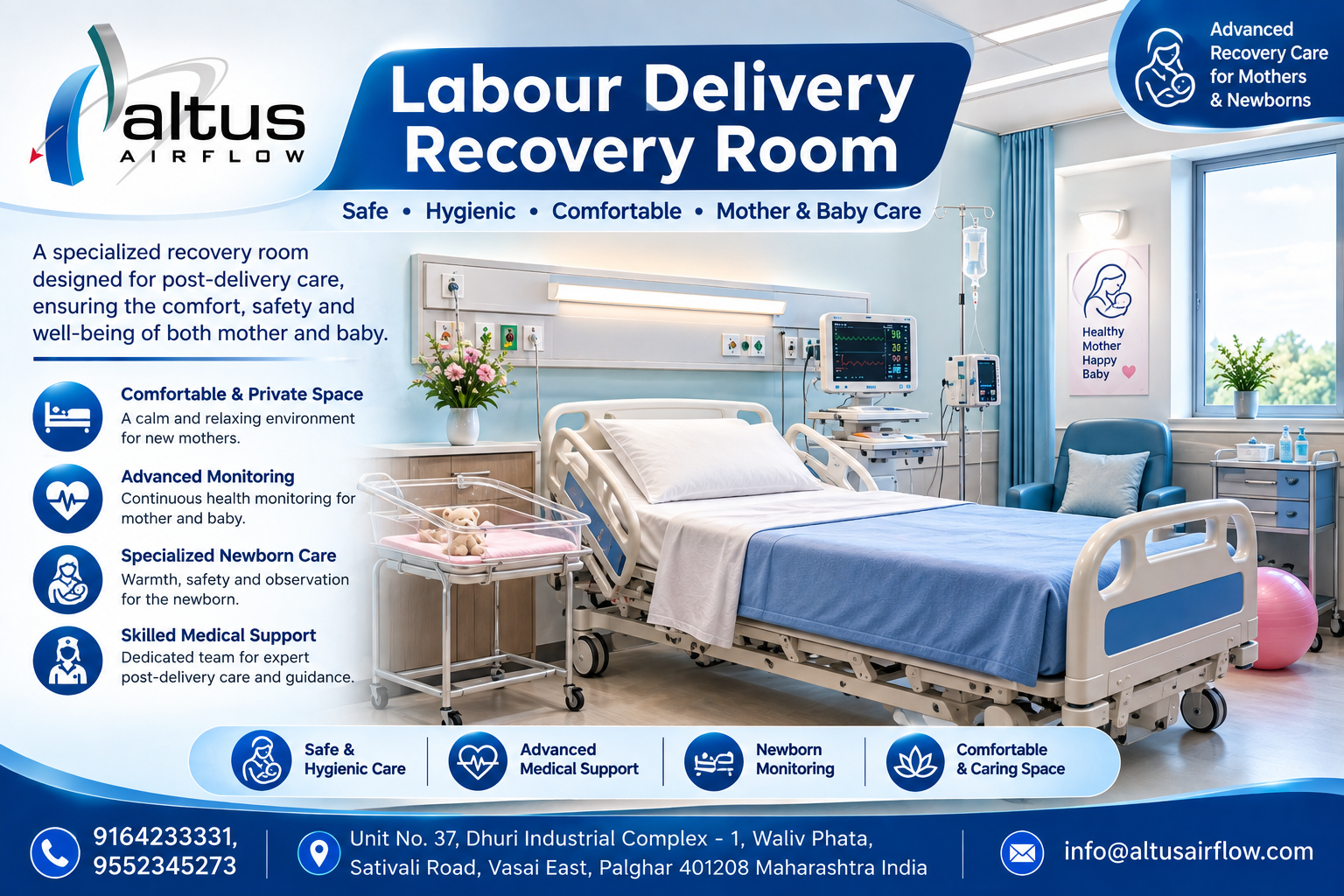
The recovery bed should be positioned to provide healthcare professionals with convenient access from appropriate sides.
Adequate surrounding space allows staff to perform assessments, administer treatments, and respond to emergencies efficiently.
Patient Monitoring
Maternal recovery may require monitoring of blood pressure, heart rate, oxygen saturation, respiratory rate, temperature, and other clinical parameters.
Monitoring equipment should be positioned for convenient access and visibility.
Newborn Care Provision
Where immediate newborn assessment is performed in the same area, suitable space and equipment should be planned.
The arrangement should prevent newborn-care activities from interfering with maternal monitoring and emergency access.
Medical Gas Access
Depending on clinical requirements, the room may require oxygen, medical air, and vacuum.
Outlets should be positioned close enough to the patient and clinical equipment while keeping circulation areas clear.
Oxygen Support
Oxygen may be required for maternal or newborn support in certain situations.
Appropriate oxygen delivery equipment and infrastructure should therefore be readily accessible where clinically indicated.
Suction Facilities
Suction equipment may be required for airway management or other clinical interventions.
Central vacuum outlets or portable suction systems can be incorporated according to the services provided.
Emergency Equipment
The room should provide quick access to appropriate emergency resources.
These may include maternal and neonatal resuscitation equipment, emergency medications, oxygen, suction, defibrillation equipment, airway supplies, and other resources according to hospital protocols.
Maternal Resuscitation Readiness
The arrangement should allow staff to respond quickly if a mother's condition changes.
Emergency equipment should remain accessible without obstructing the bed or main circulation routes.
Newborn Resuscitation Area
If newborn resuscitation is expected within the recovery environment, a designated area can be planned with suitable warming, oxygen, suction, monitoring, and resuscitation equipment.
Infection-Control Measures
Labour and delivery environments require strong infection-prevention practices.
The recovery room should support hand hygiene, cleanable surfaces, appropriate equipment organization, suitable patient spacing, and controlled movement.
Privacy Arrangements
Patients may require examinations, personal care, and breastfeeding support.
Curtains, screens, partitions, or individual recovery spaces can provide privacy while preserving necessary clinical visibility.
Lighting
Adequate lighting supports maternal assessment and clinical procedures.
Adjustable lighting can also help create a more comfortable environment for mothers and newborns during routine recovery.
Temperature Control
Appropriate environmental temperature is important for maternal comfort and newborn care.
HVAC systems should be designed according to the room's clinical function and applicable healthcare requirements.
Ventilation
Ventilation, filtration, airflow, humidity, and pressure relationships should be appropriately planned.
Qualified HVAC professionals should coordinate these systems with the overall healthcare facility design.
Noise Management
Noise can affect patient comfort and communication.
Equipment placement, acoustic considerations, alarm management, and staff practices can help reduce unnecessary noise while maintaining important clinical alerts.
Nursing Station
A nursing or observation station should provide convenient access to patient information and communication facilities.
Its position should support effective observation without obstructing clinical movement.
Staff Workflow
The room should accommodate the movement of obstetricians, nurses, anesthesiology teams, pediatric professionals, and other authorized staff.
Patient beds, equipment, medication areas, storage, and emergency resources should be arranged to support efficient workflow.
Storage
Essential supplies should be readily accessible.
Storage can accommodate maternal care supplies, newborn-care equipment, medications, protective equipment, monitoring accessories, linens, and emergency resources.
Electrical Infrastructure
The room may contain several electrically powered devices.
Appropriate outlets, grounding, essential circuits, equipment connections, cable management, and backup power should be planned according to applicable requirements.
Monitoring and Communication Systems
Communication infrastructure can support coordination with labour rooms, operating theatres, neonatal units, laboratories, wards, and other departments.
Nurse call systems, telephones, intercoms, and approved data connections can be incorporated as required.
Safe Movement and Transfers
Mothers and newborns may need to be transferred to wards, neonatal units, operating theatres, or other areas.
Doorways, corridors, lifts, and turning spaces should support beds, stretchers, newborn equipment, staff, and accompanying caregivers.
Family and Caregiver Support
Depending on hospital policies, appropriate seating or space for an accompanying partner or caregiver can improve the recovery environment.
These provisions should be balanced with privacy, infection control, and clinical workflow.
Equipment Integration
Medical equipment should be positioned so that it remains accessible without creating congestion.
Wall- or ceiling-mounted supports may help organize selected equipment and utilities where suitable.
Flexible Infrastructure
Healthcare requirements can change as maternity services develop.
Flexible infrastructure can make it easier to modify equipment arrangements, upgrade monitoring technologies, or adapt selected utilities in the future.
Maintenance Access
Electrical systems, medical gas connections, HVAC components, communication infrastructure, and equipment supports should remain accessible for inspection and maintenance.
Testing and Commissioning
Before the room becomes operational, relevant infrastructure should be tested and commissioned.
This can include medical gases, electrical systems, emergency power, HVAC, communication systems, monitoring connections, and equipment supports according to project scope.
Conclusion
A Labour Delivery Recovery Room should be arranged around maternal safety, effective observation, rapid emergency response, infection control, privacy, and efficient clinical workflow. Important provisions can include suitable patient bedspaces, maternal and newborn monitoring, medical gases, suction, emergency and resuscitation equipment, electrical infrastructure, appropriate lighting and ventilation, storage, communication systems, and safe transfer routes. The final arrangement should be developed according to the hospital's maternity services, patient requirements, available space, clinical protocols, and applicable healthcare standards.
FAQs
1. What arrangements are important in a Labour Delivery Recovery Room?
Important arrangements include maternal bedspaces, monitoring, medical gases, suction, emergency equipment, newborn support, infection control, privacy, storage, communication, lighting, ventilation, and clear staff circulation.
2. Should newborn care be accommodated in the recovery room?
Where the clinical service requires immediate newborn assessment or support, an appropriately equipped newborn-care area can be incorporated without compromising maternal care.
3. Why is emergency access important?
Maternal or newborn conditions can change quickly. Clear access to patients and emergency equipment helps healthcare professionals respond promptly according to established clinical protocols.
4. How can patient privacy be maintained?
Curtains, screens, partitions, or individual recovery spaces can provide privacy during examinations and personal care while maintaining suitable clinical observation.
5. What infrastructure supports equipment in the recovery room?
Depending on clinical requirements, infrastructure may include medical gases, vacuum, electrical outlets, monitoring connections, communication systems, equipment supports, and appropriate environmental controls.
Read Our Previous Blog----------->How does a Post Operative Recovery Room support patients during the initial recovery phase?




 English
 Arabic
 French
 Spanish
 Portuguese
 Deutsch
 Turkish
 Dutch
Dutch
 Italiano
 Russian
 Romaian
 Portuguese (Brazil)
