


What Makes a Website Look Professional in 2026?
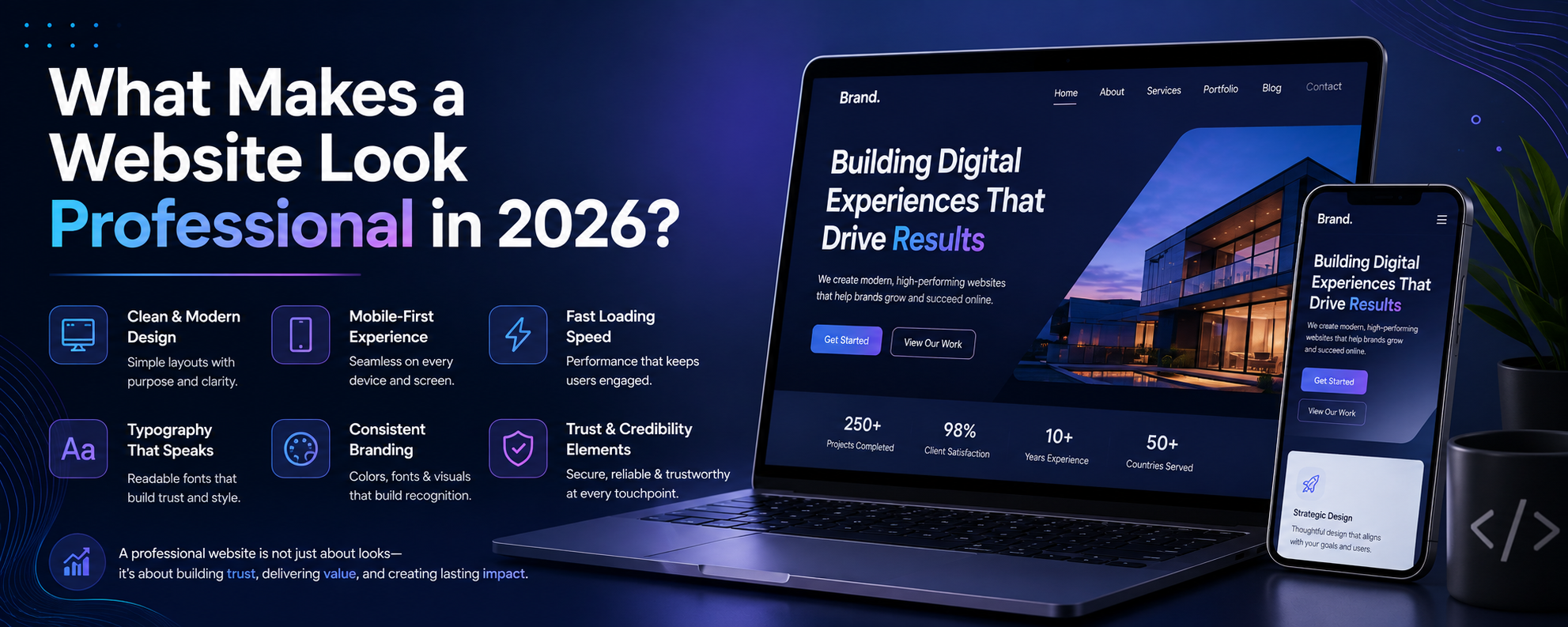
In 2026, a professional website is no longer simply a digital business card. It is one of the most important parts of a brand’s identity, credibility, and customer experience. Whether you run a small business, an e-commerce store, a consultancy, or a large company, visitors often form their first impression of your business based on your website.
Modern users expect websites to be fast, attractive, easy to navigate, mobile-friendly, secure, and useful. A website that looks outdated, loads slowly, or is difficult to use can cause potential customers to leave within seconds. On the other hand, a well-designed website can build trust, communicate professionalism, increase engagement, and encourage visitors to take action.
So, what exactly makes a website look professional in 2026? From clean visual design and mobile-first layouts to artificial intelligence, accessibility, performance, and strong branding, several factors now influence how users perceive a website.
1. A Clean and Modern Visual Design
One of the first things visitors notice is the overall appearance of a website. Professional websites in 2026 generally avoid unnecessary visual clutter. Instead, they focus on simplicity, balance, and clear communication.
A clean design gives every important element enough space to breathe. This includes headings, images, buttons, paragraphs, icons, and navigation menus. Excessive animations, too many colors, crowded layouts, and confusing graphics can make a website appear less professional.
Modern websites often use:
- Plenty of white space
- Clear typography
- Consistent color schemes
- High-quality images
- Simple navigation
- Strong visual hierarchy
- Well-designed buttons and calls to action
The goal is not to make a website look complicated. The goal is to make it look intentional.
A professional website should guide visitors naturally from one section to another. Users should immediately understand what the business offers, why it matters, and what they should do next.
2. Mobile-First Design Is Essential
In 2026, mobile responsiveness is no longer an optional feature. A large portion of website traffic comes from smartphones and tablets, so businesses need to ensure that their websites work perfectly on smaller screens.
A professional website should automatically adapt to different screen sizes. Text should remain readable, buttons should be easy to tap, images should fit properly, and menus should be simple to use.
Mobile-first design means thinking about the mobile experience from the beginning rather than creating a desktop website and trying to fix it for smartphones later.
For businesses working with a Web Designer in Dubai, mobile-first development should be an important part of the design process. Dubai has a highly competitive digital marketplace, and businesses need websites that provide a smooth experience to users regardless of the device they use.
3. Fast Loading Speed
A beautiful website is not professional if it takes too long to load.
Website speed directly affects user experience. Visitors expect pages to appear quickly, especially when they are browsing from mobile devices. If a website is slow, users may leave before they even see the main content.
Professional websites in 2026 focus heavily on performance optimization. This can include:
- Compressing images
- Using modern image formats
- Minimizing unnecessary code
- Reducing excessive animations
- Optimizing fonts
- Using efficient hosting
- Improving server response times
- Loading important content quickly
Speed also matters for search engine visibility. Search engines consider user experience and performance when evaluating websites, so a fast website can support both SEO and conversions.
4. Strong and Consistent Branding
A professional website should feel like an extension of the brand.
Colors, fonts, imagery, logos, icons, and writing style should work together consistently. When visitors move from the homepage to an inner page, they should feel that they are still interacting with the same company.
Strong branding helps businesses become memorable. For example, a company may use a specific color palette, typography style, photography approach, and tone of voice across its website and social media channels.
A professional website does not need dozens of design elements. Instead, it needs a consistent visual identity that communicates the company's personality and values.
5. Easy and Intuitive Navigation
Visitors should not have to work hard to find information.
A professional website should have a clear navigation structure. Important pages such as About, Services, Products, Contact, and FAQs should be easy to find.
Navigation should also be logical. If visitors cannot quickly understand where to click, they may become frustrated and leave.
Modern websites often use simple navigation menus with clearly labeled sections. On mobile devices, navigation should be equally straightforward.
A good rule is to make important information accessible within a few clicks. The fewer obstacles visitors face, the better the overall user experience.
6. High-Quality Content
Professional design alone cannot make a website successful. Content is equally important.
In 2026, users expect websites to provide useful, clear, and relevant information. Generic content filled with unnecessary marketing language can reduce trust.
Professional website content should answer the questions visitors are likely to have.
For example:
- What does the company offer?
- Who are its customers?
- What makes the company different?
- How does the service work?
- How much does it cost, if pricing is available?
- Why should customers trust the business?
- How can visitors contact the company?
Headings, short paragraphs, bullet points, and visual content can make information easier to understand.
Content should also be written for humans first. While SEO is important, keyword stuffing can make a website sound unnatural and reduce credibility.
7. Clear Calls to Action
A professional website should have a clear purpose.
If the goal is to generate leads, visitors should easily find a “Get a Quote,” “Contact Us,” or “Book a Consultation” button. If the website sells products, “Add to Cart” and “Buy Now” should be easy to identify.
Calls to action should stand out without looking aggressive.
Good CTA examples include:
- Get Started
- Request a Quote
- Book a Consultation
- Explore Services
- Contact Our Team
- Shop Now
- Learn More
The key is to tell visitors what they can do next.
8. Professional Photography and Visuals
Images have a major influence on how users perceive a website.
Low-quality, blurry, outdated, or irrelevant images can make even a well-designed website appear unprofessional. Businesses should use high-quality photography, illustrations, graphics, or carefully selected stock images that match their brand.
In some industries, original photography can make a particularly strong impression. For example, restaurants can showcase their food and interiors, construction companies can display completed projects, and professional service businesses can use team photography.
Visuals should support the content rather than distract from it.
9. Smart Use of Animation and Micro-Interactions
Animation is becoming more sophisticated in 2026. However, professional web design is not about adding movement everywhere.
Small animations can improve the user experience when they provide useful feedback. For example, a button might subtly change when a user hovers over it, or a section might smoothly appear as the visitor scrolls.
These details are known as micro-interactions. When used correctly, they make websites feel polished and modern.
However, excessive animation can slow down a website and distract visitors. Professional design means knowing when to use animation and when to keep things simple.
10. Accessibility Matters
A truly professional website should be usable by as many people as possible.
Accessibility means designing websites that can be used by people with different abilities and assistive technologies. This can include providing suitable color contrast, readable text, keyboard navigation, meaningful image descriptions, and properly structured content.
Accessibility is not just about compliance. It is also about creating a better experience for everyone.
Clear typography, good contrast, simple navigation, and readable content can benefit all users, not just those with accessibility requirements.
11. Security Builds Trust
Visitors want to know that a website is safe.
A professional website should use HTTPS, maintain updated software, protect forms, and follow appropriate security practices. For websites that collect customer information or process payments, security becomes even more important.
Trust signals can also include:
- Secure payment options
- Privacy policies
- Clear contact information
- Terms and conditions
- Customer reviews
- Business addresses where appropriate
- Recognized certifications or memberships
When users feel safe, they are more likely to engage with a business.
12. AI-Powered Personalization and Features
Artificial intelligence is influencing web design in many ways in 2026.
Businesses can use AI-powered features to improve customer experiences. Examples include intelligent chat assistants, personalized recommendations, automated customer support, smart search, and dynamic content.
However, AI should be used strategically. Adding an AI chatbot simply because it is trendy does not automatically make a website professional.
The technology should solve a genuine customer problem. If visitors can get answers faster or find products and services more easily, AI can add real value.
13. Professional Website Design Requires a Strong User Experience
User experience, commonly called UX, is one of the biggest factors separating an average website from a professional one.
UX involves understanding how visitors interact with a website and removing unnecessary friction.
For example, if a contact form asks for ten unnecessary pieces of information, users may abandon it. If an e-commerce checkout requires too many steps, customers may not complete their purchases.
Professional UX focuses on making important tasks simple.
This is why businesses often work with a specialized Web Design Company Dubai that understands modern user expectations, responsive design, branding, SEO, and conversion-focused layouts.
14. SEO-Friendly Structure
A professional website should also be built with search engines in mind.
SEO-friendly web design includes proper heading structures, descriptive page titles, optimized images, internal links, readable URLs, useful content, mobile responsiveness, and good performance.
Search engine optimization should not be treated as something added after a website is finished. It is much more effective when SEO considerations are included during the design and development process.
For businesses targeting customers in Dubai and the wider UAE market, local SEO can also be important. Location-specific pages, relevant business information, and locally useful content can help companies reach potential customers searching for their services.
15. Trust and Social Proof
People naturally look for evidence before choosing a business.
Professional websites use social proof to reduce uncertainty. This may include customer testimonials, reviews, case studies, client logos, awards, certifications, project portfolios, or statistics.
For example, instead of simply saying “We provide excellent web design,” a company could showcase previous projects and explain the results achieved.
Real evidence is generally more persuasive than exaggerated claims.
16. A Website Should Feel Current in 2026
Web design trends change quickly. A website that looked modern several years ago may now feel outdated.
That does not mean businesses need to redesign their websites every few months. Instead, they should regularly review typography, layouts, functionality, technology, content, security, and performance.
A modern website should feel maintained and active. Outdated information, broken links, old copyright dates, missing images, or abandoned blog sections can negatively affect credibility.
Regular updates demonstrate that the business cares about its online presence.
Conclusion
So, what makes a website look professional in 2026?
It is not one single feature. Professionalism comes from combining several elements into one seamless experience. A modern website should have a clean visual design, fast performance, mobile-first responsiveness, strong branding, intuitive navigation, useful content, clear calls to action, high-quality visuals, accessibility, security, and an effective SEO foundation.
The best websites do more than look attractive. They make it easy for visitors to understand a business, trust its services, and take action.
For businesses operating in Dubai's competitive market, investing in professional web design can make a significant difference. Working with an experienced Web Designer in Dubai or a reliable Web Design Company Dubai can help ensure that a website not only looks modern but also performs effectively across devices and supports business goals.
Ultimately, a professional website in 2026 should feel fast, trustworthy, useful, accessible, and effortless to navigate. When design and functionality work together, a website becomes more than an online presence—it becomes a powerful tool for building credibility, attracting customers, and growing a business.

 English
 Arabic
 Spanish
 Portuguese
 Deutsch
 Turkish
 Dutch
Dutch
 Italiano
 Russian
 Romaian
 Portuguese (Brazil)
 Greek
Greek