


Albert Einstein IQ and the Science of Measuring Intelligence
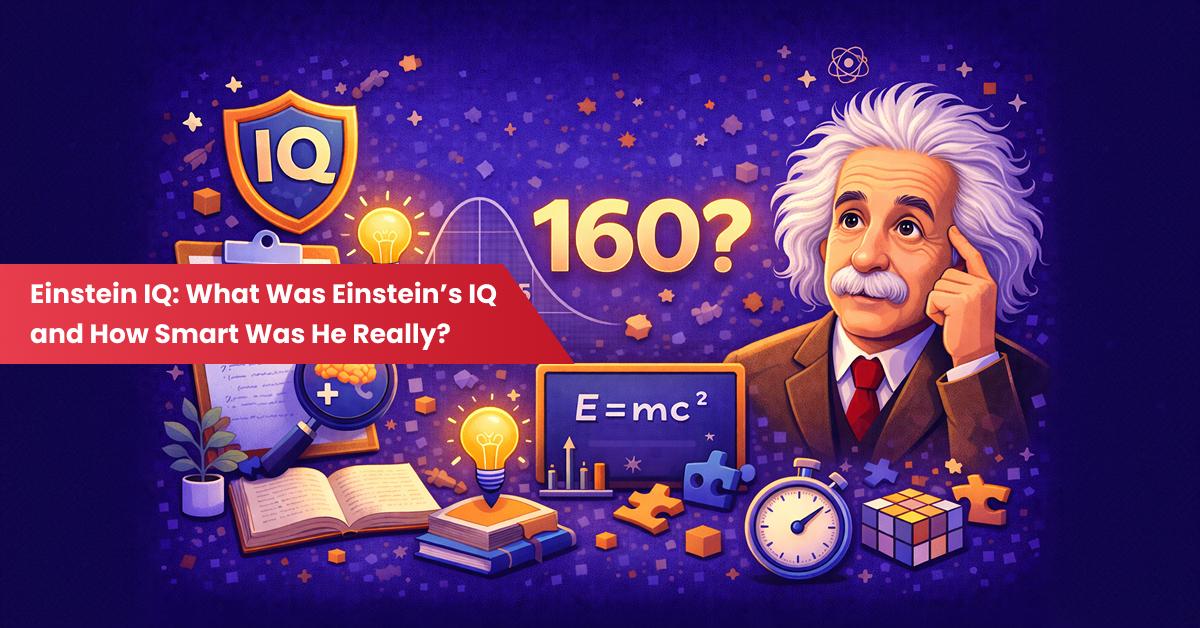
Albert Einstein is one of the most influential scientists in human history. His groundbreaking discoveries transformed physics and changed the way people understand space, time, gravity, and the universe. Because of his remarkable achievements, many people search for Albert Einstein IQ to learn whether his intelligence can be measured by a simple number.
The fascination with Einstein's intelligence has led to countless claims about his IQ, with some sources confidently assigning him scores of 160, 180, or even higher. However, the reality is much more complex. Einstein never took a modern standardized IQ test, so no official score exists. Instead, historians and psychologists estimate his intelligence by examining his achievements, reasoning ability, and scientific contributions.
This article explores Albert Einstein IQ, explains how intelligence is measured, examines the science behind IQ testing, and discusses why Einstein's genius cannot be fully captured by a single score.
Who Was Albert Einstein?
Albert Einstein was born on March 14, 1879, in Ulm, Germany. From a young age, he demonstrated a deep curiosity about mathematics, science, and the natural world. Although he sometimes challenged traditional teaching methods, he excelled in subjects that captured his interest.
Einstein became internationally famous after publishing the Theory of Special Relativity in 1905. A decade later, he expanded these ideas through the Theory of General Relativity, fundamentally changing humanity's understanding of gravity and the structure of the universe.
In 1921, he received the Nobel Prize in Physics for explaining the photoelectric effect, a discovery that helped establish modern quantum theory.
His scientific work continues to influence physics, astronomy, engineering, and many modern technologies.
What Does IQ Mean?
To understand Albert Einstein IQ, it helps to first understand what IQ actually measures.
IQ stands for Intelligence Quotient. It is a standardized score designed to estimate cognitive abilities compared with other people in the same age group.
Modern IQ tests evaluate several mental abilities, including:
-
Logical reasoning
-
Pattern recognition
-
Mathematical thinking
-
Verbal comprehension
-
Working memory
-
Processing speed
-
Spatial reasoning
These abilities combine to create an overall estimate of cognitive performance.
The average IQ score is 100. Scores above 130 are generally considered gifted, while scores above 145 are exceptionally uncommon.
However, IQ tests are not designed to measure every aspect of intelligence. Creativity, emotional intelligence, imagination, leadership, practical wisdom, and artistic talent all contribute to human ability but fall largely outside the scope of traditional IQ assessments.
Did Albert Einstein Ever Take an IQ Test?
One of the biggest misconceptions surrounding Albert Einstein IQ is that his score was officially recorded.
The truth is that Albert Einstein never completed a modern standardized IQ test.
During his lifetime, intelligence testing was still evolving, and there is no historical evidence showing that he participated in an assessment similar to those used today.
As a result, every published IQ number associated with Einstein is speculative.
There is simply no official document confirming his intelligence quotient.
Estimated Albert Einstein IQ
Although no verified score exists, many historians and psychologists estimate Albert Einstein IQ to have been between 160 and 190.
These estimates are based on several factors, including:
-
His revolutionary scientific discoveries
-
His mathematical reasoning
-
His problem-solving ability
-
His creativity
-
His influence on modern science
These estimates should not be mistaken for factual measurements.
Instead, they represent informed opinions based on Einstein's extraordinary accomplishments.
How Modern IQ Tests Measure Intelligence
The science of intelligence testing has advanced significantly over the past century.
Modern IQ assessments are carefully designed using psychological research and statistical analysis.
Professional intelligence tests measure multiple cognitive domains rather than relying on a single type of question.
Common sections include:
Verbal Comprehension
This measures understanding of language, vocabulary, and verbal reasoning.
Working Memory
Working memory evaluates the ability to temporarily store and manipulate information while solving problems.
Processing Speed
This section measures how quickly a person can process simple information accurately.
Perceptual Reasoning
These tasks involve recognizing patterns, solving visual puzzles, and understanding spatial relationships.
Together, these areas provide a comprehensive picture of cognitive ability.
Why IQ Tests Are Standardized
Professional IQ tests follow strict procedures to ensure fairness and consistency.
Standardization means every participant:
-
Receives identical instructions
-
Completes the same types of tasks
-
Has similar testing conditions
-
Is scored using the same statistical methods
These controls allow psychologists to compare scores across different individuals accurately.
Without standardization, IQ scores would have little scientific value.
What IQ Tests Cannot Measure
Although IQ testing has become increasingly sophisticated, it still has important limitations.
Traditional intelligence tests do not fully measure:
-
Creativity
-
Emotional intelligence
-
Motivation
-
Curiosity
-
Leadership
-
Practical decision-making
-
Artistic ability
-
Social skills
Einstein demonstrated many of these qualities throughout his life.
His extraordinary imagination may have contributed just as much to his success as his reasoning ability.
Why Einstein Is Considered a Genius
The reputation surrounding Albert Einstein IQ comes primarily from his achievements rather than any estimated score.
Several characteristics distinguished him from other scientists.
Revolutionary Thinking
Einstein developed theories that completely transformed modern physics.
His ideas about relativity fundamentally changed scientific understanding.
Very few researchers have reshaped an entire scientific discipline so dramatically.
Creative Imagination
Einstein frequently used thought experiments to explore scientific questions.
Instead of relying only on laboratory experiments, he imagined unusual scenarios that revealed deeper physical principles.
One famous thought experiment involved imagining himself traveling beside a beam of light.
These imaginative exercises eventually contributed to Special Relativity.
Exceptional Mathematical Insight
Einstein successfully combined advanced mathematics with observations about the natural world.
This rare combination allowed him to solve problems that had challenged scientists for generations.
Lifelong Curiosity
Einstein never stopped asking questions.
His curiosity motivated decades of scientific exploration and continuous learning.
Common Myths About Albert Einstein IQ
Many popular stories surrounding Albert Einstein IQ are not supported by historical evidence.
Myth 1: Einstein Had an Official IQ of 160
No official record confirms this number.
The commonly repeated figure is simply an estimate.
Myth 2: Einstein Failed Mathematics
Historical records clearly show that Einstein excelled in mathematics from an early age.
This popular myth has been repeatedly disproven.
Myth 3: IQ Alone Explains Genius
Even if Einstein's estimated IQ was extraordinarily high, intelligence alone does not explain his accomplishments.
His creativity, perseverance, imagination, and curiosity were equally important.
Comparing Einstein With Modern IQ Standards
If Einstein were tested today using modern psychological assessments, his score might fall within the exceptionally gifted range.
However, this remains impossible to verify.
Modern IQ tests did not exist in their current form during Einstein's lifetime.
As a result, any comparison with today's scores remains hypothetical.
The Relationship Between IQ and Success
The discussion of albert einstein iq often raises an important question.
Does a high IQ guarantee success?
Research suggests the answer is no.
High intelligence certainly helps with learning and problem-solving, but success also depends on many other factors.
These include:
-
Motivation
-
Persistence
-
Education
-
Opportunity
-
Emotional resilience
-
Creativity
-
Communication skills
Einstein demonstrated all of these qualities throughout his career.
His achievements resulted from years of dedicated effort rather than intellectual ability alone.
Why Creativity Matters as Much as IQ
Einstein himself believed imagination played a central role in scientific discovery.
One of his best-known statements is:
"Imagination is more important than knowledge."
This idea reflects a key limitation of IQ testing.
Standardized assessments measure how effectively people solve existing problems.
Einstein excelled at creating entirely new ways of understanding reality.
That level of originality extends beyond traditional IQ measurement.
Lessons From Einstein's Approach to Learning
Instead of focusing solely on Albert Einstein IQ, there are valuable lessons to learn from his habits.
Stay Curious
Einstein continually explored new ideas and asked difficult questions.
Curiosity helped fuel his scientific breakthroughs.
Think Independently
He challenged long-standing scientific assumptions whenever evidence suggested better explanations.
Independent thinking encouraged innovation.
Practice Deep Thinking
Einstein often spent long periods reflecting on complex scientific problems.
Careful analysis allowed him to develop revolutionary theories.
Never Stop Learning
Throughout his life, Einstein remained committed to expanding his understanding of the universe.
His dedication to learning continues to inspire students and researchers worldwide.
Why Einstein's Legacy Goes Beyond Intelligence Testing
People continue searching for Albert Einstein IQ because they hope a number can explain extraordinary genius.
In reality, his accomplishments resulted from an exceptional combination of intellectual ability, creativity, imagination, perseverance, and curiosity.
His discoveries permanently changed science and continue to shape modern technology, astronomy, engineering, and physics.
These achievements cannot be fully represented by any single test score.
Final Thoughts
The fascination with Albert Einstein IQ reflects humanity's enduring interest in understanding genius. Although many experts estimate Einstein's IQ to have been between 160 and 190, there is no official record because he never completed a modern standardized intelligence test. Any specific number associated with his IQ should therefore be viewed as an informed estimate rather than a verified fact.
More importantly, Einstein's legacy demonstrates that intelligence is far more complex than a single score. Modern IQ tests measure valuable cognitive abilities such as reasoning, memory, and problem-solving, but they cannot fully capture imagination, creativity, curiosity, or the determination required to transform scientific understanding.
Albert Einstein changed the world not simply because he was highly intelligent, but because he combined exceptional reasoning with original thinking and a relentless desire to understand the universe. His life reminds us that true genius is measured not only by intellectual ability but also by the lasting impact of one's ideas and discoveries.

 English
 Arabic
 French
 Spanish
 Portuguese
 Deutsch
 Turkish
 Dutch
Dutch
 Italiano
 Russian
 Romaian
 Greek
Greek