


RWA Tokenization Platform Development Tech Stack: What Should You Choose in 2026?
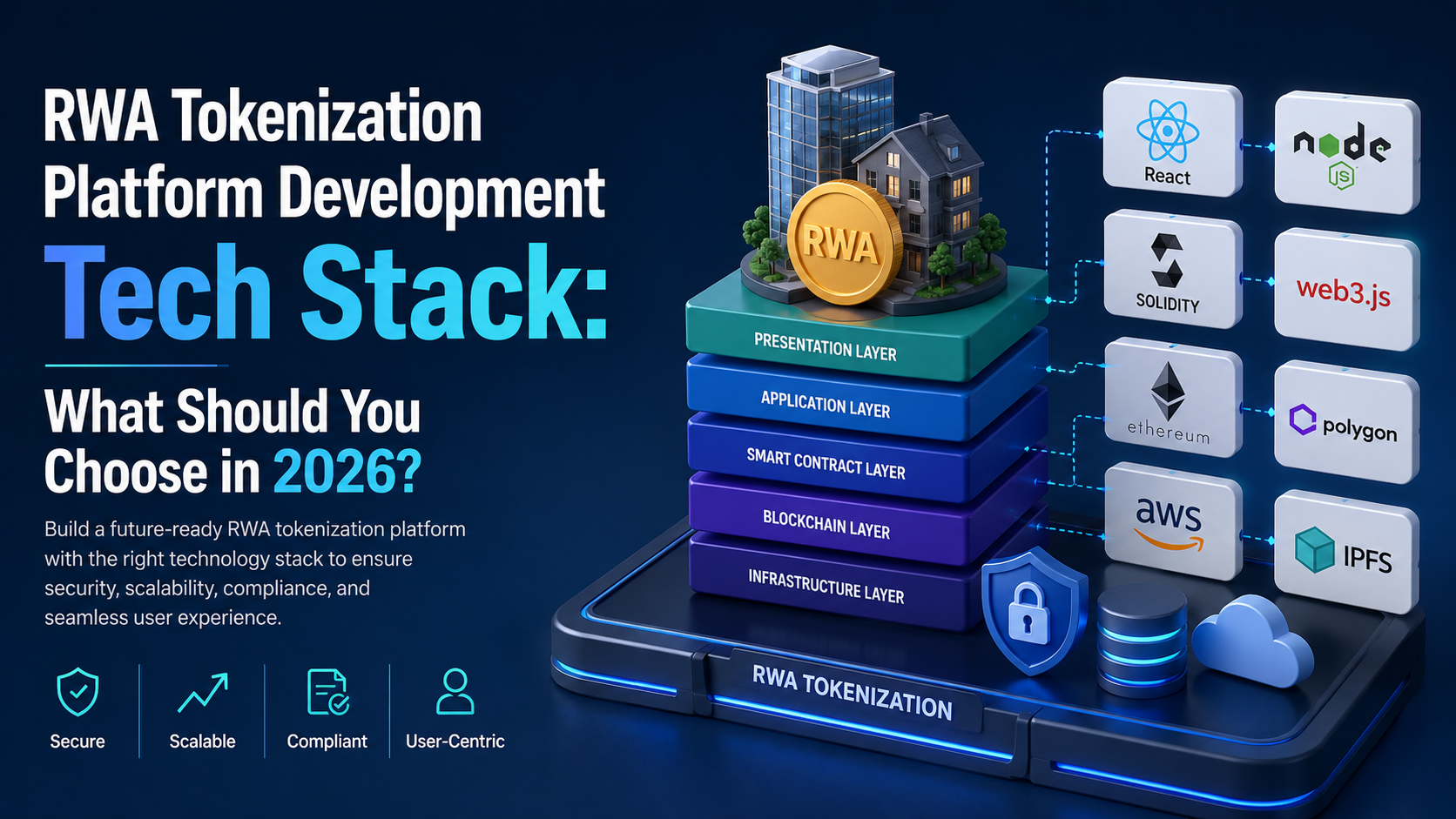
The growth of blockchain-based financial products is changing how businesses represent and manage real-world assets. Real estate, commodities, private credit, artwork, bonds, and other physical or financial assets can now be represented through blockchain tokens. This has created growing interest in RWA Tokenization platforms among financial institutions, asset managers, investment firms, and Web3 businesses.
However, launching such a platform requires more than selecting a blockchain network and adding a token contract. The technology stack must support asset onboarding, token issuance, investor management, compliance, custody, payments, smart contracts, data storage, and secondary trading. Each technology choice can affect development time, operating expenses, security, and future maintenance.
For businesses planning RWA tokenization platform development in 2026, choosing technologies based on the platform's asset type, target users, jurisdiction, transaction volume, and regulatory requirements is important. This guide examines the technology stack that can be considered for a modern RWA tokenization platform and explains how each layer fits into the overall system.
What Is an RWA Tokenization Platform?
An RWA Tokenization platform is a blockchain-based application that represents ownership rights or economic interests in real-world assets through digital tokens. Depending on the legal structure, one token may represent direct ownership, a share in a legal entity, a claim against an asset, or another form of financial interest.
Real World Asset Tokenization can cover several categories, including commercial properties, residential properties, gold, private equity, debt instruments, investment funds, invoices, collectibles, and infrastructure assets. The platform usually connects asset issuers, investors, administrators, custodians, compliance teams, and other participants through a unified application.
A platform may include token issuance, investor onboarding, identity verification, wallet management, token transfers, payment processing, asset information, reporting, and trading features. Because these functions involve financial activity, technology decisions should be made alongside legal and compliance requirements.
Blockchain Layer for RWA Tokenization
The blockchain network is one of the first technology decisions for RWA Tokenization. Ethereum remains a widely used option because of its mature smart contract ecosystem, developer availability, wallet support, and established token standards. However, businesses do not have to rely on one network for every project.
Polygon, Avalanche, Arbitrum, Base, BNB Chain, and other EVM-compatible networks can also be considered depending on transaction requirements and application architecture. EVM compatibility is useful because developers can use familiar Solidity tools and established development frameworks.
For institutional applications, permissioned blockchain networks may also be suitable when access restrictions and private transaction environments are required. The right selection depends on whether the platform targets public markets, private investment groups, institutions, or a combination of these participants.
Smart Contract Technology
Smart contracts handle many blockchain functions inside an RWA platform. Solidity is widely used for EVM-compatible networks and can support token creation, transfer restrictions, investor permissions, distribution rules, and other contractual logic.
Token standards should match the asset model. ERC-20 may work for certain fungible interests, while ERC-721 and ERC-1155 can support non-fungible or semi-fungible assets. Security-focused standards such as ERC-1400 can also be considered for regulated security tokens because they provide features related to transfer restrictions and compliance.
Smart contracts should undergo testing before deployment. Unit testing, integration testing, code review, and independent security audits can help identify issues before contracts hold user funds or represent valuable assets.
Backend Technology
The backend connects the blockchain layer with the platform's application logic. Node.js with TypeScript is a practical option for Web3 applications because it works well with blockchain libraries and modern API development.
Other backend choices such as Python, Java, Go, or .NET can also be used depending on the development team's experience and the platform's requirements. Python is particularly useful when the system includes analytics, financial calculations, artificial intelligence, or data-processing components.
A service-based backend can separate functions such as user management, asset management, token operations, compliance, payments, notifications, and reporting. This approach can make individual services easier to maintain as the platform grows.
Frontend Technology
The frontend is the part investors, issuers, administrators, and compliance teams interact with. React.js and Next.js are commonly considered for web applications because they support component-based interfaces and large application structures.
The investor dashboard can include portfolio balances, asset information, token holdings, transaction history, investment opportunities, distributions, and account verification status. Issuer dashboards may include asset registration, token issuance settings, investor records, and reporting functions.
For a platform intended for institutional users, the interface should prioritize readable financial information and straightforward workflows rather than unnecessary visual effects. Mobile responsiveness is also useful because investors may access portfolio information from different devices.
Database Selection
A database stores information that does not need to exist directly on the blockchain. PostgreSQL is a suitable choice for many RWA platform applications because it supports structured financial and user data.
The database may store user profiles, KYC records, asset information, transaction references, compliance status, investment records, payment details, and platform settings. Sensitive information should not be stored directly on public blockchains.
MongoDB can also be considered where document-based data structures are useful. In some architectures, PostgreSQL may handle transactional data while Redis handles caching and temporary session information.
The database design should maintain a reliable relationship between off-chain records and blockchain transactions. Transaction hashes, wallet addresses, token identifiers, asset IDs, and ownership records should be linked carefully.
Identity Verification and KYC Technology
RWA platforms usually require identity verification because many tokenized assets fall under financial regulations. KYC and AML checks may be required before investors can purchase or receive tokens.
A platform can integrate third-party identity verification providers through APIs. These services can support document verification, facial checks, address verification, sanctions screening, and other compliance checks.
The platform should also maintain permission rules after verification. For example, an investor may be approved for one asset but restricted from another because of location, investor category, holding limits, or other regulatory conditions.
Wallet Infrastructure
Wallet technology is another major part of RWA tokenization development. Platforms can support external wallets such as MetaMask or institutional custody solutions, while some applications may use embedded wallets for easier onboarding.
Custodial wallets can provide a simpler user experience because users do not always need to manage private keys themselves. Non-custodial wallets provide users with greater control over their assets but introduce additional responsibility for key management.
Multi-signature wallets can be used for administrative accounts, treasury operations, and other high-value activities. Hardware-based custody and institutional custody providers may also be considered for platforms dealing with significant asset values.
API and Web3 Integration Layer
APIs connect the frontend, backend, blockchain, payment systems, identity providers, custody services, and other external systems.
Libraries such as ethers.js and viem can be used for communication with EVM-compatible blockchain networks. APIs can handle wallet connection, token balances, contract calls, transaction monitoring, and blockchain event processing.
Blockchain indexing services can also reduce the need to query raw blockchain data repeatedly. The platform can use indexed information to display ownership records, transfers, transaction history, and token activity more efficiently.
Payment and Fiat Integration
RWA platforms often need both blockchain-based payments and traditional payment methods. Depending on the business model, users may invest through bank transfers, cards, stablecoins, or other approved payment methods.
Payment providers can be connected through secure APIs. Stablecoins may also be supported where regulations and business requirements permit them. The platform should maintain accurate records of deposits, withdrawals, conversions, investment amounts, and distributions.
For regulated assets, payment processing should be connected with investor eligibility and transaction approval rules. A payment should not automatically result in token ownership unless the relevant compliance and settlement conditions have been satisfied.
Cloud Infrastructure
Cloud infrastructure provides the environment for hosting the application, APIs, databases, monitoring systems, and background services. AWS, Microsoft Azure, and Google Cloud are common choices.
AWS services such as EC2, ECS, RDS, S3, CloudFront, Lambda, and CloudWatch can support different parts of an RWA platform. Similar services are available through Azure and Google Cloud.
Container technologies such as Docker can help developers maintain consistent application environments. Kubernetes may be considered when the platform has complex deployment requirements, although smaller projects may not need it during the initial release.
Security Technology
Security should be considered throughout the RWA tokenization development process. Smart contract vulnerabilities, compromised wallets, weak authentication, API attacks, database exposure, and unauthorized administrative actions can create serious financial risks.
The platform can use multi-factor authentication, role-based access control, encryption, secure API authentication, rate limiting, wallet permission controls, audit logs, and transaction monitoring.
Smart contract audits should be performed before contracts are used for live assets. The application should also undergo penetration testing and security reviews. Administrative actions involving token issuance, asset updates, and fund movement should require appropriate authorization.
Data Oracles
Tokenized assets often depend on information outside the blockchain. For example, a platform may need property valuations, commodity prices, exchange rates, interest rates, or other external information.
Oracle technology can connect external data with blockchain applications. Chainlink and other oracle providers may be considered depending on the data requirements and supported network.
For an RWA platform, oracle data should come from reliable sources and should have suitable verification procedures. The platform architecture should also account for situations where an external data source becomes unavailable or provides incorrect information.
Compliance and Permission Management
Compliance technology should be integrated into the platform rather than treated as an optional feature. Token transfers may need restrictions based on investor identity, location, holding limits, accreditation status, or asset-specific rules.
Smart contracts can contain transfer restrictions, while the backend can maintain investor eligibility records. These two layers should work together so that blockchain transactions follow the platform's legal and operational rules.
Businesses working with an RWA Tokenization Company should also evaluate how the development team handles regulatory requirements across target markets. Regulations can differ significantly between jurisdictions, so the platform architecture should leave room for market-specific rules.
Recommended Tech Stack for 2026
A practical stack for many RWA platforms could include an EVM-compatible blockchain such as Ethereum, Polygon, Avalanche, Arbitrum, or Base; Solidity for smart contracts; React or Next.js for the frontend; Node.js with TypeScript for backend services; PostgreSQL for structured data; Redis for caching; Docker for application packaging; AWS, Azure, or Google Cloud for infrastructure; and ethers.js or viem for blockchain interaction.
The final selection should depend on the asset category and business model. A real estate investment platform may have different requirements from a private credit platform. Similarly, a platform serving institutions may require different wallet, custody, compliance, and permission systems than a retail-focused application.
How to Select the Right Development Partner
Technology is only one part of a successful RWA platform project. The development team should understand blockchain architecture, smart contracts, financial workflows, token standards, wallet infrastructure, compliance integrations, and security practices.
When evaluating an RWA tokenization development company, businesses should review previous blockchain projects, smart contract experience, supported networks, security processes, API integration capabilities, and post-launch maintenance practices.
An experienced provider of RWA tokenization development services should also be able to explain why particular technologies are being selected instead of simply presenting a fixed technology list. The technology stack should relate directly to the asset type, target investors, transaction model, regulatory environment, and expected platform usage.
Final Thoughts
The right technology stack for RWA Tokenization in 2026 depends on more than choosing a popular blockchain or programming language. A successful platform needs coordinated blockchain, smart contracts, backend services, databases, wallets, compliance systems, payment integrations, cloud infrastructure, security controls, and external data services. Businesses entering Real World Asset Tokenization should select each layer according to their asset category, investor requirements, legal environment, and operating model. Working with a reliable RWA Tokenization Company can also reduce technical gaps during planning, development, testing, and deployment. Businesses can consider professional RWA Tokenization Services when they need assistance across multiple stages of the project, from architecture planning to production deployment. Blockchain App Factory provides RWA tokenization development services for businesses planning tokenized asset platforms and related blockchain applications.
FAQs
1. What technology is used for RWA tokenization platforms?
RWA platforms commonly use blockchain networks, Solidity smart contracts, React or Next.js, Node.js or other backend technologies, PostgreSQL databases, Web3 libraries, wallet infrastructure, cloud services, identity verification APIs, and compliance systems.
2. Which blockchain is best for RWA Tokenization?
There is no single blockchain that fits every project. Ethereum, Polygon, Avalanche, Arbitrum, Base, BNB Chain, and permissioned networks can be considered based on transaction requirements, asset type, regulatory needs, ecosystem support, and target users.
3. Why are smart contracts important for RWA tokenization?
Smart contracts can manage token issuance, transfers, ownership rules, restrictions, distributions, and other blockchain-based functions. Their design should reflect the legal and operational structure of the underlying asset.
4. What database is suitable for an RWA platform?
PostgreSQL is a practical choice for structured investor, asset, transaction, and compliance information. Redis can be added for caching and temporary application data. The final database setup depends on the platform architecture.
5. Does an RWA platform need KYC and AML integration?
Many RWA projects require identity and compliance checks because tokenized assets can involve regulated financial interests. The exact requirements depend on the asset, jurisdiction, investor type, and legal structure.
6. Can an RWA platform support multiple blockchains?
Yes. A multi-chain architecture can support several blockchain networks when the platform's business model requires it. However, adding networks increases testing, monitoring, wallet, smart contract, and maintenance requirements.
7. What is involved in RWA token development?
RWA token development can include asset analysis, token model selection, smart contract creation, compliance rules, wallet integration, issuance workflows, investor management, testing, auditing, deployment, and post-launch monitoring.
8. How much does RWA tokenization platform development cost?
The cost varies according to platform features, blockchain networks, token standards, compliance requirements, custody setup, payment integrations, smart contract complexity, security testing, and development time. A simple platform and an institution-focused platform can have very different budgets.
9. What should businesses look for in RWA tokenization development services?
Businesses should assess blockchain experience, smart contract capabilities, security practices, compliance integrations, wallet support, API development, cloud architecture, testing procedures, and experience with similar asset categories.
10. Why is technology selection important for Real World Asset Tokenization?
Technology choices affect how the platform handles asset issuance, ownership records, investor activity, security, compliance, transactions, data management, and future maintenance. Selecting the stack according to the actual business model can prevent unnecessary technical changes later.

 English
 Arabic
 Spanish
 Portuguese
 Deutsch
 Turkish
 Dutch
Dutch
 Italiano
 Russian
 Romaian
 Portuguese (Brazil)
 Greek
Greek
