


Photoplethysmography Biosensors Market Advances in Wearable Sensor Design
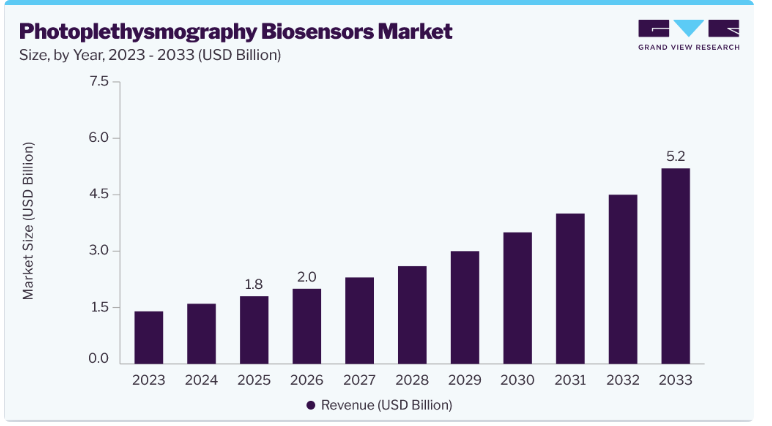
The growth of wearable health technology is creating new demand for sensors that can collect physiological information conveniently and non-invasively. Photoplethysmography (PPG) biosensors are becoming increasingly important in this environment because they can measure changes in blood flow using optical signals and can be integrated into compact devices. The Photoplethysmography Biosensors Market was valued at USD 1.8 billion in 2025 and is projected to reach USD 5.2 billion by 2033, growing at a CAGR of 14.8% from 2026 to 2033.
Key Highlights
Smartwatches accounted for approximately 43.0% of product revenue in 2025, while heart rate monitoring held around 41.0% of application revenue. Pulse oximeters are expected to grow fastest among products. North America led with a 40.0% share, and Asia Pacific is projected to record the fastest regional growth. Sensor accuracy, wearable adoption, and cardiovascular monitoring needs will influence future development.
The Technology Behind Everyday Health Tracking
PPG is an optical sensing technique that detects changes in blood volume beneath the skin. Light emitted by a sensor interacts with tissue, and a light-sensitive component measures changes in the returning signal. Processing this signal enables devices to estimate heart rate and, in suitable configurations, blood oxygen saturation.
Want to Understand What’s Driving Market Growth? Ask Prism AI for research-backed insights into market size, evolving opportunitie
One of the technology's main advantages is its adaptability. Sensors can be incorporated into smartwatches, wristbands, rings, patches, earbuds, and pulse oximeters. This allows manufacturers to develop products for different monitoring needs without requiring large or complex sensor assemblies.
The ability to collect readings during everyday activities has helped bring physiological monitoring into consumer electronics. Users can review selected indicators while exercising, sleeping, or going about daily routines. This convenience is a central factor supporting market demand.
Accuracy Remains Essential to Adoption
The expansion of PPG biosensors depends not only on product availability but also on measurement reliability. Optical signals can be affected by movement, sensor placement, fit, and environmental conditions. These factors may influence the quality of readings, particularly when a user is exercising or the sensor is not positioned correctly.
Signal-processing algorithms play an important role in interpreting collected data. Improvements in processing methods and sensor design may help reduce interference and support more robust measurements across different conditions.
Accuracy is particularly important when devices are used to monitor health-related indicators. Consumer wellness tracking and clinical monitoring have different requirements, so product capabilities must be evaluated according to their intended purpose. Wearable readings should not automatically be treated as a diagnosis or as a replacement for appropriate medical assessment.
Cardiovascular Health Is a Major Market Driver
The growing burden of cardiovascular disorders is supporting demand for monitoring technologies. Heart rate and other physiological indicators can help users track patterns and may contribute to monitoring programs when used appropriately.
The American Heart Association's 2025 statistics update, cited in the supplied market source, reported more than 941,000 cardiovascular disease-related deaths in the United States in 2022. The source also states that nearly 47% of U.S. adults have high blood pressure.
PPG biosensors offer a non-invasive way to measure certain physiological signals. Their compact form and potential for repeated readings make them suitable for wearable applications and selected remote monitoring use cases.
The technology's contribution is primarily measurement and monitoring. The clinical significance of a reading depends on the specific parameter, the device's performance, and the context in which the information is interpreted.
Download a free sample report or claim your copy of this full market intelligence report
Product Innovation Is Creating Multiple Growth Paths
Smartwatches represented approximately 43.0% of product revenue in 2025. Their leading position reflects the integration of optical heart rate monitoring and other health-related features into widely used consumer devices.
Pulse oximeters are anticipated to register the fastest growth during the forecast period. These devices commonly use dual-wavelength PPG to estimate blood oxygen saturation non-invasively. Compact handheld formats and connected monitoring options support their use across different environments.
Smart wristbands and other wearable formats, including rings and patches, provide further opportunities. Different designs can accommodate user preferences for comfort, convenience, and device functionality. As sensor integration advances, PPG technology may continue to appear in a broader range of connected products.
Applications Are Expanding Beyond Heart Rate
Heart rate monitoring accounted for around 41.0% of application revenue in 2025. Its wide adoption in consumer wearables makes it a core use case for PPG sensors.
Blood oxygen saturation monitoring is another important application and is expected to grow considerably. Pulse oximetry uses optical measurements to estimate oxygen saturation, while other wearable applications may track indicators related to respiration and sleep.
Blood pressure-related monitoring is also included in the market's broader application landscape. However, the ability to measure a particular parameter depends on the device's design and capabilities; it should not be assumed that every PPG device measures all these indicators.
Regional Market Development
North America accounted for approximately 40.0% of global revenue in 2025. Wearable health technology adoption, cardiovascular monitoring needs, and access to advanced healthcare facilities contribute to the region's leading position.
Asia Pacific is projected to record the fastest CAGR between 2026 and 2033. Growing smartwatch adoption in India, China, Japan, Singapore, and Australia supports demand, while continued research and development may contribute to further sensor innovation.
What the Market Needs for Sustainable Growth
The projected increase to USD 5.2 billion by 2033 presents opportunities for sensor developers and wearable device manufacturers. Continued integration into consumer electronics, improvements in signal processing, and demand for convenient monitoring are expected to support market expansion.
At the same time, measurement accuracy, signal interference, and appropriate interpretation remain important considerations. Products that combine wearer comfort, reliable performance, and clearly defined intended uses can help address these needs.
The long-term development of the photoplethysmography biosensors market will depend on how effectively innovation improves measurement quality while making monitoring technologies accessible across consumer wellness and healthcare applications.
 Turkish
 English
 Arabic
 French
 Spanish
 Portuguese
 Deutsch
 Dutch
 Italiano
 Russian
 Romaian
 Portuguese (Brazil)
 Greek
