


Food Additives Market Competitive Landscape and Innovation Strategies
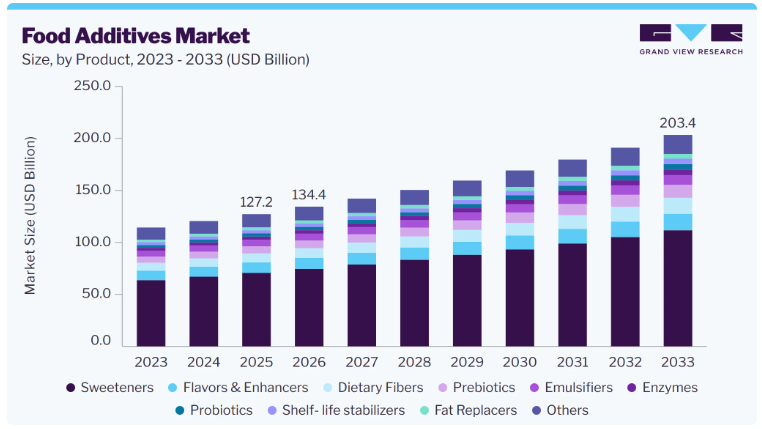
The global food additives market is evolving as food manufacturers balance convenience, product quality, shelf life, and changing consumer expectations. Valued at USD 127.2 billion in 2025, the Food Additives Market is projected to reach USD 134.4 billion in 2026 and USD 203.4 billion by 2033, expanding at a CAGR of 6.1%. While processed and packaged foods continue to create demand for functional ingredients, the growing preference for natural formulations, reduced-sugar products, and nutritional benefits is changing how additives are selected and incorporated into food products. The industry's next phase will depend on how effectively manufacturers deliver consistent performance while responding to evolving ingredient preferences.
The Big Question: Can Food Additives Deliver Both Convenience and Cleaner Labels?
Food additives perform several functions that influence the quality and usability of packaged foods. Preservatives help extend shelf life, stabilizers maintain consistency, emulsifiers support texture, and sweeteners provide alternatives for managing sugar content. These functions are particularly important as food products move through processing, storage, transportation, and retail distribution.
However, manufacturers face a changing expectation: consumers increasingly want products that offer convenience without compromising ingredient transparency.
This is creating two parallel directions in product development:
- Functional performance: Maintaining taste, texture, appearance, stability, and shelf life across different food categories.
- Formulation reformulation: Exploring natural alternatives, low-sugar ingredients, and functional additives that align with changing consumer preferences.
The opportunity lies in developing formulations that meet both requirements without sacrificing product consistency or affordability.
Four Market Signals Worth Watching
55.5%: Sweeteners dominate product demand
Sweeteners accounted for the largest product share in 2025, supported by widespread use in beverages, bakery products, dairy, and processed foods. Demand for low-calorie and sugar-free formulations is encouraging manufacturers to explore both natural and artificial sweeteners.
82.7%: Natural ingredients hold the leading position
Natural additives accounted for 82.7% of market revenue in 2025, reflecting demand for clean-label formulations and ingredients perceived as minimally processed.
30.4%: Bakery and confectionery remain major applications
This application category held the largest share in 2025. Sweeteners, emulsifiers, colorants, and leavening agents support the texture, flavor, appearance, and freshness of products such as bread, cakes, biscuits, and confectionery.
7.8%: Prebiotics present a growth opportunity
Prebiotics are projected to record the fastest growth among the product segments described in the source, at a CAGR of 7.8% from 2026 to 2033. Growing interest in digestive wellness and functional nutrition is supporting their use in fortified foods, dairy products, and supplements.
Want to Understand What’s Driving Market Growth? Ask Prism AI for research-backed insights into market size, evolving opportunities, and the forces shaping the Global Veterinary Diagnostics Market.
What Happens When Consumer Preferences Change?
The impact of clean-label demand extends beyond ingredient selection. Food manufacturers must consider how reformulation affects the finished product.
For example, replacing a synthetic additive with a natural alternative may require adjustments to preserve flavor, texture, stability, and shelf life. Similarly, reducing sugar in a formulation can create a need for alternative sweeteners that maintain the expected sensory experience.
This makes ingredient innovation an important competitive consideration. Manufacturers increasingly need solutions that can meet technical requirements while accommodating nutritional positioning and ingredient transparency.
Natural additives currently dominate the source segment, while synthetic additives continue to serve applications requiring cost-effectiveness, consistency, and stability under demanding processing conditions. Their continued use reflects the importance of performance and scalability alongside consumer preferences.
Where Will Demand Come From Next?
The market's expansion is linked to the changing structure of food consumption and manufacturing.
Convenience foods: Ready-to-eat meals, packaged snacks, and frozen foods require ingredients that maintain quality during storage and distribution. The convenience food application segment is projected to grow at a CAGR of 6.5% through 2033.
Functional nutrition: Prebiotics and nutritional additives are gaining relevance as consumers show greater interest in digestive wellness, fortified products, and functional foods.
Product reformulation: Demand for reduced-sugar and clean-label offerings is encouraging manufacturers to reassess ingredient combinations and develop alternative formulations.
Food manufacturing expansion: Urbanization, changing dietary habits, and rising packaged food consumption are supporting demand for additives across bakery, confectionery, beverages, dairy, and other processed food categories.
Together, these developments are broadening the role of additives from basic preservation and flavor enhancement to more specialized formulation functions.
Download a free sample report or claim your copy of this full market intelligence report
Asia Pacific Leads as Regional Markets Follow Different Paths
Asia Pacific accounted for 32.8% of global food additives market revenue in 2025, making it the leading regional market. Strong processed food consumption, expanding food manufacturing, and increasing product diversification support its position. China held the largest country market share in 2025, according to the supplied report.
Other regions present distinct opportunities.
- North America: Projected to grow at a CAGR of 6.2% from 2026 to 2033, supported by clean-label formulations, functional ingredients, and product reformulation.
- Europe: Demand is influenced by regulatory requirements, ingredient transparency, and interest in natural and plant-based additives.
- Latin America: Expanding packaged food consumption and retail distribution are supporting demand for preservation and flavor-enhancement solutions.
- Middle East and Africa: Packaged food demand, food imports, and the expansion of local processing activities are supporting the use of preservatives, stabilizers, and flavor enhancers.
These differences create opportunities for ingredient suppliers to develop solutions suited to regional manufacturing conditions, consumer preferences, and product requirements.
The Challenge: Innovation Must Still Meet Safety and Cost Requirements
Clean-label expectations do not remove the need for reliable ingredient performance. Food additives must continue to satisfy applicable safety requirements while delivering consistent results in commercial production.
Regulatory approvals can influence the introduction of new ingredients and the pace of formulation changes. At the same time, manufacturers must assess ingredient costs, processing compatibility, product stability, and the performance of natural alternatives.
The market's moderately concentrated structure also shapes competition. Established multinational suppliers benefit from research capabilities, distribution networks, and regulatory expertise, while specialized producers compete through customized and application-specific ingredient solutions.
What Could Define the Food Additives Market Through 2033?
The global food additives market is projected to reach USD 203.4 billion by 2033, growing at a CAGR of 6.1% from 2026 to 2033. Sweeteners, natural ingredients, and bakery and confectionery applications currently represent important areas of market demand, while prebiotics and convenience foods offer additional growth opportunities.
The industry's future will depend on more than increasing packaged food consumption. Ingredient suppliers and food manufacturers will need to balance functionality, safety, affordability, nutritional expectations, and transparency. Companies that can develop effective formulations while adapting to changing consumer preferences will be better positioned to participate in the market's continued expansion.
 Arabic
 English
 French
 Spanish
 Portuguese
 Deutsch
 Turkish
 Dutch
 Italiano
 Russian
 Romaian
 Portuguese (Brazil)
 Greek
