


5 Steps for Custom Audio Product Development and Manufacturing
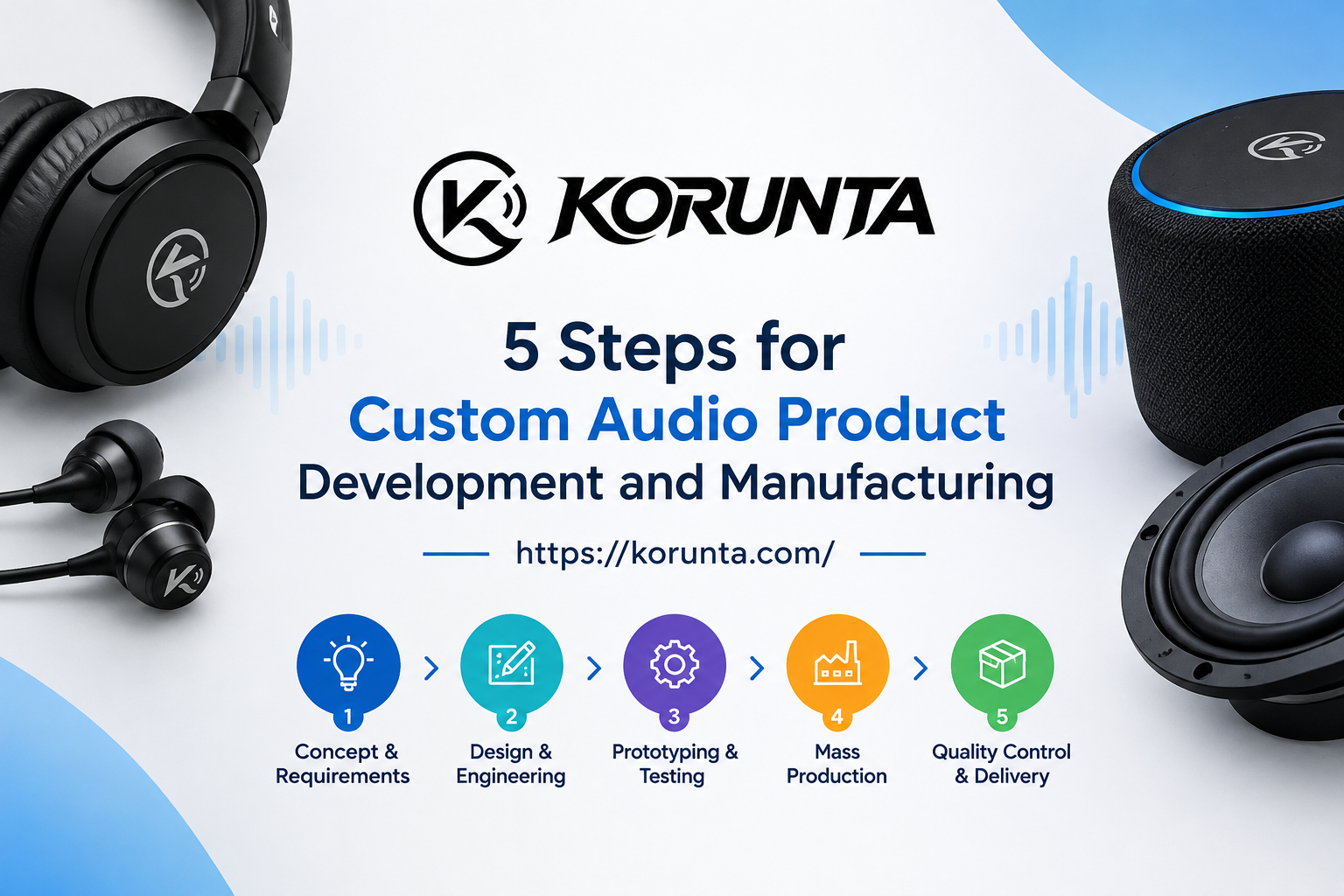
Picking a speaker shape and adding a logo is the easy part. Real custom audio product development and manufacturing ask for more, because early choices show up later in unit cost, sound quality, and return rates. This guide walks through five stages, from the first product brief to production and quality checks. Before anyone cuts tooling, three things need to line up. Those are the specifications, the target price, and the buyers you plan to serve.
Steps for Custom Audio Product Development and Manufacturing
Think of the five steps as a funnel. Early on, choices are wide and changing your mind is cheap. After samples are approved, every change gets slower and costlier. Each step ends with a decision you should write down, because each one feeds the next. Portable Bluetooth speakers, party speakers, and karaoke speakers are examples, since their intended use pushes specifications in different directions. Already know what you are building? Use the steps as a checklist to find gaps.
Step 1: Define Product Specifications
Begin with the buyer, not the box. Write down your target market, your target users, your retail positioning and the expected order volume. Then list sound output, connectivity, battery life, dimensions, design preferences and target price. Portability, battery life and water resistance all come together in a Bluetooth speaker. A party speaker usually needs more output and a bigger enclosure, and buyers expect clean sound at volume. Put it all into one short brief. A clear brief lets us build a realistic quotation instead of guessing.
Step 2: Select the Right Development Model
OEM means we build to your design or adapt an existing product with your branding. ODM means our engineers develop the design for you. Private label projects often suit OEM, since logo, color, packaging, and small feature changes can set a product apart at modest cost. Choose custom engineering when the product itself must differ, such as a new enclosure. More differentiation means more development time and budget. A good audio equipment manufacturer will tell you which route fits your budget and your product goals.
Step 3: Develop and Review Samples
Samples turn the brief into something you can hold. Our ODM process includes design development, technical renderings, sample production, and revisions, so you see the concept before volume work begins. Judge each sample on sound quality, controls, connectivity, appearance, and usability. A karaoke speaker deserves a real microphone test. Send feedback as one written list, because custom audio product development and manufacturing slows down when comments arrive in pieces. We typically allow two to three free revisions at this stage. Approve the final sample only after every requested change is documented.
Step 4: Test Quality and Performance
Listening matters, but ears drift. Measure against the agreed specification instead. Acoustic testing will measure the output, while electrical testing will involve the battery and charging and functional testing will involve buttons and pairing. Write acceptance criteria before testing starts, so both sides know what passing looks like. Then confirm certifications. CE, FCC, and RoHS apply in many markets, depending on where you sell. Any serious audio equipment manufacturer should share test results and help with that paperwork. We assist with CE, FCC, and RoHS for your target market.
Step 5: Prepare for Mass Production
Confirm the approved sample, the bill of materials meaning the full parts list, plus branding, packaging, and production specifications. Set agreement on order quantities, time schedules, quality checks and logistics. Updates and inspections will help identify any problems that may occur before loading the cargo. Shenzhen Korunta Electronics Co., Ltd manufactures more than 100,000 pieces per month from eight production lines. Before ordering, confirm the final quotation, minimum order quantity, delivery schedule, and export documentation.
Conclusion
Five stages, one thread. You define the product, choose between OEM and ODM, review samples, test against written criteria, and prepare production details before the order goes in. Good custom audio product development and manufacturing comes down to clear specifications, approved samples, and documented quality expectations. As an audio equipment manufacturer supplying various sound equipment including Bluetooth speakers, karaoke speakers, party speakers, and other audio products, OEM and ODM are applicable for businesses that develop or customize their own line.
Contact Shenzhen Korunta Electronics Co., Ltd to talk about your needs. Ask for a quote or consider OEM and ODM development.
FAQs
Q: What does custom audio product development entail?
Custom audio product development entails planning, designing, testing and preparing an audio product for production.
Q: What is the distinction between OEM and ODM speakers?
OEM modifies or creates from an existing design and ODM indicates that we design and manufacture a new product based on your needs.
Q: What is the timeline for custom audio manufacturing?
Depending on design, sample approval and order volume. OEM production usually takes between 45 and 60 days whereas ODM production takes 90 to 120 days.

 English
 Arabic
 French
 Spanish
 Portuguese
 Deutsch
 Turkish
 Dutch
 Italiano
 Russian
 Romaian
 Portuguese (Brazil)
