


Furniture Market Insights: Understanding Emerging Industry Trends
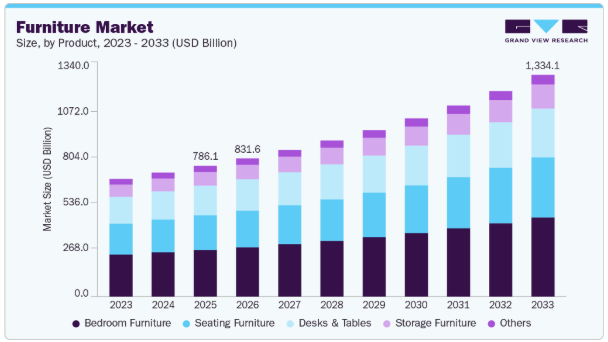
The global furniture market is evolving alongside changing lifestyles, expanding housing infrastructure, and rising consumer expectations for comfort, functionality, and design. Furniture Market Valued at USD 786.1 billion in 2025, the market is projected to reach USD 831.6 billion in 2026 and USD 1,334.1 billion by 2033, growing at a CAGR of 7.0% from 2026 to 2033. Demand is increasingly influenced by residential construction, commercial development, home improvement spending, and consumer interest in space-efficient, customizable, and multifunctional furniture. At the same time, digital retail channels, sustainable materials, and technology-enabled furnishings are changing how consumers discover and purchase products.
Three Forces Reshaping the Furniture Market
Housing and infrastructure expansion: New residential developments, hotels, hospitals, educational facilities, offices, and community spaces create demand for furniture across multiple applications.
Smarter use of living space: Urban households are increasingly interested in compact, modular, multifunctional, and customizable furniture that combines storage, comfort, and contemporary design.
Digital purchasing and personalization: Retailer websites, online reviews, direct-to-consumer platforms, and digital visualization tools are influencing product discovery and purchasing decisions.
These developments are broadening furniture demand beyond traditional household purchases. Institutional and commercial buyers increasingly require products that combine durability, functionality, and design suitability. Healthcare environments, in particular, place additional emphasis on easy-clean surfaces, stain resistance, hygiene, and long-term performance.
Want to Understand What’s Driving Market Growth? Ask Prism AI for research-backed insights into market size, evolving opportunities, and the forces shaping the Global Veterinary Diagnostics Market.
The Consumer Decision: Price, Quality, and Functionality
Furniture purchases involve more than appearance. A Consumer Insights Now survey conducted among nearly 1,900 U.S. consumers in late June and early July 2023 illustrates how buyers balance affordability, product quality, and design.
What matters when consumers choose furniture?
Staying within budget: 29%
Product quality: 28%
Furniture style: 16%
Discounts and sales: 11%
Product information also influences buying confidence. In the same survey, 64% of respondents considered furniture dimensions, 48% considered fabric details, 46% looked at warranty information, and 40% considered expected product lifespan. Retailer websites were the starting point for furniture searches for 50% of respondents, while 43% consulted online reviews.
Download a free sample report or claim your copy of this full market intelligence report
These findings indicate that manufacturers and retailers must communicate practical product details alongside design benefits. Accurate dimensions, material specifications, durability information, and warranty terms can all help consumers evaluate their options.
Opportunities Emerging Across Product Categories
Bedroom furniture: With a 35.7% market share in 2025, this category benefits from housing growth, renovation activity, and interest in comfortable, visually coordinated interiors. Adjustable mechanisms, built-in lighting, charging ports, and integrated storage are expanding product functionality.
Storage furniture: Projected to grow at a CAGR of 7.6% through 2033, this segment is benefiting from smaller living spaces and the popularity of apartments and rental housing. Modular wardrobes, shelves, cabinets, and multifunctional storage products help consumers organize limited space without major renovations.
Materials and design: Wood accounted for 39.8% of market revenue in 2025, supported by its versatility, durability, and wide range of finishes. Meanwhile, plastic furniture is projected to grow at a CAGR of 7.7%, supported by affordability, lightweight construction, and improvements in product design.
Commercial furnishings: Offices, hotels, restaurants, cafés, and other establishments require furniture that balances aesthetics, durability, and space efficiency. The commercial application segment is projected to grow at a CAGR of 7.3% from 2026 to 2033, the fastest among the application segments described in the source.
Why Housing Development Matters
Residential construction creates a direct pathway to furniture demand: newly completed homes require furnishing, while established households generate additional purchases through renovation and replacement.
Saudi Arabia illustrates this connection. Its Housing Program targets a 70% homeownership rate among Saudi families by 2030. Homeownership had risen from 47.0% in 2016 to more than 60.0% in 2025, according to the supplied source. During the first half of 2025, approximately 26,000 housing units and more than 5,200 residential plots were announced through off-plan projects.
Such development can create downstream opportunities for bedroom furnishings, seating, dining products, storage units, and other household essentials as properties move toward occupancy. Hospitality, healthcare, and commercial construction extend this demand to institutional and contract furniture.
Regional Growth: Asia Pacific Sets the Pace
Asia Pacific accounted for 38.5% of global furniture
market revenue in 2025 and is expected to record the fastest regional CAGR over the forecast period. Rising disposable incomes, urbanization, housing development, and greater spending on home interiors support the region's leadership.
China's furniture market is anticipated to grow at a CAGR of 8.2% from 2026 to 2033. Demand is being shaped by premiumization, multifunctional designs, space-efficient products, and the integration of online and offline retail channels.
Other regions present different growth drivers:
- North America: Projected CAGR of 6.5%, supported by residential construction, furniture replacement, home improvement, and digitally enabled retail.
- Europe: Projected CAGR of 6.8%, with opportunities in premium furnishings, hospitality, urban development, and sustainable sourcing.
- Middle East and Africa: Projected CAGR of 7.0%, supported by residential development, tourism, hotels, and commercial infrastructure, particularly in Saudi Arabia and the UAE.
These differences underline the importance of matching product portfolios to regional purchasing patterns, housing conditions, and commercial requirements.
Challenges and the Next Phase of Competition
Raw-material price fluctuations involving timber, metals, polyurethane foam, and specialty textiles can put pressure on manufacturers' margins. Energy, logistics, and ocean freight costs add further uncertainty. At the same time, intense price competition in mass-market furniture makes cost management important.
Competition is also shifting as established manufacturers, regional businesses, specialized design brands, and digitally native retailers compete through different approaches. Omnichannel distribution, customization, product diversification, and supply chain optimization are becoming important elements of market positioning.
Sustainability presents another opportunity, particularly through responsibly sourced materials, recycled inputs, durability, repairability, and product longevity. Smart furniture, including LED bedside tables and furnishings with charging functionality, represents an additional intersection between traditional home products and technology.
Conclusion
The furniture market is projected to reach USD 1,334.1 billion by 2033, supported by housing development, consumer spending on interiors, and demand across residential and commercial applications. Bedroom furniture, wood products, and residential furnishings remain central to the market, while storage solutions, plastic furniture, smart features, and commercial projects create additional opportunities.
Long-term growth will depend on how effectively the industry balances affordability, product quality, functionality, sustainability, and changing consumer expectations. Manufacturers and retailers that respond to these priorities will be better positioned to address evolving demand across global furniture markets.

 English
 Arabic
 French
 Portuguese
 Deutsch
 Turkish
 Dutch
 Italiano
 Russian
 Romaian
 Portuguese (Brazil)
 Greek
