


Commercial Biogas Plant Subsidy: Eligibility, Requirements & Application Guide
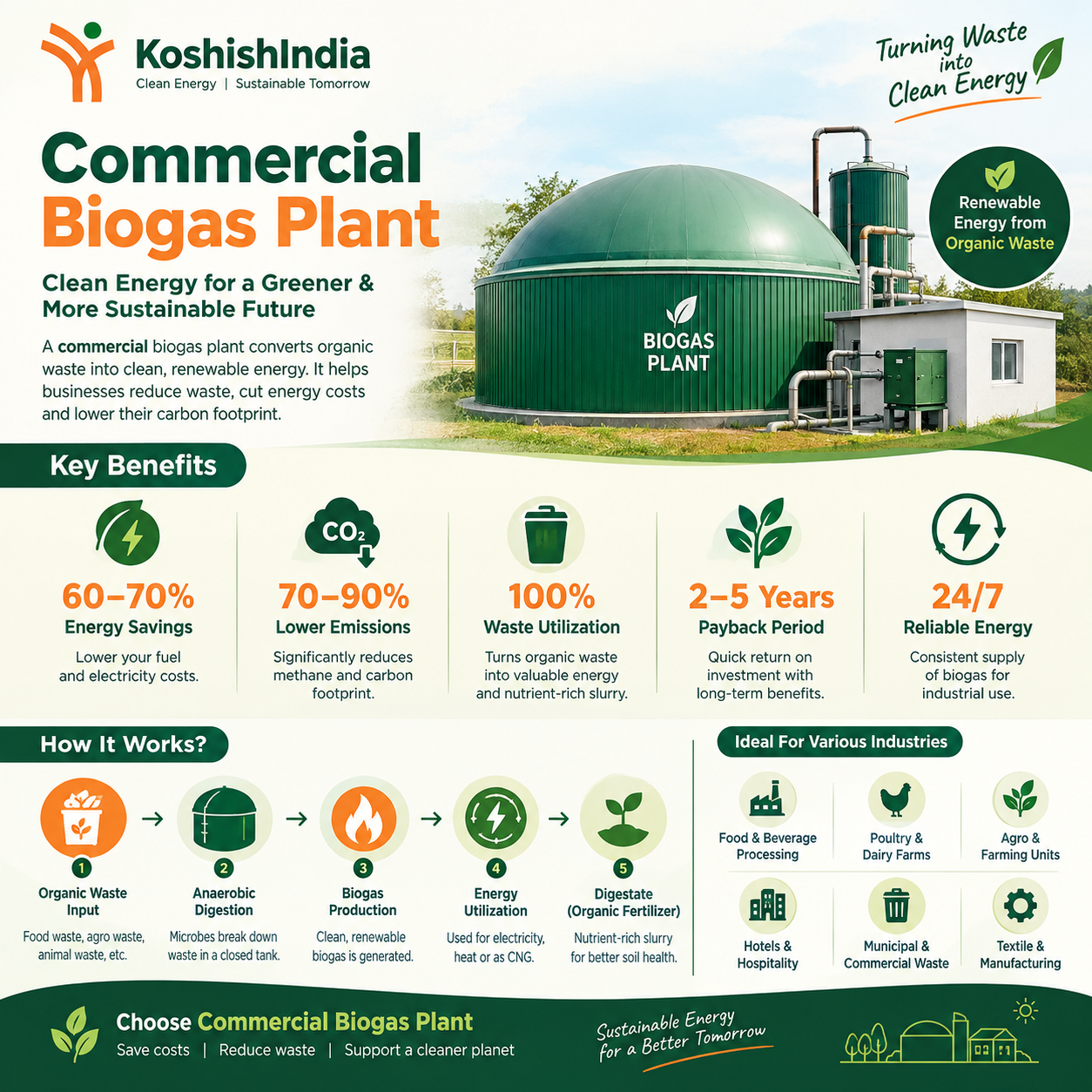
Setting up a commercial biogas plant can help businesses convert organic waste into renewable energy while improving waste management practices. However, the initial investment in equipment, plant construction, and installation can be a concern for many project owners. Government support may help eligible businesses reduce some of these costs through applicable renewable energy and waste management schemes.
Before applying for a Commercial Biogas Plant Subsidy, it is important to understand who can qualify, what project requirements must be fulfilled, and which documents may be needed. Eligibility and financial assistance depend on the specific government scheme, plant capacity, technology, and intended use of the biogas.
Which Businesses Should Consider Applying for a Biogas Subsidy?
Businesses that generate a regular supply of biodegradable waste may consider developing a commercial biogas project. The suitability of a project depends on waste availability, energy requirements, site conditions, and the applicable scheme guidelines.
The following organizations may be suitable applicants, depending on the scheme:
-
Dairy farms: Cattle dung can be processed to produce biogas and nutrient-rich digestate.
-
Poultry farms: Suitable poultry waste can be used as feedstock with appropriate treatment and plant design.
-
Food processing units: Organic residues from food production can serve as raw material for biogas generation.
-
Hotels and restaurants: Food scraps and kitchen waste can be processed to support on-site waste management.
-
Agricultural businesses: Crop residues and other suitable agricultural waste can be utilized.
-
Gaushalas: Cattle dung can be converted into renewable energy and organic manure.
-
Municipal bodies: Segregated biodegradable municipal waste can support larger waste-to-energy projects.
-
MSMEs and private companies: Eligible businesses can explore projects that match the requirements of the relevant scheme.
-
Cooperatives and Farmer Producer Organizations (FPOs): Groups of farmers may explore shared biogas facilities for managing agricultural waste.
Being part of one of these categories does not automatically guarantee subsidy approval. Applicants must confirm the permitted beneficiary categories under the specific scheme.
Key Factors That Can Determine Subsidy Eligibility
There is no single eligibility checklist that applies to every commercial biogas project in India. Different programs may have different technical conditions, financial assistance limits, and application procedures.
1. Availability of Organic Waste
A successful project needs a consistent supply of suitable biodegradable material. Applicants should estimate the quantity of waste generated daily and identify its source.
For example, a dairy farm may use cattle dung, while a food processing unit may use suitable organic production waste. The feedstock quantity and quality help determine the plant's capacity and design.
2. Suitable Land and Project Location
Businesses should identify a suitable location for the proposed plant. The site must provide sufficient space for the digester, waste storage, gas handling equipment, and other essential infrastructure.
Applicants should also establish ownership or valid rights to use the land and check applicable local permissions.
3. Appropriate Technology and Plant Design
The proposed plant should use technology that meets the technical requirements of the selected scheme. Its design should match the type of waste, expected gas production, and intended application.
A plant designed for cooking fuel or heat generation may have different requirements from a project that produces compressed biogas (CBG).
4. Environmental and Regulatory Compliance
Depending on the project's size and location, approvals or clearances may be required from relevant authorities. Businesses should assess applicable pollution control requirements, waste handling rules, construction permissions, and safety standards before proceeding.
5. Financial and Project Feasibility
Applicants should prepare a realistic project budget covering civil construction, machinery, installation, operation, and maintenance. Some schemes may require technical proposals, financial information, or evidence of the applicant's ability to implement the project.
Government Schemes to Explore
Businesses can investigate different government initiatives depending on whether their project focuses on biogas production, organic waste management, or compressed biogas.
National Bioenergy Programme: The Ministry of New and Renewable Energy (MNRE) operates bioenergy support programs. Applicants should check the current guidelines to determine whether their proposed plant and beneficiary category qualify for central financial assistance.
GOBARdhan initiative: This initiative promotes the conversion of organic waste, particularly cattle dung and agricultural waste, into useful resources such as biogas and organic manure. Businesses should verify the applicable implementation framework and available support for their project.
SATAT initiative: Sustainable Alternative Towards Affordable Transportation (SATAT) focuses on promoting compressed biogas production and its use as an alternative fuel. It is particularly relevant to businesses planning eligible CBG projects rather than every conventional commercial biogas installation.
State-level renewable energy schemes: Some states may offer additional incentives or assistance under their renewable energy, agriculture, or waste management policies. Availability depends on the state and the current policy provisions.
Applicants should not assume that every scheme provides a direct capital subsidy. Financial assistance, procurement arrangements, incentives, and eligibility conditions differ across programs.
Documents to Prepare Before Applying
Preparing the required paperwork in advance can help businesses organize their applications and avoid unnecessary delays. Depending on the scheme, the following documents may be requested:
-
Business registration documents and identity proof of the applicant.
-
Land ownership documents or a valid lease agreement.
-
Details of the organic waste source and estimated daily quantity.
-
A project report covering capacity, technology, cost, and expected output.
-
Plant layout, technical specifications, and equipment details.
-
Estimated project cost and relevant financial documents.
-
Applicable local permissions and environmental approvals.
-
Bank details and other forms required by the implementing agency.
The official scheme guidelines should always be treated as the final reference for the required documents.
How to Prepare a Strong Subsidy Application
Businesses can follow a practical preparation process before submitting their applications.
First, assess the quantity and type of organic waste available at the site. Next, determine the required plant capacity and intended use of the generated biogas. Prepare a detailed project report with estimated investment, operating costs, and expected benefits.
After this, identify the scheme that matches the proposed project and verify its current eligibility conditions. Confirm whether prior approval, registration, or application submission is required before purchasing equipment or beginning construction. Follow the official procedure and maintain records of expenses, technical documents, and correspondence.
Working with an experienced biogas technology provider can also help businesses evaluate plant requirements and prepare technical information for the project.
Why Subsidy Support Can Make a Difference
When a project qualifies for financial assistance, the support may improve its financial feasibility. A commercial biogas plant can also provide benefits beyond the initial investment.
Businesses may reduce the volume of organic waste sent for disposal, generate renewable energy for suitable applications, and produce digestate that may be used as an organic soil amendment when properly processed and compliant with applicable requirements.
These benefits can support resource efficiency, operational planning, and sustainability objectives. However, actual savings and returns depend on feedstock availability, plant performance, energy utilization, operating costs, and the level of assistance approved.
Conclusion
A commercial biogas project can be a practical option for organizations looking to manage organic waste and generate renewable energy. Dairy farms, poultry farms, food processing units, hotels, agricultural businesses, municipalities, and other eligible organizations can explore suitable government support programs.
The first step is to assess the project's waste supply, site suitability, technical design, and financial feasibility. Businesses should then compare the available schemes and confirm the latest eligibility rules directly with the relevant government department or implementing agency.
For organizations planning a new installation, KoshishIndia provides solutions related to commercial biogas plants and organic waste utilization. A project-specific assessment can help determine the plant requirements and identify the next steps for implementation.
Frequently Asked Questions (FAQs)
1. Can a small business apply for a commercial biogas plant subsidy?
A small business or MSME may qualify if its project and beneficiary category meet the conditions of the relevant scheme. Plant capacity, technology, waste availability, and other requirements must be checked.
2. Is a subsidy available for every commercial biogas plant?
No. Financial assistance is not automatic for every installation. Eligibility depends on the scheme, project type, technical standards, and applicable application conditions.
3. Can poultry farms and dairy farms apply for biogas support?
They may be eligible under relevant programs if their waste management project meets the prescribed conditions. The quantity and suitability of available waste are important considerations.
4. Is the SATAT initiative applicable to all biogas plants?
SATAT is focused on compressed biogas (CBG). A conventional biogas plant should not be assumed to qualify under SATAT unless its project meets the relevant CBG-related requirements.
5. Should businesses apply before starting construction?
Businesses should check the current scheme guidelines before purchasing equipment or starting construction. Some programs may require registration, application submission, or approval at a specific stage of project development.

 English
 Arabic
 French
 Spanish
 Portuguese
 Deutsch
 Turkish
 Italiano
 Russian
 Romaian
 Portuguese (Brazil)
 Greek
