


PFD Patch: Understanding Its Role in Modern Laser Tattoo Removal
Introduction
The aesthetic medicine industry continues to evolve as healthcare professionals explore technologies that can make cosmetic treatments more efficient and improve the overall patient experience. Laser tattoo removal is one area where these developments are particularly interesting. Although laser technology has made tattoo removal increasingly accessible, practitioners still face challenges related to treatment visibility, skin reactions, patient comfort, and the number of sessions required.
One innovation attracting attention in this field is the PFD patch. Designed around perfluorodecalin (PFD) technology, this specialized patch has been investigated as an accessory for selected laser tattoo removal procedures. Its primary purpose is to help manage the temporary whitening that occurs on the skin during laser treatment, allowing practitioners to maintain better visibility of the tattooed area under appropriate treatment conditions.
For dermatologists, aesthetic physicians, and laser treatment professionals, understanding how a PFD patch works can help them make informed decisions about treatment accessories and clinical workflows.
What Is a PFD Patch?
A PFD patch is a specialized accessory developed for use during certain laser tattoo removal procedures. PFD stands for perfluorodecalin, a fluorocarbon liquid that has been investigated for its optical-clearing properties.
During laser tattoo removal, the laser targets tattoo pigments beneath the skin. The resulting interaction can produce a temporary white appearance on the treated area, commonly known as laser frosting. Although this reaction is generally temporary, it can make it difficult for the practitioner to see the tattoo clearly immediately after a laser pass.
PFD-based patches have been studied for their ability to reduce this visible whitening. By helping restore visibility, the technology may support additional laser passes during selected treatment protocols.
It is important to understand that a PFD patch does not independently remove tattoo ink. Instead, it serves as an accessory to a suitable laser procedure performed by a qualified professional.
Clinics considering this technology should review the exact product specifications, manufacturer instructions, and compatibility requirements before incorporating it into their treatment protocols.
Understanding Laser Frosting During Tattoo Removal
Laser frosting is a familiar phenomenon for professionals who perform laser-assisted tattoo removal. It typically appears as a temporary white or cloudy layer over the treated tattoo shortly after laser exposure.
This appearance is associated with microscopic changes in the skin following the laser's interaction with tattoo pigment and surrounding tissue. The temporary whitening can obscure the tattoo, making it harder for the practitioner to assess the treatment area during a session.
Without an appropriate optical-clearing approach, practitioners may need to wait for the whitening to subside before continuing with additional passes.
This waiting period can influence the pace of treatment and the number of passes that can be performed within a particular session.
PFD patch technology has been explored as a way to address this challenge. By reducing the visible frosting under appropriate conditions, a suitable patch may allow practitioners to reassess the treated area more readily.
For clinics focused on improving treatment workflows, this represents an interesting development in the broader field of aesthetic laser technology.
How Does PFD Patch Technology Work?
The technology behind a PFD patch centres on the optical properties of perfluorodecalin.
When a transparent PFD-infused patch is used in a suitable laser treatment protocol, the PFD can help reduce the temporary whitening that develops after laser exposure. This optical-clearing effect can improve visibility of the treated tattoo.
Better visibility may help practitioners determine whether another laser pass is appropriate, subject to the treatment device instructions, the patient's skin response, and professional clinical judgment.
Published research has examined the potential benefits of PFD-infused patches during selected laser tattoo removal procedures. However, the results depend on the particular patch, laser platform, treatment settings, and patient population studied.
For this reason, clinics should not assume that findings from one product automatically apply to every PFD patch available on the market.
The most responsible approach is to evaluate the research alongside the manufacturer's documentation for the specific product being considered.
Potential Benefits of Using a PFD Patch
1. Improved Visibility During Treatment
One of the main reasons PFD patch technology has attracted interest is its potential to reduce laser-induced frosting.
When the whitening effect subsides more quickly, practitioners may be able to see the tattoo more clearly during the treatment process.
This can support assessment of the treatment area and help inform decisions about whether further passes are appropriate.
2. Support for Selected Multi-Pass Protocols
Laser tattoo removal sometimes involves multiple passes during a single appointment. However, temporary frosting can limit how quickly practitioners can continue treating the same area.
Research involving particular PFD-infused patches has explored whether optical clearing can facilitate additional passes during a defined treatment period.
A 2017 clinical study involving 30 participants reported an average of 3.7 passes with the studied patch compared with 1.4 passes without it during a five-minute treatment period.
These findings relate to the specific patch and laser protocol used in that study. They should not be interpreted as a guaranteed outcome for other products, practitioners, or patients.
3. An Opportunity to Evaluate Treatment Tolerability
Patient comfort is another important consideration during cosmetic procedures.
Some published research involving PFD-infused patches has reported differences in temporary reactions, including redness and swelling, between treatment groups.
Nevertheless, a PFD patch should not be presented as eliminating discomfort or preventing every possible adverse reaction. Pain, redness, swelling, blistering, and other skin responses may still occur during or after laser tattoo removal.
Practitioners should discuss expected outcomes and potential risks with patients before treatment.
4. A Specialized Accessory for Professional Clinics
The development of PFD patch technology reflects a wider trend in aesthetic medicine: improving treatment workflows through specialized accessories rather than relying exclusively on changes to the main device.
For clinics that already provide laser tattoo removal, evaluating a suitable accessory may be a useful way to explore additional treatment options.
The decision should always be guided by product documentation, compatibility, clinical evidence, and the needs of the individual practice.
Why PFD Patch Technology Matters for Aesthetic Clinics
Modern aesthetic clinics must balance several priorities. Patients want realistic treatment expectations, practitioners need reliable visibility during procedures, and clinic owners must consider workflow, product quality, and operating costs.
An accessory that addresses a specific procedural challenge can therefore be worth evaluating.
PFD patch technology is particularly relevant to clinics that perform laser tattoo removal and want to understand the available approaches to managing temporary frosting.
Before introducing a new accessory, practitioners should consider how it fits into their existing treatment process. They should also evaluate whether the published evidence reflects their intended use, including the laser system, tattoo characteristics, patient population, and treatment protocol.
Importantly, the ability to perform more passes in one appointment does not automatically mean that fewer appointments will be required overall. Tattoo removal outcomes depend on several factors, including ink colour, tattoo depth, pigment composition, skin characteristics, laser technology, and the body's response to treatment.
Clear communication and individualized treatment planning remain essential.
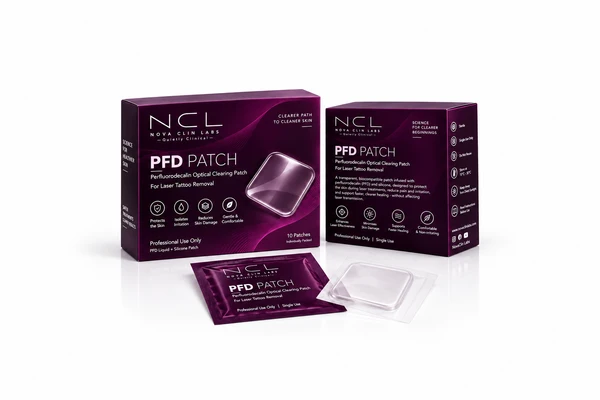
Introducing the PFD Skin Protection Patch from NovaClin Labs
Healthcare professionals looking to explore PFD patch technology in India can review the PFD Skin Protection Patch offered by NovaClin Labs.
NovaClin Labs supplies products for professional applications in dermatology, aesthetic medicine, mesotherapy, and related clinical fields. Its product portfolio includes specialized needles, dermal filler cannulas, and other accessories intended for professional use.
The company's PFD Skin Protection Patch is a perfluorodecalin-based accessory developed for consideration in selected laser treatment workflows.
According to the current product listing, the patch measures 10 × 10 cm and is supplied in a box containing 10 patches.
These specifications are useful starting points for procurement discussions. However, practitioners should confirm the current product details, intended use, compatibility, handling requirements, and applicable documentation directly with the supplier before ordering or using the product.
What Should Professionals Consider Before Choosing a PFD Patch?
Selecting a clinical accessory requires more than comparing prices or product descriptions. The exact product must be appropriate for the intended procedure.
Product documentation: Review the manufacturer's instructions, specifications, intended use, and limitations. Do not rely solely on general descriptions of PFD technology.
Laser compatibility: Confirm whether the specific patch is suitable for the laser system and procedure being considered. Evidence involving one wavelength or laser platform does not establish compatibility with every system.
Patient suitability: The treating clinician should determine whether the proposed procedure is appropriate for the individual patient, considering relevant skin conditions and other clinical factors.
Handling and storage: Follow the supplied instructions for storage, application, expiry, and disposal. Check the packaging and batch information before use.
Clinical evidence: Review the available studies carefully, paying attention to sample size, treatment settings, outcome measurements, follow-up periods, and potential limitations.
Professional training: Only appropriately qualified practitioners should perform laser tattoo removal, using suitable equipment and established safety procedures.
These considerations help clinics assess new technology responsibly and maintain appropriate standards of professional care.
Can a PFD Patch Reduce the Number of Tattoo Removal Sessions?
This is a common question among practitioners and patients exploring newer tattoo removal technologies.
Certain PFD-infused patches have been studied for their ability to facilitate additional laser passes within a treatment session. This may offer practical advantages in selected circumstances.
However, the number of appointments needed to remove or fade a tattoo depends on multiple variables. These include the tattoo's age, size, colour, ink density, location, and depth, as well as the patient's skin characteristics and response to treatment.
Consequently, it would be misleading to promise a fixed reduction in the total number of sessions simply because a PFD patch is used.
Clinicians should set expectations based on an individual assessment and explain that tattoo removal generally requires multiple appointments, with appropriate intervals for recovery.
The role of a PFD patch should be understood as an adjunct to treatment rather than a replacement for professional assessment or established laser safety practices.
The Future of Accessories in Laser Tattoo Removal
As aesthetic medicine develops, specialized treatment accessories are likely to remain an important area of professional interest.
Advances in laser systems have expanded the options available for tattoo removal, while research into optical-clearing materials continues to explore ways of addressing practical challenges during treatment.
PFD patch technology is one example of how a focused innovation may help clinicians reconsider the way they manage a particular step in a procedure.
Future research, product-specific evaluations, and continued professional experience will help clarify where these accessories offer the greatest practical value.
For clinics, the priority should remain straightforward: select products based on reliable documentation, evaluate the evidence carefully, and use each accessory only within its supported intended purpose.
Conclusion
The PFD patch represents an interesting development in the field of professional laser tattoo removal. By using perfluorodecalin-based optical-clearing technology, certain patches have been investigated for their ability to reduce temporary laser frosting and facilitate additional laser passes under specific treatment conditions.
For dermatologists, aesthetic physicians, and laser treatment professionals, understanding this technology can support more informed decisions when evaluating new clinical accessories.
NovaClin Labs provides an option for professional buyers in India who wish to explore its PFD Skin Protection Patch and review the associated product information.
Before making a purchasing decision, clinics should confirm the exact product specifications, manufacturer instructions, laser compatibility, and clinical suitability for their intended application.
Ultimately, successful tattoo removal depends on appropriate technology, professional expertise, realistic patient expectations, and careful treatment planning. A PFD patch may have a role within that process when its use is supported by the relevant documentation and clinical judgment.

 English
 Arabic
 French
 Spanish
 Portuguese
 Deutsch
 Turkish
 Dutch
 Italiano
 Russian
 Romaian
 Portuguese (Brazil)
