


End to End Data Center Security Solutions in Saudi Arabia
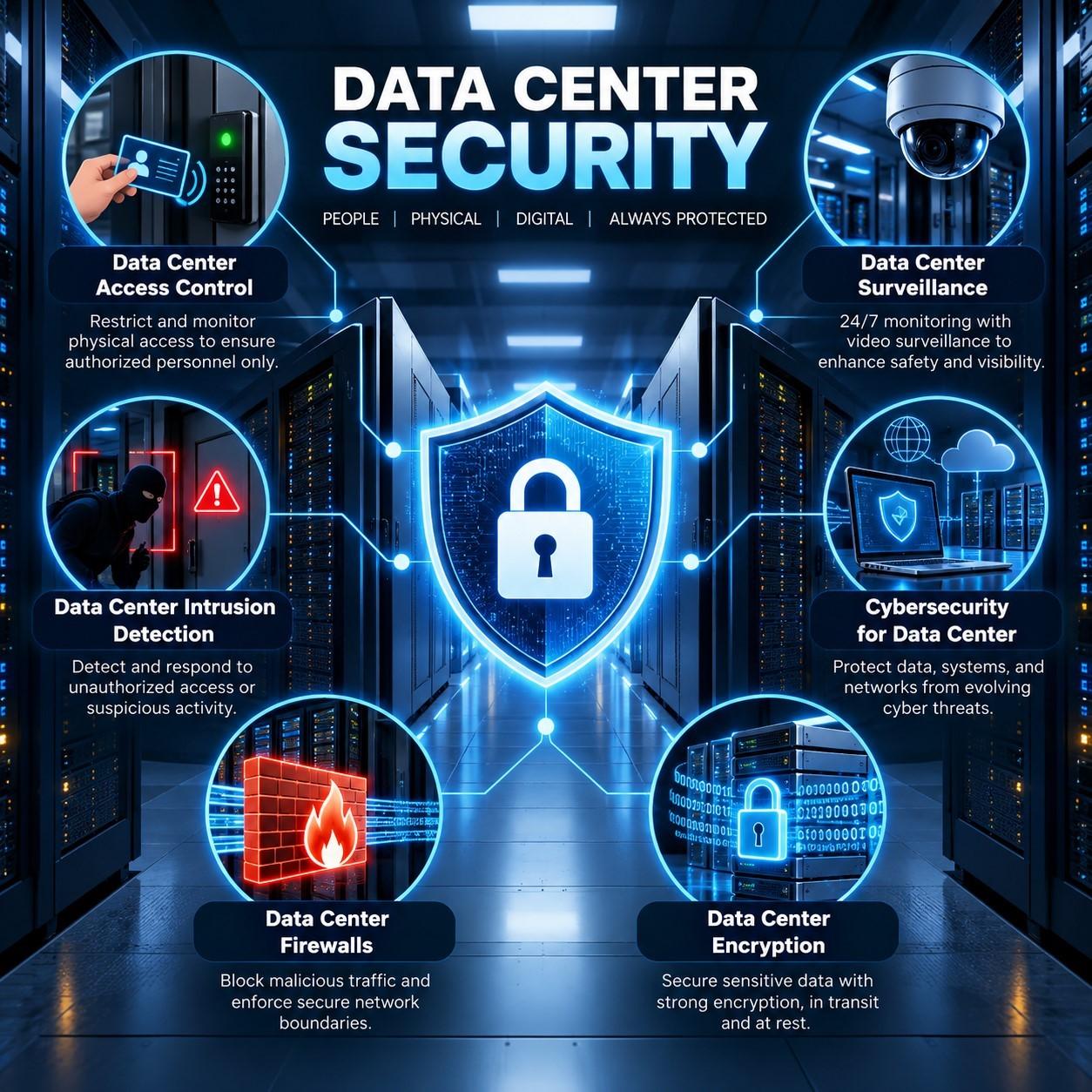
A data center is only as safe as its weakest stage, and in Saudi Arabia, where banks, ministries, hospitals, and cloud providers all depend on a few critical buildings, Data Center Security has to be planned from the day a site is chosen until the day-old equipment is retired, not added later as an afterthought.
What End to End Protection Means
Security is often bought piece by piece, a firewall in one year and cameras in the next. An end to end approach treats the facility as a complete lifecycle: site selection, design, construction, commissioning, daily operation, change management, and final decommissioning.
This article follows that lifecycle in order, showing which controls matter at each stage and how they fit together into one defensible whole.
Stage One: Choosing and Assessing the Site
Protection starts with geography. Planners examine flood risk, heat, dust and sand exposure, distance from public roads, grid reliability, fiber routes, and neighbouring land use. A site that looks cheap but sits beside a busy road or a flood channel will cost far more in mitigation later.
Threat Modeling Before the First Drawing
A short threat workshop lists realistic risks, from insider misuse to vehicle intrusion and cyber-attack, and gives the design team clear priorities before any money is committed.
Stage Two: Designing the Perimeter and Building Layers
Good design places layers between the public and the servers: fence, vehicle barrier, guarded gate, building envelope, lobby, corridor, data hall, cage, and rack. Each layer slows an intruder and buys time for staff to respond.
Standoff distance, blast resistant walls were justified, and carefully placed utilities all belong in the design, because they are very costly to add after construction.
Stage Three: Controlling Who Enters Each Layer
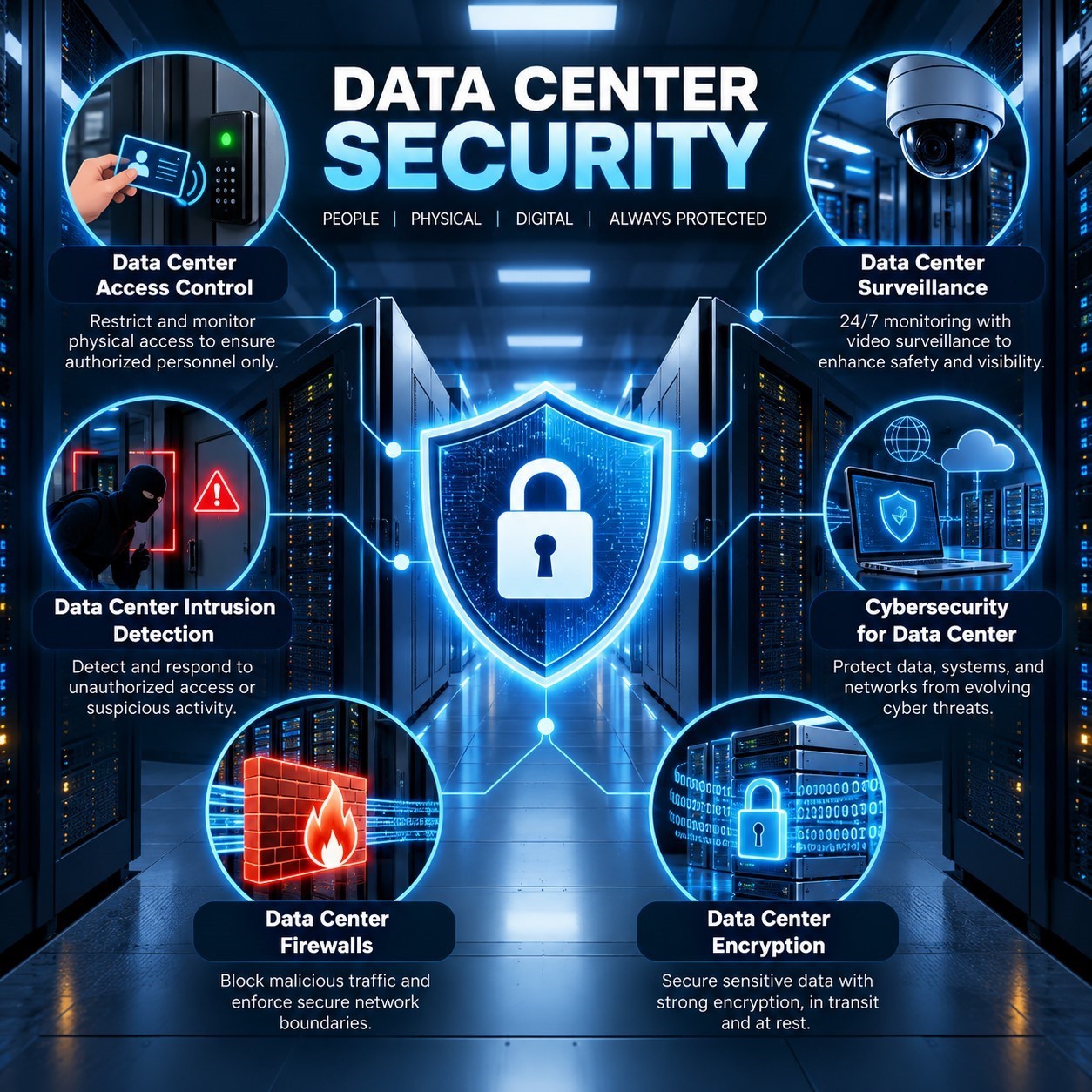
Many serious incidents begin with a person in the wrong room. Strong Data Center Access Control assigns permissions by role, zone, and time, uses biometrics or mobile credentials for sensitive areas, adds mantraps against tailgating, and logs every entry and exit against a named identity.
Contractor passes should expire automatically so a permit from last month cannot be used today.
Stage Four: Seeing the Whole Site
Cameras turn guesses into evidence. Well placed Data Center Surveillance covers fences, gates, corridors, and data halls with no blind corners and recordings kept long enough for audits. You can see how this fits a complete design on our end to end data center security page, including integration with doors and alarms.
Analytics can flag loitering, an open cabinet door, or an unauthorized vehicle, alerting operators within seconds.
Stage Five: Building the Cyber Foundation
Physical walls mean little if the network is open. Practical Cybersecurity for Data Center operations covers identity management, least privilege, patching, secure remote access, backups, and trained staff who rehearse their response before an incident occurs.
Management networks should be separated from customer networks, and administrator accounts reviewed regularly, because stale credentials are a favourite route for attackers.
Stage Six: Filtering Traffic Between Zones
Traffic should be inspected where it enters the site and again between internal zones. Properly configured Data Center Firewalls block unnecessary paths, log what they stop, and prevent one compromised server from reaching the database that holds sensitive records.
Scheduled rule reviews remove temporary exceptions that would otherwise widen the attack surface over time.
Stage Seven: Protecting the Data Itself
If every other control fails, information should still be unreadable. Data Center Encryption covers disks, backups, databases, and links between sites, with keys stored apart from the data and rotated on a schedule.
Encryption also supports compliance, because it shows regulators that sensitive records were protected even in a worst case.
Stage Eight: Detecting Break ins Early
Alarms must work at the network and at the door. Data Center Intrusion Detection watches for suspicious logins, forced doors, and unusual traffic, then notifies the response team while there is still time to contain the problem.
Careful tuning matters, because a system that raises hundreds of false alarms teaches staff to ignore the one alert that is real.
Stage Nine: Connecting Signals into One Picture
Individual alerts rarely tell the whole story. Data Center Threat Detection correlates events from servers, firewalls, cameras, and doors, so a badge used at an odd hour followed by an unusual login is treated as one incident with one response playbook.
Written playbooks and regular drills reduce decision time when pressure is highest.
Stage Ten: Power, Cooling, and Fire Resilience
Security also means keeping systems alive. Redundant power, tested generators, cooling designed for Saudi summers, early smoke detection, and clean agent fire suppression protect hardware as seriously as locks do. Fire protection and escape routes must meet Saudi Civil Defense requirements.
Regular failover tests under real load prove the design works and give customers and auditors real evidence.
Stage Eleven: Change Control and Safe Retirement
Many breaches follow poorly managed change, such as a new rule or device added without review. Formal change control, asset inventories, and regular audits keep the site in a known state, and secure decommissioning ensures retired disks are wiped or destroyed so no data leaves with them.
Certificates of destruction and logged chain of custody give owners proof that old equipment was handled properly.
Regulators and Standards in the Kingdom
Operators in Saudi Arabia work within the National Cybersecurity Authority controls, including the Essential Cybersecurity Controls and Cloud Cybersecurity Controls, the Personal Data Protection Law overseen by SDAIA, and the cloud rules of the Communications, Space and Technology Commission. Many facilities also pursue ISO 27001 certification, TIA 942 design ratings, and Uptime Institute tiers.
Documented policies, regular audits, and tested controls make each of these reviews shorter and calmer.
Experience and Trust Signals for Saudi Buyers
Our engineering team has delivered access, surveillance, and security projects across Saudi Arabia, the UAE, Qatar, Bahrain, and Kuwait, giving direct field knowledge of Gulf climate, approval routes, and regional compliance rather than assumptions borrowed from other markets.
Each project is handed over with drawings, configuration records, test results, and training, so operators and auditors can verify exactly how the site was secured.
Selecting Data Center Security KSA Partners Wisely
When comparing offers for Data Center Security KSA projects, buyers should weigh regional references, integration across physical and network layers, quality of local support, and willingness to document every control, and should treat price as one factor among several instead of the deciding point.
Priorities for Riyadh Facilities
Riyadh is becoming a major hub for government, finance, and cloud capacity, so Data Center Security Riyadh projects often need fast delivery, integration across several halls or sites, and local support that reaches the facility within hours when a fault appears.
Early coordination with consultants, contractors, and regulators keeps installation on schedule and avoids costly rework.
Conclusion
End to end Data Center Security protects Saudi digital infrastructure from site selection to safe retirement, with Cybersecurity for Data Center operations supported by Data Center Encryption and Data Center Firewalls. Data Center Access Control and Data Center Surveillance keep every person and movement accountable on site. Data Center Intrusion Detection and Data Center Threat Detection give teams early warning before incidents spread. For Data Center Security KSA and Data Center Security Riyadh projects, regional experience and documented controls decide long term success. Contact our team today to plan a secure and resilient facility.
FAQs
1. Why must Data Center Access Control use several layers instead of one main door?
Layers slow an intruder and limit the damage from a stolen credential, because each zone needs its own permission.
2. Where should Data Center Firewalls be placed inside a facility?
They belong at the site edge and between internal zones, so a compromised server cannot reach sensitive databases.
3. What does Data Center Encryption protect when a disk is removed?
Encrypted data stays unreadable without the correct keys, so a stolen or retired disk reveals nothing.
4. How does Data Center Intrusion Detection differ from a firewall?
A firewall blocks defined traffic, while intrusion detection watches for suspicious behaviour and alerts staff when something unusual happens.
5. Why does Data Center Threat Detection combine data from cameras and doors?
Linking physical and network events shows one connected incident instead of unrelated alerts, which speeds response.
 Arabic
 English
 French
 Spanish
 Portuguese
 Deutsch
 Turkish
 Dutch
 Italiano
 Russian
 Romaian
 Portuguese (Brazil)
 Greek
