


Flavors and Fragrances Market Trends Driving Industry Innovation
A familiar citrus note in a beverage, a botanical aroma in a skincare product, or a distinctive fragrance in a premium perfume can influence how consumers experience a product. These sensory elements are becoming increasingly important as brands compete through product differentiation, ingredient quality, and distinctive formulations.
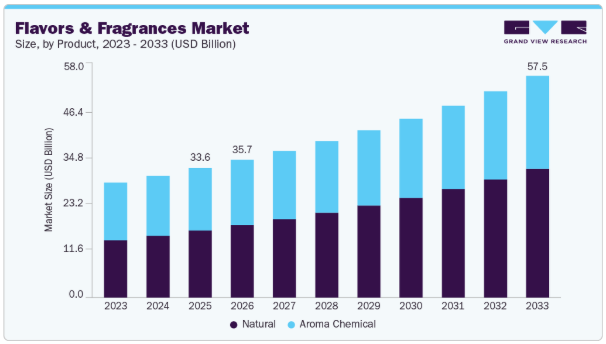
The global Flavors And Fragrances Market reached USD 33.6 billion in 2025 and is projected to increase from USD 35.7 billion in 2026 to USD 57.5 billion by 2033, registering a CAGR of 7.1%. Growing interest in natural ingredients, clean-label formulations, premium fragrances, and personalized sensory experiences is creating new avenues for market development.
The Shift from Ingredients to Experiences
Flavor and fragrance ingredients are no longer selected solely for their basic functional purpose. Manufacturers increasingly consider how taste and aroma influence product identity, consumer preferences, and perceived quality.
In food and beverages, flavor formulations help brands develop distinctive profiles for snacks, bakery products, dairy items, and beverages. Botanical infusions, fruit-derived ingredients, and globally inspired tastes are expanding product development possibilities.
In personal care, cosmetics, household products, and fine fragrances, scent contributes to product differentiation. Consumers are showing interest in premium, long-lasting, and distinctive fragrance profiles, encouraging the development of new formulations.
Gourmand profiles featuring notes associated with vanilla, chocolate, and caramel also connect food-inspired sensory experiences with premium fragrance and personal care products.
Want to Understand What’s Driving Market Growth? Ask Prism AI for research-backed insights into market size, evolving opportunities, and the forces shaping the Global Veterinary Diagnostics Market.
Natural Ingredients Take the Lead
Natural ingredients accounted for 51.6% of market revenue in 2025. Their prominence reflects growing consumer interest in recognizable ingredients, botanical extracts, essential oils, and plant-derived components.
The natural segment is projected to grow at a CAGR of 8.6% through 2033. Essential oils are expected to record an even faster CAGR of 9.5%, supported by applications across food and beverages, cosmetics, personal care, fragrances, and aromatherapy.
This shift creates opportunities for ingredient developers to improve extraction methods, strengthen sourcing traceability, and develop formulations that meet evolving expectations around sustainability and ingredient transparency.
However, natural sourcing presents practical challenges. Agricultural availability, raw material price fluctuations, and variations in ingredient composition can complicate production planning. Manufacturers must maintain consistent sensory performance while managing costs and supply reliability.
Fragrance Applications Dominate, While Flavors Expand
The fragrances segment accounted for 78.2% of global market revenue in 2025 and is projected to grow at a CAGR of 7.2% during the forecast period. Its extensive use across perfumes, personal care, cosmetics, and household products supports its dominant position.
Premiumization is an important influence, with consumers exploring niche scents, differentiated fragrance profiles, and products that deliver lasting sensory experiences. Natural extracts and biotechnology-derived ingredients are also creating opportunities for product differentiation.
The flavors segment is projected to grow at a CAGR of 6.7% from 2026 to 2033. Demand is supported by processed foods, packaged beverages, bakery products, and convenience foods. Manufacturers are exploring botanical, floral, savory, umami, and nostalgic profiles to respond to changing consumer tastes.
Encapsulation technologies can help protect sensitive flavor compounds, improve stability, and control release in food and beverage formulations. Such approaches offer practical opportunities to address formulation challenges while maintaining desired taste characteristics.
Download a free sample report or claim your copy of this full market intelligence report
Regional Markets Reflect Different Consumer Priorities
Europe held the largest regional share at 31.3% in 2025. Its established food, cosmetics, and fragrance industries, combined with consumer interest in ingredient transparency and sustainable products, support regional demand. Germany held the largest country share in 2025.
Asia Pacific is projected to record the fastest regional CAGR of 7.8% from 2026 to 2033. A large consumer base, competitive manufacturing capabilities, expanding food and beverage industries, and increasing demand for personal care products are contributing to the region's growth potential. China accounted for 36.2% of the regional market in 2025.
North America represented 30.0% of market revenue in 2025. Demand for natural ingredients, functional food products, premium personal care, and differentiated fragrances supports market activity.
Latin America is projected to grow at a CAGR of 7.3%, while the Middle East and Africa market is forecast to expand at a CAGR of 7.4%. In these markets, changing consumption patterns, expanding retail access, and demand for culturally relevant flavors and fragrance profiles create opportunities for localized product development.
Technology Is Changing How Ingredients Are Developed
Biotechnology, fermentation, synthetic biology, and advanced extraction methods are creating new ways to produce flavor and fragrance ingredients. These approaches can support the development of consistent compounds and alternatives to certain conventional sourcing methods.
Microencapsulation is another important technology, particularly for protecting sensitive ingredients and controlling their release. AI-assisted formulation can also support ingredient selection and formulation development, potentially improving the efficiency of product innovation.
Sustainability remains closely connected to these developments. Manufacturers are exploring renewable feedstocks, responsible sourcing, and production processes designed to reduce environmental impact. At the same time, regulatory requirements and safety expectations continue to influence ingredient selection and formulation practices.
What Could Limit Expansion?
Despite favorable demand trends, the market faces challenges associated with raw material availability, price volatility, supply chain complexity, and regulatory compliance. Natural ingredients can be more expensive and variable than some synthetic alternatives, making consistency difficult to maintain at scale.
Manufacturers must also balance sensory quality, formulation performance, cost, and sustainability objectives. Continued investment in research and development, supplier relationships, and advanced production methods will be important for addressing these competing requirements.
Market Outlook to 2033
The projected expansion to USD 57.5 billion by 2033 highlights the growing commercial importance of flavors and fragrances across food, beverages, personal care, cosmetics, and household products.
Natural ingredients and essential oils offer substantial growth opportunities, while fragrances remain the largest application segment. Meanwhile, biotechnology, encapsulation, and differentiated sensory profiles are expanding the possibilities for future formulations.
The market's direction will ultimately be shaped by the ability to combine consumer appeal with consistent quality, responsible sourcing, and cost-effective production.
Explore Our Research & Intelligence Solutions
Grand View Signal: Understand the Factors Shaping Commodity Prices – Explore the Platform

 English
 Arabic
 French
 Spanish
 Portuguese
 Deutsch
 Turkish
 Dutch
 Italiano
 Russian
 Romaian
 Greek
