


Enhanced Oil Recovery Market Technology and Innovation
The next opportunity in oil production may lie beneath fields that companies already know. As conventional reservoirs mature and output declines, energy producers are looking for ways to extract the oil that traditional recovery methods leave behind. Enhanced oil recovery (EOR) is becoming an important part of this strategy, combining specialized extraction techniques with reservoir management to improve production from existing assets.
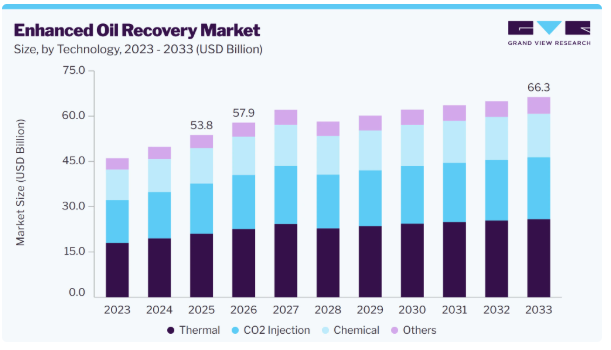
The global Enhanced Oil Recovery Market was valued at USD 53.8 billion in 2025. It is projected to reach USD 66.3 billion by 2033, expanding at a CAGR of 2.0% between 2026 and 2033. North America accounted for 38.2% of market revenue in 2025.
The Industry Is Rethinking Existing Oil Reserves
For oil producers, declining output from established fields creates a difficult business decision: invest in new exploration or attempt to recover more oil from current operations. EOR technologies provide another route by targeting hydrocarbons that remain trapped within reservoir formations.
Primary and secondary recovery methods cannot extract all the oil originally present in a reservoir. Advanced recovery techniques can help improve the amount recovered, extend the productive life of mature fields, and make existing infrastructure more useful.
This approach is attracting attention as energy demand grows and governments and producers continue to consider energy security. Mature oilfields account for approximately 70% of global oil production, according to the supplied market report, making recovery optimization an important industry consideration.
Inside the Recovery Toolkit
Rather than relying on a single extraction method, the market brings together technologies designed for different reservoir conditions.
Thermal recovery — the leading technology
Thermal methods use heat to improve oil extraction, particularly from heavy-oil reservoirs. Steam injection and in-situ combustion are important techniques in this category. Thermal recovery held a 39.1% revenue share in 2025.
Gas injection — improving reservoir recovery
Gas injection techniques help operators recover additional oil from formations where conventional production has become less effective. Their suitability depends on reservoir characteristics and project requirements.
Chemical recovery — adapting to field conditions
Chemical methods provide another option for improving extraction. Their application requires an assessment of reservoir properties, operating requirements, and the economic value of the expected production gains.
Want to Understand What’s Driving Market Growth? Ask Prism AI for research-backed insights into market size, evolving opportunities, and the forces shaping the Global Veterinary Diagnostics Market.
The choice between these technologies depends on the reservoir, the type of oil, available infrastructure, and the cost of implementation. Effective project planning is essential because a technique that works in one field may not deliver the same results in another.
Why Onshore Assets Have the Advantage
Onshore applications accounted for 89.4% of market revenue in 2025. Their leading position reflects the presence of mature onshore fields and the opportunity to improve production using established wells and infrastructure.
For operators, existing facilities can provide a foundation for introducing advanced recovery methods. This may reduce the need to build an entirely new production operation, although specialized equipment and additional infrastructure can still require considerable investment.
Onshore EOR activity is particularly relevant in areas with aging reserves across North America, the Middle East, and Africa. As fields experience natural production declines, operators are evaluating ways to maintain output and improve the economics of existing assets.
The Carbon Connection: An Opportunity With Conditions
One developing area is carbon dioxide-based enhanced oil recovery, commonly called CO₂-EOR. Captured carbon dioxide can be injected into suitable reservoirs to support oil recovery, creating a potential connection between carbon management projects and established oil production.
The opportunity is closely linked to investment in carbon capture, utilization, and storage infrastructure. Oil and gas companies may be able to incorporate captured carbon into recovery operations where the technical and commercial conditions support it.
However, CO₂-EOR is not automatically economical or environmentally beneficial in every application. Carbon sourcing, transportation, injection infrastructure, reservoir suitability, and project costs all influence its feasibility. These considerations will shape how widely the approach is adopted.
Regional Markets: Different Resources, Similar Priorities
North America remains the largest regional market. The United States leads the region's national markets, supported by mature oilfields, unconventional resources, and the use of thermal recovery, gas injection, and chemical flooding. Canadian producers also apply EOR technologies to improve extraction from existing fields.
Elsewhere, market development reflects different production challenges:
- Asia Pacific: Industrialization and urbanization in China and India are increasing energy requirements and strengthening the need to optimize existing oil reserves.
- Europe: Aging oilfields, including fields in the North Sea, are encouraging the adoption of methods that can sustain production.
- Central and South America: Oil resources in Brazil and Argentina provide opportunities to improve recovery from established fields.
- Middle East and Africa: Extensive reserves and mature reservoirs support demand for advanced extraction methods.
Across these markets, the shared objective is to improve resource utilization while managing the cost and complexity of oil production.
Download a free sample report or claim your copy of this full market intelligence report
The Economics Behind Every EOR Decision
The main obstacle to broader adoption is the investment required. EOR projects can involve specialized equipment, injection systems, advanced materials, and detailed reservoir assessments. Operating expenses and fluctuations in crude oil prices can further influence expected returns.
Research and technology development are helping the industry explore ways to improve recovery performance. In May 2026, North Dakota announced a USD 157 million research initiative focused on boosting oil production through advanced recovery and reservoir management technologies.
Digital oilfield tools and improved reservoir characterization may also help operators make better-informed decisions about where to deploy recovery methods. Nevertheless, project-specific evaluation remains essential.
Key Companies Shaping the Market
The Enhanced Oil Recovery Market includes established energy companies with experience in reservoir management, production optimization, and advanced extraction technologies.
- BP plc
- Cenovus Energy, Inc.
- Chevron Corporation
Competition depends on the ability to improve recovery efficiency, manage costs, and apply suitable technologies across diverse reservoir conditions. Technical capabilities and experience with mature oilfields remain important advantages.
What Will Define the Market's Next Phase?
The future of enhanced oil recovery will depend less on adopting one universal solution and more on matching technologies to individual field requirements. Thermal methods will remain important, while gas injection, chemical recovery, digital reservoir management, and CO₂-EOR offer additional approaches for improving production.
With the market projected to reach USD 66.3 billion by 2033, opportunities will continue to centre on extracting more value from existing assets. Companies that balance production gains with investment discipline and effective reservoir management will be better positioned to benefit from the industry's gradual expansion.
Explore Our Research & Intelligence Solutions
Prism AI: Ask. Analyze. Get Cited Market Insights. – Explore Now
Grand View Signal: Understand the Factors Shaping Commodity Prices – Explore the Platform
 Turkish
 English
 Arabic
 French
 Spanish
 Portuguese
 Deutsch
 Dutch
 Italiano
 Russian
 Romaian
 Portuguese (Brazil)
 Greek
