


Consultancy Market Analysis Certification (CMA): Your Fast Track to a Career in Strategy and Consulting
Turn Market Knowledge into Better Business Decisions
Good consultants do more than offer opinions. They investigate markets, interpret financial information, evaluate risk and help organisations make decisions based on evidence. Whether a business is considering an investment, assessing a new opportunity or reviewing its strategic direction, the quality of its analysis can influence the decisions that follow.
This is why financial market knowledge can be valuable for aspiring consultants and business professionals. Understanding investment products, market behaviour, taxation and regulation provides a stronger foundation for evaluating commercial opportunities and explaining financial risks.
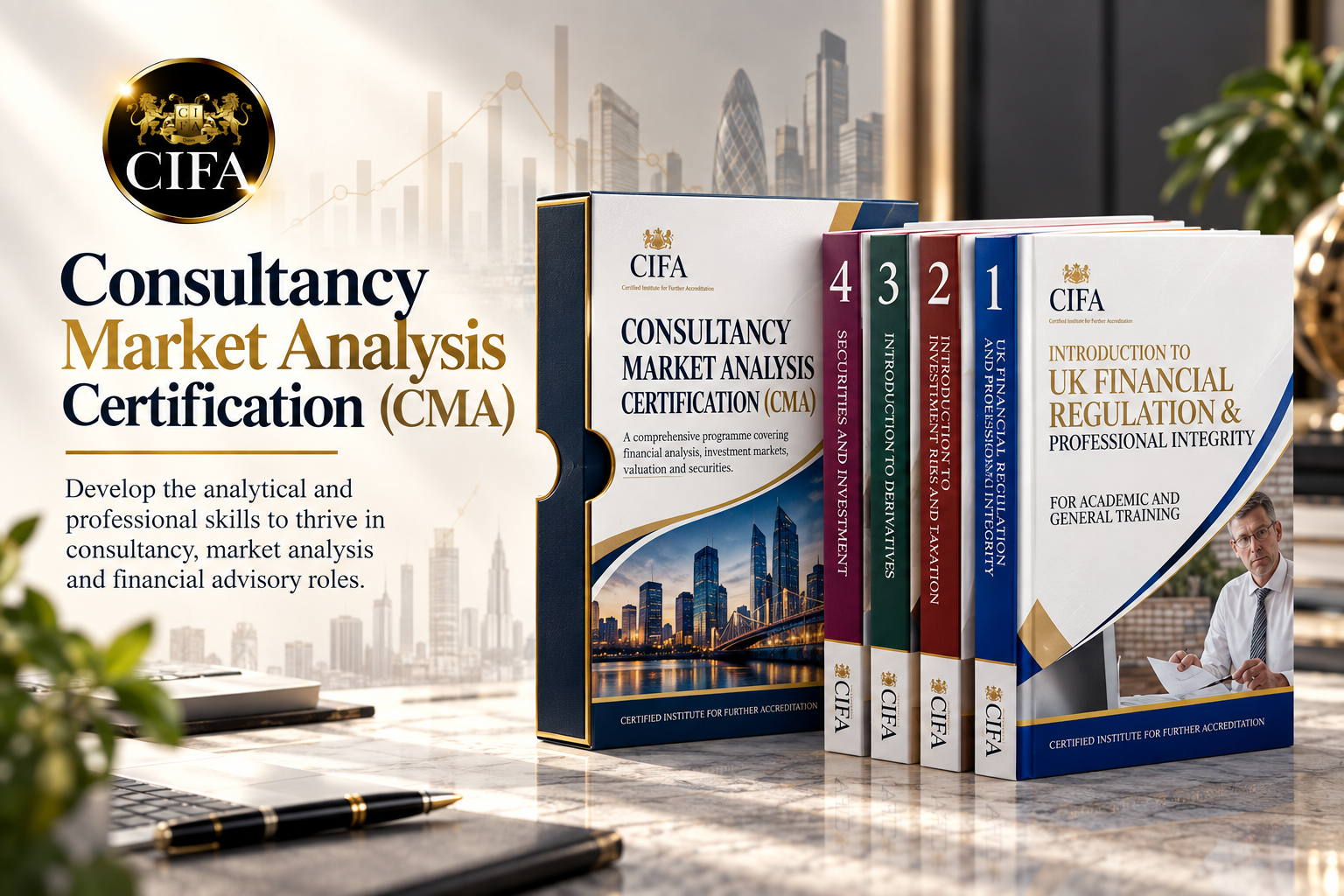
The Consultancy Market Analysis Certification (CMA) from CIFA is designed to develop knowledge across several connected areas of financial services. Through its four-course structure, the programme introduces financial regulation, investment risk and taxation, derivatives, and securities and investment. Learners interested in exploring this pathway can explore the CMA programme to review the course details and learning structure.
Although the programme focuses on financial markets rather than every aspect of management consulting, its subject coverage can provide a useful foundation for individuals who want to strengthen their analytical understanding and explore opportunities in finance-related consulting, investment analysis and business support.
Why Market Analysis Matters in Consulting
Consulting involves identifying problems, evaluating possible solutions and helping clients make informed decisions. Market analysis supports this process by examining the financial, competitive and economic factors that may affect an organisation.
Consider a business planning to enter a new market. Before recommending a strategy, an adviser may need to understand the industry's financial conditions, the risks associated with investment, relevant regulations and the characteristics of available financial products. A recommendation that ignores these factors may overlook important costs or expose the business to unnecessary risk.
Market analysis is equally relevant when assessing investment opportunities. Changes in interest rates, market prices, taxation and investor behaviour can influence financial outcomes. Understanding these relationships helps professionals ask better questions, challenge assumptions and distinguish between an attractive opportunity and one that carries risks the client may not fully appreciate.
For aspiring consultants, this knowledge can strengthen the financial dimension of their analysis. It does not replace broader consulting skills such as client communication, project management and operational strategy, but it can complement them.
What Does the CMA Certification Cover?
The CMA programme listed by CIFA combines four courses into one digital learning bundle. Each course addresses a different area of financial knowledge, helping learners build a more connected understanding of markets, investments and regulation.
1. UK Financial Regulation and Professional Integrity
Business and financial decisions take place within a regulatory environment. This module introduces the UK financial regulatory framework, including the roles of relevant regulatory bodies such as the Financial Conduct Authority (FCA) and the Prudential Regulation Authority (PRA).
Learners also explore professional integrity, ethical conduct and the importance of maintaining appropriate standards in financial services.
For someone interested in consulting, this knowledge is useful because recommendations must account for more than commercial potential. Regulatory responsibilities, customer protection and professional ethics can all influence which options are appropriate.
Understanding these principles helps learners recognise why sound analysis should consider both the benefits and the limitations of a proposed decision.
2. Investment Risk and Taxation
Every financial opportunity involves uncertainty. Market movements, credit exposure, liquidity constraints and changes in economic conditions can affect the value and performance of investments.
This module introduces different types of investment risk and examines taxation considerations that may influence financial decisions. Learners develop a foundation for understanding the relationship between potential returns, risk exposure and tax implications.
These concepts can be relevant when evaluating investment proposals, comparing financial options or examining the assumptions behind a business recommendation.
For example, an investment that appears attractive based on its projected return may look different once its risk profile, liquidity requirements and applicable taxation are considered. A more complete analysis recognises these factors rather than relying on a single performance measure.
3. Introduction to Derivatives
Derivatives are financial instruments whose value is linked to an underlying asset, rate or other reference. Common examples include futures, options, forwards and swaps.
They can be used for purposes such as hedging, managing exposure and taking positions on market movements. However, derivatives can also involve complexity and substantial risk, depending on how they are structured and used.
The CMA programme introduces the characteristics and applications of these instruments, helping learners understand their place in modern financial markets.
This knowledge may be particularly relevant to individuals interested in investment-related consulting or financial analysis. It provides context for understanding how organisations manage certain financial exposures and why derivative transactions require careful assessment.
4. Securities and Investment
Securities form an important part of capital markets. Shares, bonds and collective investment products have different characteristics, risks and potential uses within an investment portfolio.
This module introduces securities and investment principles, including how financial instruments operate and how investors may evaluate their features. It also provides context for portfolio construction, diversification and the relationship between risk and return.
For aspiring analysts and consultants, understanding these instruments can help when reviewing investment information, comparing asset classes or discussing the financial considerations behind a strategic decision.
The objective is to build foundational knowledge, not to replace advanced investment training or the practical experience required for specialist analytical positions.
Who Should Consider the CMA Programme?
The Consultancy Market Analysis Certification (CMA) may appeal to graduates, aspiring finance professionals and individuals seeking to broaden their understanding of investment markets.
People considering a move into financial services may use the programme to develop foundational knowledge before pursuing entry-level opportunities. Existing professionals in administrative, operational or financial support roles may also find the subject coverage useful when planning their next stage of development.
The course may be relevant to aspiring consultants who want a stronger understanding of financial markets, particularly those interested in investment-related projects, financial services businesses or market-facing organisations.
However, learners should distinguish between financial market analysis and the wider discipline of management consulting. Management consultants may also need expertise in areas such as business operations, organisational change, commercial research, project delivery and client relationship management. Those aiming for a broader consulting career should develop these complementary capabilities alongside their financial knowledge.
What Skills Can Learners Develop?
A structured course can help learners organise their understanding of complex subjects and develop a clearer vocabulary for discussing financial decisions. The value of that knowledge depends on how well it can be applied and communicated.
The CMA programme's subject areas can support the development of several foundational capabilities:
-
Financial analysis: understanding investment products, market information and financial considerations.
-
Risk assessment: recognising different forms of investment risk and considering their possible implications.
-
Regulatory awareness: understanding why financial activities operate within defined legal and professional standards.
-
Critical thinking: examining assumptions, comparing alternatives and considering more than one factor before reaching a conclusion.
-
Ethical judgement: appreciating the importance of integrity and responsible conduct when handling financial information.
These skills can complement the broader analytical approach required in consulting. To strengthen them further, learners can practise reviewing company reports, following market developments and writing short, evidence-based assessments of financial scenarios.
Career Opportunities and Professional Development
The CMA programme can help learners explore possible career directions, although suitable opportunities will depend on their experience, additional skills and employer requirements.
Potential pathways to investigate include junior financial analyst, investment operations assistant, research support analyst, financial services consultant at an appropriate entry level, and business or market research support roles involving financial information.
Some learners may also use the programme as a starting point before pursuing more specialised training in investment analysis, financial planning, risk management or consulting.
It is important to be realistic about career outcomes. Completing the certification does not guarantee a consulting position or automatically qualify someone to provide regulated financial advice. Employers may look for relevant qualifications, analytical tools, communication skills, industry experience and evidence of practical problem-solving.
A sensible approach is to review vacancies in your chosen field, identify the skills they repeatedly request and build a development plan around those requirements. Practical projects, case studies and work experience can help turn theoretical knowledge into demonstrable ability.
How to Get More Value from the Certification
The strongest learning outcomes come from connecting course content with real questions. When studying investment risk, for example, consider how changing market conditions could affect an investment decision. When exploring financial regulation, examine why compliance requirements matter to the organisations and customers involved.
You can also practise preparing concise market assessments. Identify a financial topic, gather reliable information, outline the main opportunities and risks, and explain your conclusions in clear language. This exercise develops the ability to communicate analysis—a useful skill in both consulting and financial services.
Before enrolling, review the current course structure, assessment requirements, study commitment and total cost. The CMA bundle is listed by CIFA as a digital programme comprising four courses, with a published price of £1,249 and a stated total duration of 610 hours. Confirm the latest details with the provider, as course information and fees can change.
For further information about the training provider and its wider course offering, visit About CIFA.
Build Your Foundation for a More Analytical Career
A successful consulting recommendation depends on evidence, sound judgement and an understanding of the environment in which a client operates. Financial market knowledge can contribute to that process by helping professionals evaluate investment considerations, recognise risk and understand the regulatory context surrounding financial decisions.
The Consultancy Market Analysis Certification (CMA) offers a structured introduction to four important areas: UK financial regulation and professional integrity, investment risk and taxation, derivatives, and securities and investment.
For learners interested in finance-related consulting or developing stronger financial analysis skills, it can be a useful part of a wider professional development plan. Combined with practical experience, clear communication and continued learning, this foundation can help learners prepare more confidently for the next stage of their careers.
 Turkish
 English
 Arabic
 French
 Spanish
 Portuguese
 Deutsch
 Dutch
 Italiano
 Russian
 Romaian
 Portuguese (Brazil)
 Greek
