


Docking Station Market Future Driven by Computing Flexibility
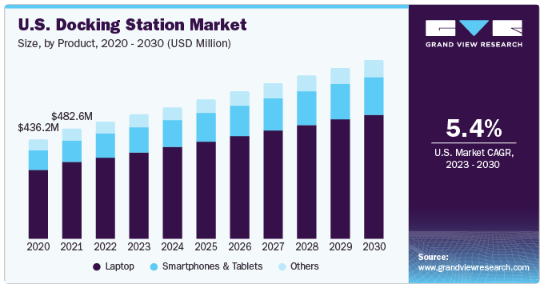
The global Docking Station Market is projected to increase from USD 1.5 billion in 2022 to USD 2.4 billion by 2030, growing at a CAGR of 6.1% from 2023 to 2030. The market is expected to reach USD 1.9 billion in 2026 as businesses and consumers seek more efficient ways to connect laptops, smartphones, tablets, and peripheral devices. The growing adoption of remote work, hybrid offices, and Bring-Your-Own-Device (BYOD) policies is creating new demand for accessories that simplify device connectivity.
North America accounted for 37.4% of market revenue in 2022. However, the industry's development extends beyond regional demand. Changing workstation habits, the growth of mobile computing, advances in wireless connectivity, and the expansion of digital retail are influencing how manufacturers design, distribute, and position docking stations.
A Market Built Around Changing Device Habits
The traditional desktop workstation has increasingly given way to flexible computing arrangements. Laptops allow employees to work across locations, but users often still need external monitors, keyboards, storage devices, and other peripherals to perform complex tasks. Docking stations bridge this gap by enabling a portable computer to function as part of a more complete workstation.
This requirement became particularly visible during the expansion of remote work, when demand for laptops and associated accessories increased. Manufacturers across the consumer electronics industry responded to changing purchasing patterns, while brands adjusted their sales strategies to reach customers through online channels and direct-to-consumer platforms.
The same underlying shift continues to influence demand: consumers want computing equipment that can adapt to different activities without requiring an entirely separate setup for every device. Docking stations therefore serve both professional productivity and personal entertainment needs.
Why Laptops Continue to Anchor the Market
Laptop docking stations accounted for 72.0% of global market revenue in 2022. Their position reflects the extensive use of portable computers across corporate offices, supply chains, e-commerce operations, and remote working environments.
For businesses, docking stations can help standardize employee workstations while preserving the portability of laptops. A user can move a laptop between locations and reconnect it to compatible peripherals when needed. This flexibility is particularly useful in offices with shared workstations, meeting rooms, and adaptable desk arrangements.
The opportunity is not limited to conventional office applications. As laptops remain important tools for professional and creative work, docking accessories can support configurations involving multiple displays and other connected equipment.
Smartphones and tablets represent a developing opportunity. This segment is expected to record a CAGR of 6.4% during the forecast period, the fastest growth among the product categories discussed in the supplied market information. Mobile gaming and the increasing functionality of portable devices are contributing to interest in accessories that extend their capabilities.
Connectivity Is the Central Product Decision
The distinction between wired and wireless docking stations reflects two different customer priorities. Wired products dominated the market in 2022, accounting for approximately 73% of revenue. Their established position is supported by reliable connections and high-speed data transfer, particularly where users depend on external monitors and consistent peripheral performance.
Wireless docking stations offer greater flexibility in device placement and can reduce cable clutter. Technologies including Wi-Fi, Bluetooth, and WiGig are helping manufacturers develop alternatives for users who prefer less complicated workstation arrangements. This segment is projected to grow at a CAGR of 6.3% during the forecast period.
Download a free sample report or claim your copy of this full market intelligence report
The continued presence of both technologies means that product development must respond to the intended use case. Professional users may prioritize dependable connections, while consumers creating flexible home workspaces may place greater emphasis on convenience. Compatibility, installation simplicity, and performance remain important considerations across both categories.
Retail Competition Is Moving Beyond the Storefront
Offline channels held 57.4% of docking station revenue in 2022. Physical retailers remain relevant because customers can examine accessories, seek specialist recommendations, and receive support when choosing products for particular computers or devices.
Online retail is changing the competitive environment by making it easier to compare specifications, brands, and prices. E-commerce platforms can offer broad product selections, discounts, and convenient purchasing options. These advantages create opportunities for manufacturers to reach customers beyond traditional retail networks.
For suppliers, distribution strategy increasingly involves balancing physical availability with digital visibility. Retail partnerships can provide customer access and product support, while online channels offer additional reach and purchasing convenience. Marketing initiatives, sponsorships, and brand collaborations can further improve awareness in competitive accessory categories.
Regional Demand Reflects Different Technology Priorities
North America's 37.4% revenue share in 2022 establishes the region as the leading market in the supplied data. Its established use of laptops, PCs, and smartphones, together with flexible working practices and interest in esports, supports demand for docking accessories.
Asia Pacific presents an important growth opportunity as IT activity, manufacturing automation, and the adoption of connected devices expand. Increasing use of laptops, tablets, and smartphones across professional and consumer applications can broaden the potential market for docking products.
The Middle East and Africa region is also expected to experience significant demand. Replacement of older computing equipment may encourage purchases of new desktops and laptops, subsequently creating demand for compatible accessories. These differences suggest that manufacturers need distribution and product strategies suited to the maturity and purchasing needs of individual markets.
Product Launches Reveal the Competitive Direction
Recent product developments illustrate how manufacturers are differentiating their offerings rather than relying exclusively on basic connectivity.
In July 2021, Targus partnered with Samsung to launch a DeX-enabled Universal USB-C Phone Dock. The product addressed the growing intersection between smartphone functionality and docking accessories.
In March 2022, Dell Technologies introduced a docking station with a wireless charging stand for compatible smartphones and earbuds. This approach combined workstation connectivity with additional charging functionality.
Two further developments followed in April 2022. Targus announced two Thunderbolt 3 docking stations designed for high-resolution graphics and the requirements of creative professionals and studios. Kensington, a sub-brand of ACCO Brands, introduced a Blackbelt Rugged Case with an integrated mobile dock for Surface Pro 8, combining device protection with docking capabilities.
These examples highlight several directions for product differentiation: higher-performance connections, mobile-device support, integrated charging, and rugged designs for specialized users.
The Road to 2030
With the global docking station market projected to reach USD 2.4 billion by 2030, growth will depend on continued demand for flexible computing, the expansion of connected devices, and manufacturers' ability to address changing customer requirements.
Laptop docking stations remain the established foundation of the industry, while smartphone and tablet accessories provide opportunities for product expansion. Wired connectivity continues to serve performance-focused users, and wireless technologies offer another path toward more adaptable workspaces. Meanwhile, changing retail habits are creating new ways to reach buyers.
The industry's long-term opportunity lies in making connections between devices simpler, more dependable, and better suited to how people work and use technology.
Explore Our Research & Intelligence Solutions
Prism AI: Ask. Analyze. Get Cited Market Insights. – Explore Now
Grand View Signal: Understand the Factors Shaping Commodity Prices – Explore the Platform

 English
 Arabic
 French
 Spanish
 Portuguese
 Deutsch
 Turkish
 Dutch
 Italiano
 Russian
 Portuguese (Brazil)
 Greek
