


ISO Consultancy for Multi-Site Businesses in Malaysia: How Can Companies Standardise Processes Across Locations?

ISO consultancy helps multi-site businesses in Malaysia by defining which processes must be identical across locations, which can vary, and which central functions hold the system together, so that every branch, plant or outlet works from the same core system and can be audited on the same basis. Consultants also help decide whether one multi-site certificate or several separate ones fits the business.
Standardisation is not uniformity at any cost. This article takes a third-party view of how multi-site certification works, why consistency across locations is hard, how ISO consultancy for multi-site businesses helps, and where the risks and criticisms lie.
What Is Multi-Site ISO Certification, and How Does It Work?
Multi-site certification lets an organization with several locations, run from a central function under one management system, hold a single certificate covering all listed sites. The certification body audits the central function every time and, where the organization is eligible, only a sample of the sites.
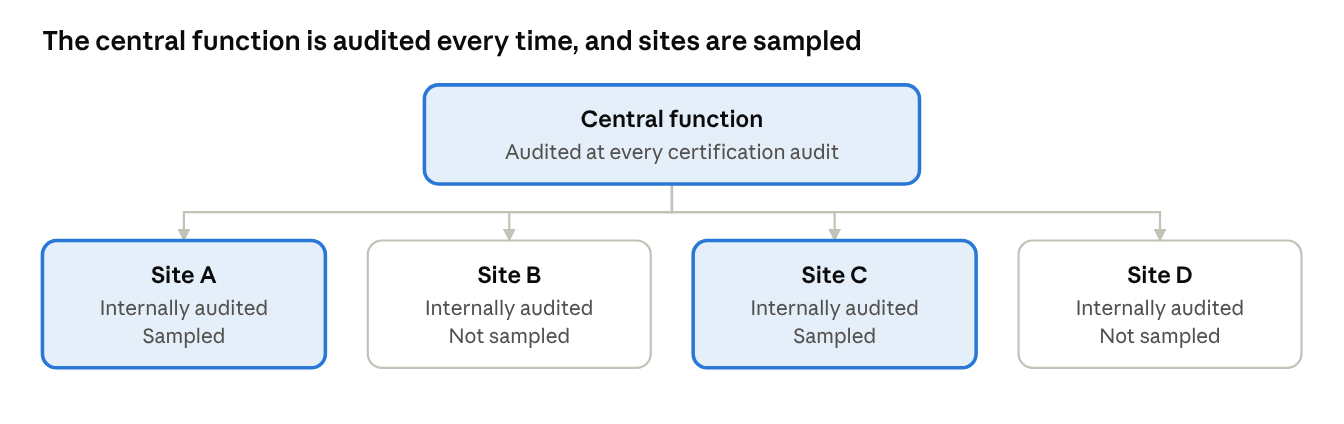
Multi-site certification · 1 central function, 4 sites (illustrative sample)
In this illustration, four sites mean a sample of two, although every site must still be covered by the internal audit programme.
Which Organizations Are Eligible?
The rules come from IAF Mandatory Document 1 (IAF MD 1), which sets out what makes an organization suitable. It needs an identified central function with authority over the sites, a single management system, sites that perform very similar processes, an internal audit programme covering every site, and a central function that collects and analyses data from all of them. Not every standard is suitable, and not every multi-site organization qualifies for sampling. Where sites do very different work or operate independently, sampling is usually refused and every site is audited. Some certification bodies also state that franchise arrangements are generally not eligible.
How Does Site Sampling Work?
For a normal risk profile, the initial audit sample is the square root of the number of sites, rounded up. A European Accreditation FAQ applying IAF MD 1 shows smaller samples at surveillance, at 0.6 times the square root, and larger ones at recertification, at 0.8 times, and at least a quarter of the sample must be chosen at random. The central function is audited at every certification and recertification audit, and the certification body can widen the sample whenever concerns arise. Over a three-year cycle most sites are therefore seen, which is why ISO consultancy for multi-site businesses concentrates on making every site ready, not just those likely to be picked.
Why Is It Hard to Standardise Processes Across Locations?
It is hard because each location has its own history, people, customers and local conditions, so practices drift apart over time, and central teams often lack the authority or visibility to pull them back together. Growth and acquisitions make the problem worse by adding legacy methods that never fully merge.
What Causes Variation Between Sites?
Practitioners most often point to these causes:
• Legacy practices inherited from acquired or long-established sites
• Local managers who run their sites with considerable autonomy
• Different customers, products or equipment at each location
• Staff turnover and uneven training
• Documents copied from the head office and then edited locally
One vendor describes the typical result as three sites, three versions of a document, and one certificate that covers all of them.
Why Does Variation Matter for ISO?
It matters because every site in the scope is subject to the full requirements of the standard, and auditors compare findings across locations to spot inconsistency. Certification body guidance warns that a major failure at one site can affect certification for all sites, so a weak location puts the whole certificate at risk.
Is All Variation Bad?
No. Some variation is legitimate, such as different equipment, local legal requirements or a different customer base. The aim is to control variation, not erase it. That means deciding in advance which processes must be identical, which may differ in defined ways, and who has authority to approve the difference. This is the central question in ISO consultancy for multi-site businesses.
How Does ISO Consultancy for Multi-Site Businesses Help Standardise Processes?
It helps by mapping what each site actually does, defining a common core of processes with controlled local variants, building the central functions that hold the system together, and preparing every site to the same standard. The goal is consistency where it matters and flexibility where it does not.
What Is a Common Core With Local Variants?
A common core is the set of processes and documents that must be the same everywhere, such as the policy, document control, internal audit, corrective action, management review, competence and supplier control. Local variants cover site-specific activities, for example a different machine or a different service format, and they sit under central control with an approval route for any difference. This keeps one system while respecting real local needs.
How Does Consultancy Build Central Capability?
It helps the head office take on the role the certification rules expect. The central function needs authority to require corrective actions at sites and responsibility for collecting and analysing data from all of them. In practice that means one controlled document library with a single current version, a central register of findings and actions, cross-site internal auditors who do not audit their own location, and a management review that uses data from every site.
Can Consultants Help Every Site Become Audit-Ready?
They can, and the usual method is to pilot the system at one site, learn from it, and then roll it out with trained site champions. Because the certification body samples sites and can widen the sample, a sensible rule is to prepare every site as if it will be visited. Mock audits that rotate across locations expose weak sites before the certification body does, which is one of the clearest benefits of ISO consultancy for multi-site businesses.
What Does a Multi-Site ISO Project Look Like Step by Step?
A multi-site project maps the sites, tests eligibility, sets up the central function, designs a common core with local variants, pilots it at one site, rolls it out, audits every site internally and then goes to the certification audit.
What Are the Steps?
The steps usually run as follows:
1. Map every site: activities, size, staff, customers and legal link to the central entity.
2. Test eligibility for a multi-site certificate with the certification body, including whether sampling applies.
3. Establish the central function and give it authority over the sites.
4. Run a gap analysis at a representative set of sites.
5. Design the common core and the approved local variants.
6. Pilot at one site, refine, then roll out to the rest.
7. Complete an internal audit at every site, followed by a central management review, before the certification audit.
8. Go through the certification audit, which covers the central function and the sampled sites, and close findings across all sites.
How Are New Sites Added Later?
The certification body decides whether a new site must be audited before it joins the certificate. Where sampling is not appropriate, a new site is audited first. Planning for growth is therefore part of good design, since a system built around a clear common core makes each additional location easier to bring in.
What Is a Realistic Timeline?
It depends on the number of sites, their starting point and the central team's capacity, and no reliable public benchmark turned up in this research. Phasing the work, with a pilot first, is safer than promising a date for all locations at once.
What Are the Risks and Criticisms of ISO Consultancy for Multi-Site Businesses?
The main risks are over-standardisation, shared fate if one site fails, a central bottleneck, cost, and systems that sites do not feel they own. Each is manageable, but a fair assessment of ISO consultancy for multi-site businesses has to include them.
What Do Critics Say?
Critics raise five concerns:
• Over-standardisation: identical procedures forced onto sites with different realities create paper compliance and informal workarounds
• Shared fate: a major failure at one site can affect certification for all sites, and practitioners summarise the downside as "if one fails they all fail"
• Central bottleneck: a head office that controls every change slows the sites down
• Eligibility limits: not every organization qualifies for sampling, and the certification body can widen the sample
• Cost: a central team, cross-site auditing and travel all add expense
What Do Supporters Reply?
Supporters reply that a common core with approved local variants answers the over-standardisation charge, and that shared fate encourages sites to help one another instead of working in isolation. A single certificate with sampling can also lower audit effort compared with certifying each site separately, and central data gives management one view of performance. Where the sites are too different for one system, separate certificates remain an option, which the next section covers.
How Should a Company Decide Between One Multi-Site Certificate and Separate Certificates?
A company should choose one multi-site certificate when its sites perform very similar processes under a strong central function, and separate certificates when sites differ significantly, operate independently or must hold their own certificates for customers or regulators.
What Questions Help Decide?
Five questions help: do the sites perform very similar processes, does the head office have real authority and data, do customers or tenders require site-specific certificates, can the business accept the shared-fate risk, and do some sites need certification sooner than others.
Which Option Fits Which Situation?
• One multi-site certificate: a network of similar plants, branches or outlets managed from a strong centre
• Separate certificates: diverse business units with different processes and risks
• A mix: similar sites grouped under one certificate and the rest certified separately
The certification body has the final say on eligibility, so testing the plan with it early avoids redesign later.
Final Takeaway
Standardisation works when it is designed, not imposed. ISO consultancy for multi-site businesses is most useful when it defines a common core, controls local variants, builds a central function with real authority and prepares every site as if it will be audited. The shared fate of a multi-site certificate raises the stakes, so companies should test eligibility with the certification body early and be honest about whether their sites are alike enough for one system.
References
- IAF, IAF MD 1: Audit and Certification of a Management System Operated by a Multi-Site Organization (training slides) — https://www.iasonline.org/wp-content/uploads/2021/02/2.-IAF-MD1.pdf
- IAF, Class Exercises for IAF MD Training — https://www.iasonline.org/wp-content/uploads/2021/02/23.-Class-Exercises-for-IAF-MD-Training.docx.pdf
- European Accreditation, Question 46.5: IAF MD1 Sampling Size — https://european-accreditation.org/?p=43136
- DQS Global, ISO Audit Multi-Site Sampling: A Business Guide — https://www.dqsglobal.com/en/explore/blog/iso-audit-multi-site-sampling-business-guide
- LRQA, Multi-Site Assessments (CIN005) — https://assets.lrqa.com/m/58df3738d0dec9af/original/CIN005-Multisite-Assessment-Global.pdf
- GUT Certifying, Instruction Sheet: Certification of Organisations With Multiple Sites — https://www.gut-cert.de/files/content/download/qms/AA152EN_Instruction%20sheet%20_multi_site.pdf
- Author-it, ISO Audit-Ready Manufacturing Across Multiple Plants — https://www.author-it.com/resources/iso-audit-ready-manufacturing-multiple-plants
- Elsmar Cove Forum, Multiple Site Certifications — https://elsmar.com/elsmarqualityforum/threads/multiple-site-certifications.662/
- Open Exam Prep, Accredited Certification Audits and the Certification Cycle (ISO/IEC 17021-1) — https://open-exam-prep.com/study-guides/iso-9001-lead-auditor/chapter-7/accredited-certification-audits-certification-cycle

 Arabic
 French
 Spanish
 Portuguese
 Deutsch
 Turkish
 Dutch
Dutch
 Italiano
 Russian
 Romaian
 Portuguese (Brazil)
 Greek
Greek
