


Async-First Engineering: How Distributed Teams Ship Without Constant Meetings
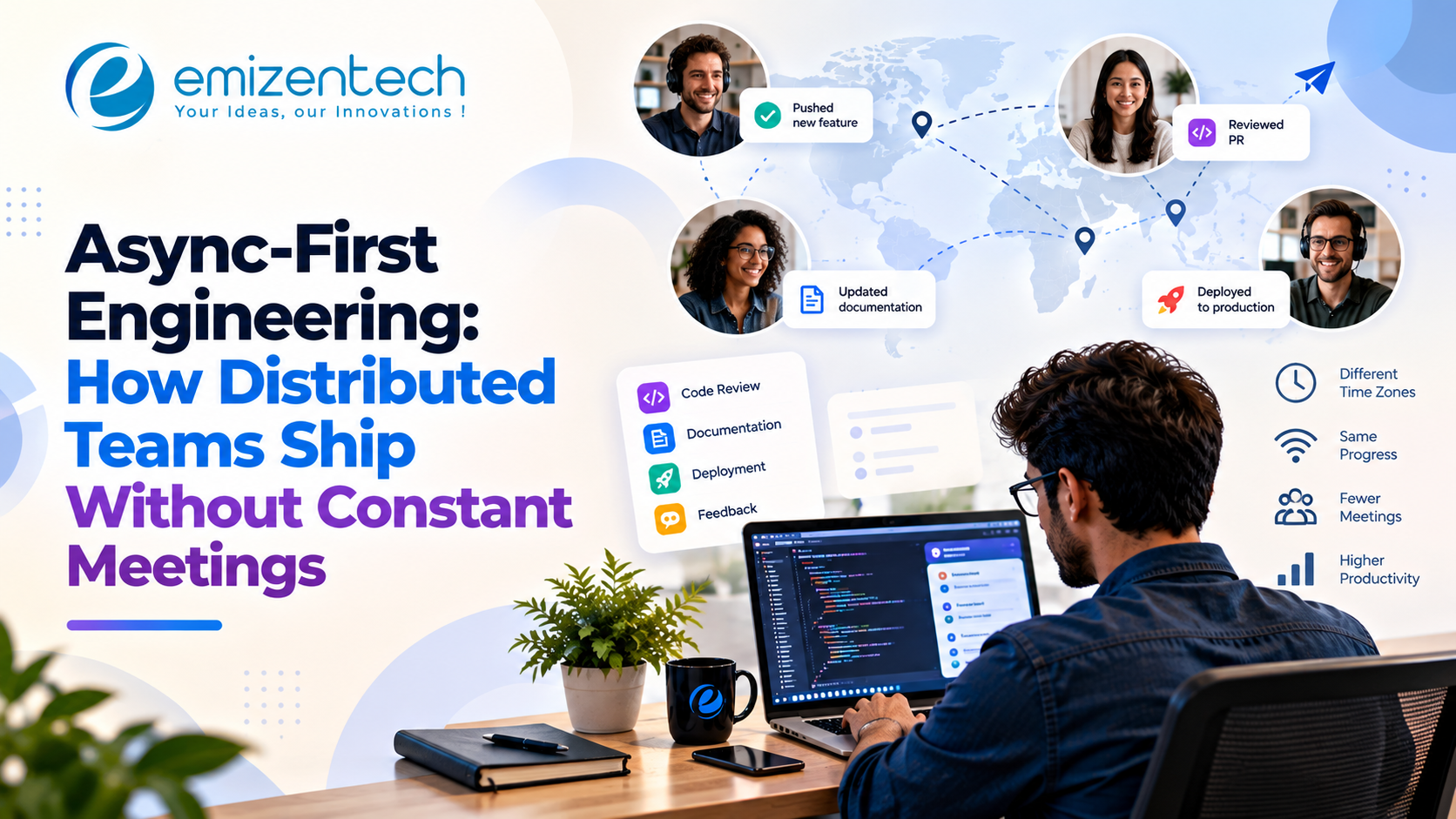
Most remote teams don't struggle because people are far apart. They struggle because they copied an office routine onto a video call. The daily stand-up becomes a 30-minute status read-out, every question turns into a calendar invite, and the developer in the wrong time zone attends meetings at 10 pm.
Async-first engineering takes a different starting point. Work is designed so that people don't need to be online at the same moment to make progress. Meetings still exist, but they become the exception that needs a reason.
What "Async-First" Actually Means
Async-first doesn't mean "never talk live." It means the default way of sharing information is written and durable, so someone who joins eight hours later can catch up without asking anyone to repeat themselves.
In practice, that default shows up in a few habits:
- Decisions are recorded where everyone can find them, not left in a call.
- Questions are asked in a way that can be answered without a follow-up.
- Work in progress is visible without anyone having to report it.
- Live conversations are used for things that genuinely need them: conflict, brainstorming, and sensitive feedback.
A useful rule of thumb is this: if the outcome of a conversation will matter next week, it should exist in writing by tonight.
The Written Layer: Docs, Tickets and Decision Records
Everything in an async team rests on writing, so the quality of that writing decides whether the model works or collapses into confusion.
Three kinds of documents carry most of the weight.
Tickets with context. A good ticket explains the problem, the expected outcome, and any constraints. "Fix login bug" forces someone to ask three questions. "Users on Safari can't log in after a password reset; expected behaviour is a redirect to the dashboard; see the linked error log" lets a developer start immediately.
Decision records. A short note that says what was decided, why, and what alternatives were rejected. Six months later, nobody has to guess why the team chose one database over another.
An architecture overview. One living page that explains how the main parts of the system fit together. New people read it first, and so do experienced ones who haven't touched a module in a while.
This is also where hiring changes. When a team sets out to hire remote dedicated developer profiles for an async setup, a short written exercise tells you more than another round of live interviews. Ask the candidate to explain a technical trade-off in a few paragraphs. Clear, structured writing is a strong sign they'll work well without someone sitting next to them.
Handoffs and Overlap Hours
Time zones don't disappear in an async team, but they stop being the main obstacle. The key is to handle the handoff at the end of each person's day deliberately.
A good handoff note answers four things: what was finished, what is in progress, what is blocked, and what the next person should do first. Five lines are usually enough. The goal is that the next developer can start work within minutes, not after a call.
Most teams also keep a small window of overlap, often two or three hours, for questions that don't suit writing. Those hours are valuable, so protect them. Use them for pairing on a tricky problem, resolving a disagreement, or reviewing something complex together, and keep routine updates out of them.
Teams moving to this model for the first time often run into predictable problems with delays and unclear ownership, and the challenges of hiring dedicated developers are worth reading before you set your overlap rules.
When to Go Async and When to Meet
Not everything belongs in writing. This table works as a starting guide.
| Situation | Better as | Why |
|---|---|---|
| Daily progress updates | Async | Nobody needs to listen to a read-out |
| Code review comments | Async | Reviewers can think before replying |
| Choosing between two architectures | Short live call, then a written record | Back-and-forth is faster live, but the decision must be recorded |
| Giving difficult feedback | Live | Tone is easy to misread in writing |
| Brainstorming a new feature | Live, with notes shared after | Ideas build on each other quickly |
| Production incident | Live, with a written timeline | Speed matters, and the lessons must be kept |
| Planning the next sprint | Mix of both | Prepare in writing, finalise in a short call |
When in doubt, ask two questions. Does this need an immediate answer? Does it carry emotional weight? If both answers are no, write it down.
A Small Toolset Beats a Big One
Async teams often fail by adding too many tools. Each new channel is another place where information can hide.
A workable setup needs only a few things: one place for chat, one for tickets, one for documents, and one for code. The rule that matters more than the choice of tool is that each type of information has exactly one home. Decisions go in the decision log, not in a chat thread that scrolls away by Friday.
Short recorded video walkthroughs are worth adding. A five-minute screen recording explaining a tricky change often replaces a one-hour meeting, and the recording stays useful for future joiners.
Ownership also matters. Teams get further when each person can carry a feature from idea to release without waiting for several others, which is why many async teams favour full-stack developers for product work. Fewer handoffs mean fewer places for a message to get lost.
Signs Your Async Model Is Working
You can tell fairly quickly whether the approach is helping. Look for these signals:
- Fewer interruptions. Developers get long, uninterrupted blocks of focus.
- Questions get answered once. The answer lives in a document, not in someone's memory.
- New joiners ramp up quicker. They can read their way into the project.
- Decisions are easy to trace. Anyone can find out why something was built a certain way.
- Meetings have agendas and outcomes. And several recurring ones have been cancelled.
And watch for warning signs: people feeling isolated, messages sitting unanswered for a day, or one person becoming the bottleneck because nothing is written down. Those signal that the process needs adjusting, not that async has failed.
A Four-Week Rollout Plan
Changing how a team works is easier in small steps than in one announcement.
Week 1: Audit. List every recurring meeting and mark which ones exist only to share information. Pick two to replace with written updates.
Week 2: Write the basics. Create a ticket template, a handoff note format, and a place for decision records. Keep each one to a page or less.
Week 3: Set the rules. Agree on expected response times, for example within one working day for normal messages and within a couple of hours for urgent ones. Define what counts as urgent.
Week 4: Review. Ask the team what felt better and what felt worse. Adjust the rules. Cancel another meeting if the written version is working.
After the first month, review again every quarter. The goal isn't a perfect system. It's a team that spends more of its time building and less of it coordinating.
Conclusion
Async-first engineering works when writing is treated as part of the job, handoffs are deliberate, and live meetings are kept for the moments that need them. It rewards clear thinking, good documentation, and trust, and it gives developers the uninterrupted time that complex work needs. Teams that make the shift gradually, and review it honestly, usually find that they lose fewer hours to coordination and gain more of them for building.
EmizenTech, a mobile app development company, works with distributed engineering teams and applies this kind of written, handoff-friendly process to keep projects moving across time zones.

 Arabic
 French
 Spanish
 Portuguese
 Deutsch
 Turkish
 Dutch
Dutch
 Italiano
 Russian
 Romaian
 Portuguese (Brazil)
 Greek
Greek
