


Concrete Mix Ratio: A Simple Guide for Beginners
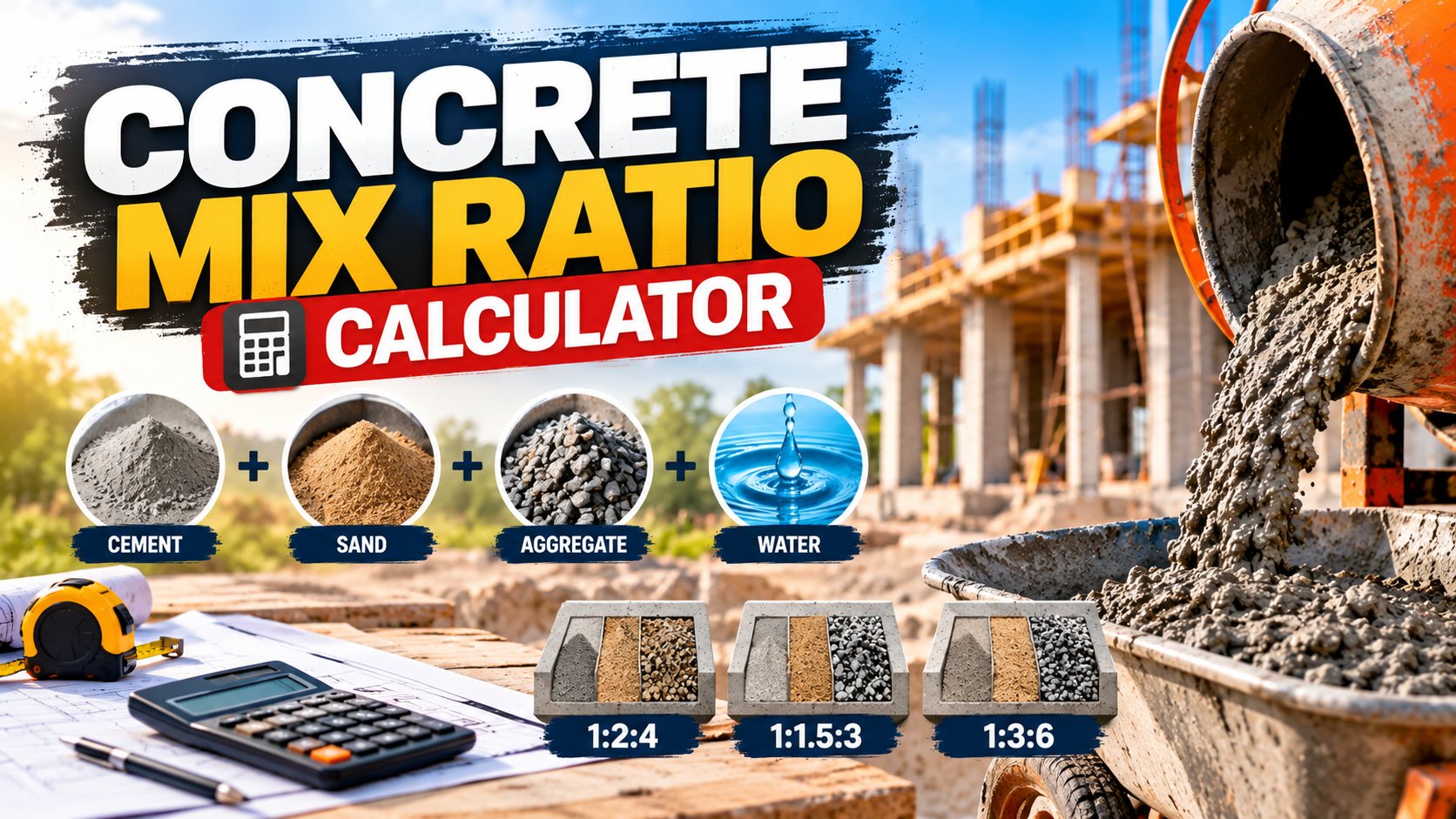
Walk into any building supply store and you’ll hear people talk about mixes like “one, two, four.” If you’re new to concrete, that sounds like a code. It isn’t. It’s a recipe, and once you know how to read it, mixing concrete gets a lot less intimidating.
If you’d rather skip the arithmetic, a concrete mix ratio calculator can turn a ratio and a volume into amounts of cement, sand, and aggregate. It still helps to understand what’s behind those numbers, so the rest of this guide walks through them one piece at a time.
What a Mix Ratio Means
Concrete has three dry ingredients plus water. Cement is the binder that glues everything together. Sand fills the small gaps. Aggregate, usually crushed stone or gravel, gives the mix its bulk and strength.
A ratio such as 1:2:4 lists those three in order: one part cement, two parts sand, four parts aggregate. The “part” can be any container you like, a bucket or a shovel scoop, as long as you use the same one for every ingredient. Water isn’t in the ratio. It gets added separately.
Common Mix Ratios
Different jobs need different strengths. A richer mix has more cement relative to sand and stone, and it generally makes stronger concrete. Here are the ratios you’ll see most often, by volume.
| Mix | Cement : Sand : Aggregate | Typical Use |
|---|---|---|
| Lean | 1 : 3 : 6 | Filling, leveling beds, non-structural work |
| General | 1 : 2 : 4 | Footpaths, slabs, driveways, light structural work |
| Stronger | 1 : 1.5 : 3 | Beams, columns, and loaded structural members |
| High strength | 1 : 1 : 2 | Heavily loaded or specialist work |
Treat the table as a starting point. Local codes, the loads involved, and your engineer’s advice decide the right mix for a real project, especially for anything structural.
Why Water Matters So Much
Water starts the chemical reaction that makes cement harden. But too much water weakens the finished concrete, because the extra water leaves tiny voids as it dries. Too little water and the mix is stiff, hard to place, and prone to gaps.
Builders talk about the water to cement ratio, which compares the weight of water to the weight of cement. A lower number generally means stronger, more durable concrete, as long as the mix can still be worked and compacted. Many general purpose mixes land somewhere around 0.4 to 0.6, but follow the guidance for your specific project.
A simple beginner rule: add water slowly and stop as soon as the mix is workable. It should hold together when you squeeze it and slump gently, not run like soup.
How to Turn a Ratio Into Quantities
Here’s where beginners get stuck. You can’t just add the parts together and call it one cubic meter. Dry materials shrink when they’re mixed with water, because the sand fills gaps between the stone and the cement fills the rest. So you need extra dry material to make one unit of wet concrete.
A common rule of thumb is to multiply the wet volume by about 1.54 to get the dry volume. Then divide by the sum of the ratio parts and multiply by each part.
Dry volume = Wet volume x 1.54
Cement = Dry volume x 1 / (1 + 2 + 4) for a 1:2:4 mix
Let’s try one cubic meter of 1:2:4 concrete. The dry volume is about 1.54 cubic meters. The ratio parts add up to 7. Cement is 1.54 / 7, which is about 0.22 cubic meters. Sand is twice that, about 0.44 cubic meters. Aggregate is four times it, about 0.88 cubic meters.
Cement is sold by weight, so you’ll want to convert. A cubic meter of cement weighs roughly 1,440 kilograms. So 0.22 cubic meters is about 317 kilograms, or around 6 to 7 bags of 50 kilogram cement. Check the bag size where you buy, since it varies.
Choosing a Mix for Your Project
For a garden path, a small patio, or a shed base, the general 1:2:4 mix is a common choice. For a lean fill under a slab, 1:3:6 is often enough. Beams, columns, and anything carrying real load call for a stronger mix and usually an engineer’s specification.
If you’re only pouring a small amount, bagged ready mix is often easier. You add water, mix, and pour. The ratio is already built in, so there’s less to get wrong.
Common Beginner Mistakes
Adding too much water is the most common. It makes mixing feel easy, but it weakens the concrete. Another is measuring with different containers for each ingredient, which breaks the ratio. A third is skipping the mixing time. Mix until the color is even and no dry pockets remain.
Many beginners also forget that sand and aggregate should be clean. Dirt, clay, or organic matter can stop cement from bonding properly. And it’s easy to forget curing. Fresh concrete needs to stay damp for several days so it can gain strength.
Final Thoughts
A mix ratio is just a recipe: cement, sand, and aggregate in set proportions, with water added carefully. Choose the ratio that suits your job, measure with the same container every time, and control the water.

 English
 Arabic
 French
 Spanish
 Portuguese
 Deutsch
 Turkish
 Italiano
 Russian
 Romaian
 Portuguese (Brazil)
 Greek
Greek
