


Hydraulics Market Trends Shaping Next-Generation Machinery
The Hydraulics Market continues to support industries that depend on high force, reliable motion control, and consistent equipment performance. From excavators and agricultural tractors to manufacturing machinery and offshore vessels, hydraulic systems convert fluid pressure into mechanical power, enabling demanding operations that require strength and precision.
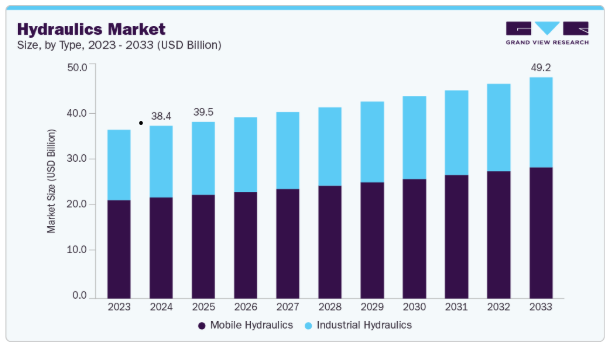
The global Hydraulics Market was estimated at USD 38.39 billion in 2024 and is projected to reach USD 49.23 billion by 2033, expanding at a CAGR of 2.8% between 2025 and 2033. Although growth is moderate, the industry is evolving through improvements in energy efficiency, automation, component design, and digital monitoring.
Infrastructure development remains a significant source of demand. Construction equipment requires dependable hydraulic cylinders, pumps, valves, and actuators to lift loads, move materials, and perform repetitive operations. Meanwhile, manufacturing facilities are adopting more automated machinery, creating opportunities for hydraulic systems that combine power density with accurate control.
Market at a Glance
- 2024 market size: USD 38.39 billion
- 2033 projected value: USD 49.23 billion
- Forecast CAGR: 2.8% from 2025 to 2033
- Leading type: Mobile hydraulics, with over 58% share in 2024
- Leading component: Cylinders, accounting for over 30% share in 2024
- Leading end-use: Construction, with over 39% share in 2024
- Largest regional market: Asia Pacific, with over 34% share in 2024
Three Shifts Redefining Hydraulic System Design
Rather than relying exclusively on conventional fluid power technology, manufacturers are developing solutions that respond to changing operational and environmental requirements.
- From conventional systems to intelligent hydraulics
The integration of the Internet of Things (IoT) and smart sensors allows hydraulic equipment to be monitored in real time. Operators can track operating conditions, identify irregularities, and schedule maintenance before component failures cause significant downtime. Predictive maintenance also helps extend equipment life and improve productivity.
- From energy losses to efficiency-focused engineering
Traditional hydraulic systems can experience energy losses and fluid leakage. Load-sensing technologies and electro-hydraulic designs are helping address these limitations by improving control and reducing unnecessary energy consumption. Environmental regulations and sustainability objectives are further encouraging the development of low-leakage and more efficient hydraulic products.
- From standard components to application-specific solutions
Equipment manufacturers increasingly collaborate with hydraulic suppliers to develop customized components, control algorithms, and materials. These partnerships are particularly relevant to demanding applications across construction, mining, aerospace, defense, and offshore operations.
Download a free sample report or claim your copy of this full market intelligence report
Market Segments: Where Demand Is Concentrated
The market's structure reveals how different equipment requirements influence component and technology adoption.
Mobile Hydraulics Set the Pace
Mobile hydraulics accounted for more than 58% of market revenue in 2024. These systems are widely used in off-highway machinery, construction equipment, agricultural tractors, and mining vehicles, where high torque, compact designs, and dependable operation are essential.
Infrastructure expansion and agricultural mechanization in emerging economies continue to support demand. Industrial hydraulics, meanwhile, is expected to grow at a CAGR exceeding 2.6% from 2025 to 2033, supported by manufacturing automation, Industry 4.0 adoption, modular components, and real-time monitoring.
Cylinders Lead Component Demand
Hydraulic cylinders represented over 30% of market revenue in 2024. Their ability to deliver substantial force through a compact design makes them essential for construction machinery, material handling, and agricultural equipment.
The development of smart cylinders incorporating position sensors and feedback controls is extending their role beyond basic actuation. These features support more precise movement and integration with automated equipment.
Hydraulic transmissions are expected to record the fastest component growth over the forecast period. Demand for smoother power delivery, improved efficiency, and variable-load performance is creating opportunities for advanced transmission solutions, particularly in hybrid and electrified machinery.
Construction Remains the Primary End-Use Market
Construction held over 39% of market revenue in 2024. Excavators, loaders, lifting equipment, and other heavy machines depend on hydraulic systems to deliver controlled movement and high power output.
The marine segment is projected to achieve the fastest growth among end-use categories from 2025 to 2033. Offshore support vessels, dredgers, submarines, and autonomous surface crafts require reliable motion-control systems capable of operating in demanding marine environments. Naval modernization and offshore energy investments further support this opportunity.
Regional Market Dynamics: Asia Pacific Leads
Asia Pacific accounted for more than 34% of global hydraulics market revenue in 2024. Industrialization, construction activity, manufacturing investments, and agricultural mechanization underpin regional demand. China led the Asia Pacific market, supported by infrastructure development and the expansion of heavy machinery and industrial equipment manufacturing.
Japan represents another important market, with demand linked to precision engineering, robotics, infrastructure renewal, and smart-factory development.
North America accounted for more than 30% of market revenue in 2024. Its established manufacturing base, infrastructure modernization, and oil and gas exploration support the use of high-performance hydraulic equipment. Sensor-based monitoring and upgrades to existing industrial systems are also creating opportunities.
Europe is expected to grow at a CAGR exceeding 2% during the forecast period. The region's engineering capabilities, manufacturing ecosystem, and emphasis on energy efficiency support the adoption of advanced hydraulic technologies. Environmental initiatives and Industry 4.0 practices are encouraging manufacturers to improve system performance and reduce resource consumption.
Key Companies
The competitive landscape includes established motion-control manufacturers and emerging engineering specialists.
- Bosch Rexroth AG: Supplies hydraulic pumps, motors, valves, cylinders, and integrated drive-and-control systems, with an emphasis on energy efficiency and digital connectivity.
- Parker Hannifin Corporation: Offers hydraulic products for industrial and mobile applications, including agriculture, construction, aerospace, and manufacturing.
- Wipro Infrastructure Engineering: Specializes in precision-engineered hydraulic cylinders and actuators, supported by engineering and manufacturing capabilities across multiple markets.
- LHY Powertrain GmbH & Co. KG: Develops hydraulic and powertrain solutions for off-highway and industrial applications, including hybrid and energy-efficient systems.
Competition increasingly depends on component reliability, engineering customization, digital integration, and the ability to meet customer-specific performance requirements.
What Could Influence the Next Phase of Growth?
The hydraulics market faces a gradual transition rather than a complete replacement of conventional technology. Electrification is encouraging equipment manufacturers to rethink powertrain architecture, while digital monitoring is changing maintenance practices and operating efficiency.
However, hydraulic systems remain important wherever high force, ruggedness, and precise movement are required. The strongest opportunities are likely to emerge from combining these established advantages with intelligent controls, energy-efficient components, and application-specific engineering.
With the market projected to reach USD 49.23 billion by 2033, suppliers that improve performance while addressing energy consumption, maintenance costs, and environmental requirements can strengthen their position across construction, manufacturing, agriculture, and marine applications.
Explore Our Research & Intelligence Solutions
Prism AI: Ask. Analyze. Get Cited Market Insights. – Explore Now
Grand View Signal: Understand the Factors Shaping Commodity Prices – Explore the Platform

 English
 Arabic
 French
 Portuguese
 Deutsch
 Turkish
 Dutch
Dutch
 Italiano
 Russian
 Romaian
 Portuguese (Brazil)
 Greek
Greek
