


Isobutene Market Revenue Forecast and Growth Drivers
Isobutene plays an important role in the chemical supply chains behind transportation, synthetic rubber, fuel blending, and specialty materials. Although it is an industrial hydrocarbon, its value extends into products used every day, from vehicle tires and tubes to packaging materials, adhesives, and electrical insulation. Demand across these applications makes isobutene an important intermediate for manufacturers seeking reliable performance and efficient chemical production.
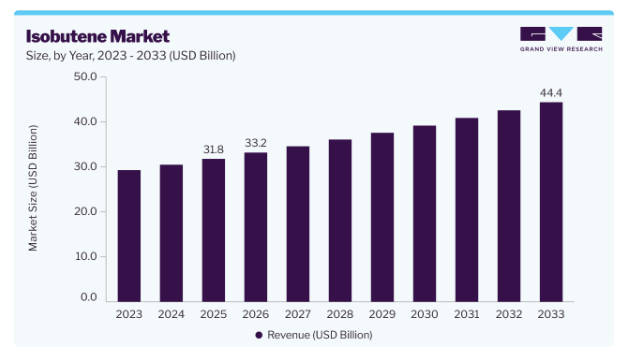
The global Isobutene Market was valued at USD 31.8 billion in 2025 and is projected to reach USD 44.4 billion by 2033, increasing from USD 33.2 billion in 2026. The market is expected to grow at a CAGR of 4.2% from 2026 to 2033. Demand from automotive, aerospace, rubber, and chemical manufacturing industries is expected to support this expansion.
The Chemistry Behind Multiple Industries
Isobutene, also known as isobutylene, is used to manufacture several commercially important derivatives. One of its major applications is the production of butyl rubber, which offers low permeability to gases and liquids, chemical resistance, and useful damping characteristics. These properties make it suitable for tire inner liners, tubes, seals, and other automotive components.
Its applications extend beyond rubber manufacturing. Isobutene is also used as an intermediate in the production of methyl tert-butyl ether (MTBE), while its derivatives support plastic packaging, hot-melt adhesives, compounding, master batches, wires and cables, and electrical insulation.
This range of uses gives the market a diversified industrial foundation. Demand is influenced not only by vehicle production but also by fuel formulation, petrochemical manufacturing, and the need for specialized materials.
MTBE Dominates the Product Mix
The methyl tert-butyl ether (MTBE) segment accounted for approximately 80.0% of isobutene market revenue in 2025. Its leading position reflects its importance in fuel-related applications, particularly gasoline blending. MTBE is used as a gasoline additive, making it relevant to refiners seeking to improve fuel characteristics.
The segment is also expected to register the fastest CAGR during the forecast period. Investment in MTBE production capacity highlights the continuing importance of fuel additives within the broader isobutene value chain.
Ethyl tert-butyl ether (ETBE) represents another application pathway. Produced using isobutylene and ethanol, ETBE has a high octane content and low vapor pressure. These characteristics support its use in petrol blending, where refiners seek to meet octane requirements and incorporate bio-based components.
Demand for these derivatives is connected to fuel quality, vehicle performance, and changing regulatory requirements. Consequently, developments in fuel formulation can influence demand across the isobutene market.
Download a free sample report or claim your copy of this full market intelligence report
Automotive Demand Creates a Strong Foundation
The automotive segment represented more than 30.0% of market revenue in 2025, making it the largest application segment. Isobutene-based elastomers are valued for their low permeability, chemical resistance, and damping properties. Halogenation can further improve their thermal performance.
These characteristics support the use of butyl rubber in tire inner liners, tubes, seals, and other components where maintaining performance and limiting gas loss are important. Growth in vehicle production and replacement tire demand therefore supports consumption of isobutene-derived materials.
The increasing popularity of electric vehicles creates another area of demand. Their battery weight and performance requirements encourage the development of tires designed to support higher loads and improve energy efficiency.
Automotive demand also extends to fuel additives. This connection between rubber manufacturing and fuel formulation gives isobutene suppliers exposure to several requirements within the transportation industry.
Aerospace Adds a Different Growth Dimension
Although automotive applications currently lead the market, aerospace is expected to record the fastest CAGR among applications during the forecast period.
Isobutene can be alkylated with butane to produce isooctane, which is used as a fuel additive in aviation fuel. Demand opportunities are associated with aviation industry expansion and the increasing importance of regional connectivity.
The civil aviation industry has benefited from factors such as liberalized trade, lower fares, foreign investment, and advances in information technology. As aviation activity develops, fuel-related chemical requirements provide an additional application pathway for isobutene derivatives.
Aerospace demand differs from automotive demand because fuel applications and specialized operating requirements shape purchasing needs. This diversification could support the market alongside its established position in rubber and fuel additives.
What Could Influence Market Growth?
The market's expansion depends on the interaction between industrial demand, feedstock availability, production economics, and innovation.
Raw material prices remain a key consideration. Fluctuations in crude oil and petrochemical feedstock prices can affect production costs and create uncertainty for manufacturers. Companies must manage input costs while maintaining consistent product quality and dependable supply.
Specialty derivatives offer additional opportunities. Growing applications for high-value derivatives and specialty chemicals could expand the role of isobutene beyond its traditional uses. Its versatility as a chemical building block creates opportunities across rubber, fuel additives, lubricants, and other industrial products.
Bio-based production is attracting attention. Renewable isobutene alternatives are being developed to address sustainability concerns associated with conventional production and derivatives. Government incentives and tax benefits for renewable isobutene production can support these developments.
Together, these factors indicate that future market performance will depend on both established industrial consumption and manufacturers' ability to respond to changing production and sustainability requirements.
Regional Demand and Manufacturing Activity
North America accounted for 40.0% of global isobutene market revenue in 2025. Strong automotive demand and consumption of derivatives such as MTBE contribute to the region's leading position. Vehicle sales and demand for passenger cars, sport utility vehicles, and electric vehicles support the need for automotive materials and related chemical products.
Asia Pacific is expected to record the fastest CAGR from 2026 to 2033. Automotive industry development and policy initiatives supporting trade liberalization are contributing to market opportunities. Countries such as Thailand, Malaysia, and Vietnam are investing in the development of their automotive sectors, supporting potential demand for isobutene-derived materials.
These markets demonstrate how regional industrial development can influence consumption. Automotive manufacturing, chemical production, and fuel-related applications remain important considerations for suppliers evaluating future demand.
Market Outlook: A Versatile Chemical With Multiple Demand Drivers
The isobutene market is projected to grow from USD 31.8 billion in 2025 to USD 44.4 billion by 2033. Its outlook is supported by MTBE demand, automotive applications, aerospace fuel additives, and the use of butyl rubber in performance-sensitive products.
At the same time, feedstock price volatility and sustainability considerations create challenges for producers. Investment in specialty derivatives and renewable production pathways may provide additional opportunities as the industry evolves.
The market's long-term development will depend on how effectively suppliers balance established demand with production efficiency, reliable raw material access, and emerging applications.
Explore Our Research & Intelligence Solutions
Prism AI: Ask. Analyze. Get Cited Market Insights. – Explore Now
Grand View Signal: Understand the Factors Shaping Commodity Prices – Explore the Platform
 Turkish
 English
 Arabic
 French
 Spanish
 Portuguese
 Deutsch
 Dutch
Dutch
 Italiano
 Russian
 Romaian
 Portuguese (Brazil)
 Greek
Greek
