


Facial Recognition Systems for Corporate Security in Oman
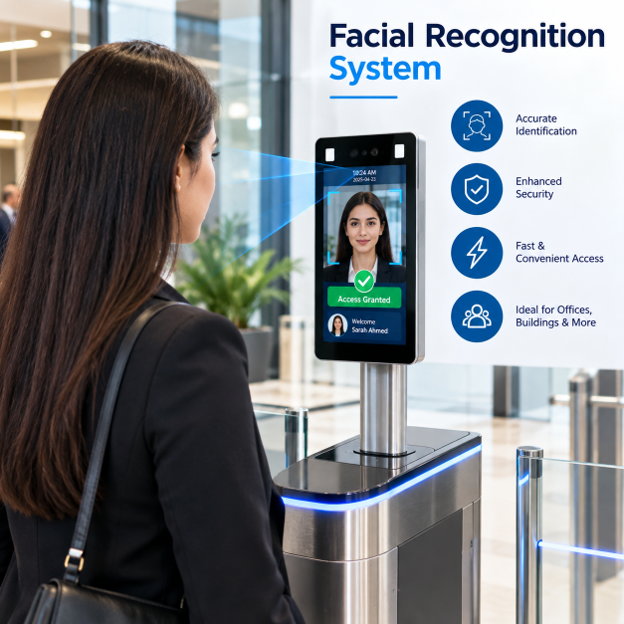
Corporate security in Oman is undergoing the same shift already underway across the wider Gulf: a reliable Facial Recognition System is fast replacing badge-swipe habits and shared PINs with fast, contactless identity verification at every entry point. As Muscat's business districts and Oman's growing free zones attract banks, oil and gas headquarters, and multinational tenants, security leaders are under pressure to stop tailgating and credential sharing without slowing down the workday.
This guide walks through how facial recognition technology works inside a corporate environment, what to look for in a device or software platform, and why organisations across Oman are standardising on it as their primary access-control layer.
Why Corporate Oman Is Moving to Facial Recognition Access Control
Oman's economic diversification agenda under Oman Vision 2040 has brought a wave of new corporate towers, free-zone facilities, and government-adjacent offices online across Muscat and beyond, and with that growth comes a sharper focus on how those spaces are secured. Boards and facility managers are adopting Facial Recognition Access Control for three practical reasons: it removes the operational cost of managing lost cards and forgotten PINs, it creates an audit-ready log of exactly who entered a space and when, and it closes the tailgating gap that keycard turnstiles routinely miss.
Insurance underwriters and corporate auditors operating in Oman increasingly ask for verifiable, timestamped access records during compliance reviews. A biometric access log satisfies that requirement in a way a shared keycard simply cannot, since a card can be handed to anyone but a face cannot.
How Face Detection Technology Works in Modern Omani Offices
Before a system can verify anyone, it first has to find them in the frame. Face Detection is the initial computer-vision step: the camera locates a human face within its field of view, isolates it from the background, and passes that region forward for analysis. This happens in real time, even in crowded lobbies, varied lighting, or when someone is wearing a mask, cap, or sunglasses.
Enterprise-grade detection engines used across Omani office towers are trained to handle the region's specific conditions, strong daylight glare through glass facades, mixed-nationality workforces, and high foot-traffic reception areas, so accuracy does not degrade during the morning rush.
Detection Versus Recognition: A Quick Distinction
Detection answers the question, is there a face here? Recognition and identification, covered next, answer the harder question, whose face is it? Both stages have to run in well under a second for the system to feel invisible to employees walking through a turnstile or glass door.
Facial Identification vs Traditional ID Cards: What Changes for Security Teams
Once a face is detected, the platform performs Facial Identification, matching the captured face against an enrolled database of employees, contractors, and approved visitors. Unlike a keycard, which only proves someone is holding a valid credential, identification proves who the person actually is, closing the single biggest loophole in traditional physical access control.
For Omani facility and HR teams, this shift changes daily operations in tangible ways:
● Offboarding is instant, since removing a profile revokes access everywhere at once, unlike collecting a physical card from a departing employee.
● Visitor and contractor logs are self-documenting, with entry photos and timestamps stored automatically for later audit.
● Shift-based access, such as facility staff rotating in and out of a site, no longer depends on card handovers between crews.
The Role of Facial Authentication in Multi-Layered Corporate Security
Where identification answers who is this person, Facial Authentication answers is this person who they claim to be, typically at a specific checkpoint such as a server room, executive floor, or finance department. It is commonly paired with a second factor, a PIN or an employee badge, to create true multi-factor security for the most sensitive zones inside a building.
Layering authentication this way lets a single organisation apply different levels of scrutiny across one campus: a light-touch face scan at the main lobby, and a stricter, dual-factor face-plus-PIN check at the data centre door or finance department entrance.
Choosing the Right Facial Recognition Device for Your Omani Facility
Hardware selection determines how well the system performs under real Omani conditions. A reliable Facial Recognition Device should combine an infrared or dual-lens camera for accuracy in low light and direct sun, liveness detection to prevent spoofing with a photo or video, and a fast local processor so verification does not depend on network latency.
Corporate security across Oman is shifting decisively toward biometrics, and a well-implemented Facial Recognition System is now the clearest way to close tailgating gaps, retire vulnerable keycards, and produce audit-ready access logs. From accurate Face Detection at the door to layered Facial Authentication at sensitive zones, the right combination of device and Facial Recognition Software turns everyday entry points into a controlled, evidence-backed security layer. Omani enterprises that plan for compliance from the outset, choose proven hardware, and partner with an experienced local provider position themselves ahead of both security incidents and regulatory scrutiny.
 Turkish
 English
 Arabic
 French
 Spanish
 Portuguese
 Deutsch
 Dutch
Dutch
 Italiano
 Russian
 Romaian
 Portuguese (Brazil)
 Greek
Greek
