


Monorail System Manufacturer in Faridabad
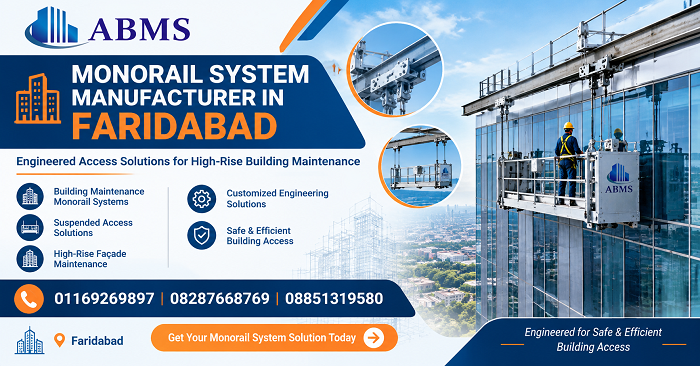
Modern buildings require reliable and efficient systems for exterior cleaning, inspection, repair, and maintenance. As residential towers, commercial complexes, hospitals, hotels, and industrial structures become taller and more complex, accessing their façades safely becomes an important operational requirement. A monorail system provides a practical solution for controlled movement along a building's exterior, helping maintenance teams reach designated working areas.
ABMS Services provides façade access and building maintenance solutions for projects with different structural designs and maintenance needs. As a Monorail System Manufacturer in Faridabad, ABMS Services can support building owners, architects, consultants, contractors, and facility management companies seeking customized façade access arrangements.
A monorail system typically consists of a track installed along an appropriate building surface, a travelling trolley, suspension equipment, wire ropes, and a compatible suspended cradle or platform. The arrangement allows horizontal travel along the track while the suspended platform provides vertical access to the façade. The final configuration depends on the building design, structural capacity, operating requirements, and applicable safety standards.
What Is a Façade Access Monorail System?
A façade access monorail system is a permanent building access arrangement designed to support exterior maintenance activities. It uses a specially engineered track and travelling mechanism to move a suspended working platform along a planned route on the building.
Unlike conventional scaffolding, which generally requires extensive assembly and relocation, a properly designed monorail system can provide a dedicated access route for repeated maintenance operations. It can be particularly useful for buildings with curved façades, restricted ground-level space, architectural projections, or areas where conventional access methods are difficult to use.
The system is generally planned during the building design or renovation stage. Engineers assess the façade layout, roof structure, available anchorage points, track alignment, platform requirements, and anticipated maintenance activities before finalizing the design.
A monorail system is not a one-size-fits-all product. Each installation should be engineered for the intended building and operating conditions, with appropriate load ratings, structural supports, safety devices, inspection procedures, and operating instructions.
Why Choose a Monorail System Manufacturer in Faridabad?
Faridabad has a diverse range of residential, commercial, institutional, and industrial properties. Many of these buildings require periodic exterior maintenance to preserve their appearance, functionality, and long-term value.
Choosing a suitable Monorail System Manufacturer in Faridabad can help project owners coordinate system design, manufacturing, installation, and maintenance support more efficiently.
1. Customized Building Access Solutions
Every building has different façade dimensions, roof conditions, architectural features, and maintenance requirements. A customized monorail system can be planned around the building's specific geometry and the locations that require regular access.
2. Efficient Façade Maintenance
A correctly designed track arrangement can help maintenance teams move between designated façade sections without repeatedly dismantling access equipment. This can improve work planning and reduce setup time for recurring tasks.
3. Long-Term Access Planning
A permanent monorail installation can provide a dedicated access route for scheduled cleaning, inspections, and repairs. It should be planned with the building's anticipated maintenance requirements and future operational needs in mind.
4. Professional Project Coordination
Working with an experienced façade access provider helps coordinate technical discussions among the building owner, structural engineer, architect, equipment supplier, and installation team.
5. Support for Different Building Types
Monorail systems may be considered for offices, residential towers, hotels, hospitals, shopping complexes, and selected industrial buildings where the building geometry and maintenance requirements make this arrangement suitable.
Main Components of a Monorail System
The design and quality of individual components influence the performance and safe operation of a façade access system. Component specifications should be selected according to the approved engineering design.
1. Monorail Track
The monorail track forms the travel path for the trolley. It may be installed on suitable brackets or structural supports, depending on the design. Track material, dimensions, alignment, connections, and support spacing must be specified by the responsible engineer.
2. Travelling Trolley
The trolley moves along the track and carries the designated suspension arrangement. Depending on the system, trolley movement may be manual or motorized. The selected mechanism must be compatible with the track design and intended working load.
3. Suspension Arrangement
The suspension arrangement connects the travelling mechanism to the suspended platform or cradle. Its configuration depends on the building's geometry, the required clearance from the façade, and the operating method.
4. Wire Ropes
Wire ropes support the suspended platform and allow vertical movement when used with compatible hoisting equipment. Their specifications, termination arrangements, inspection requirements, and replacement criteria must follow the equipment manufacturer's instructions and applicable standards.
5. Suspended Platform or Cradle
The platform provides a working area for authorized personnel performing façade maintenance. Platform dimensions, rated capacity, guardrails, access arrangements, and compatibility with the hoists and suspension equipment must be established during system design.
6. Hoisting Equipment
Hoists raise and lower the platform. They must be appropriately rated and compatible with the suspension system, platform, ropes, and control arrangement.
7. Safety Devices and Controls
Depending on the design, the system may incorporate overspeed protection, emergency stops, overload protection, limit switches, secondary safety arrangements, and other protective features. The exact safety provisions should be confirmed for each installation rather than assumed to be identical across all systems.
8. Structural Brackets and Anchors
Brackets and anchors transfer the system's loads to the building structure. Their design and installation are critical and must be based on verified structural capacity, approved drawings, suitable materials, and the required inspection and testing procedures.
Applications of Monorail Systems in Faridabad
A monorail system may support several exterior building maintenance activities when designed for the intended task.
Commercial Office Buildings
Office buildings often require regular glass cleaning, façade inspections, sealant checks, and exterior repairs. A permanent access arrangement can help facility teams schedule this work with less disruption to building operations.
Residential High-Rise Buildings
Apartment towers and residential complexes may use façade access systems to maintain exterior glazing, cladding, architectural finishes, and other building elements. The system must be suitable for the building's layout and the maintenance tasks involved.
Hotels and Hospitality Properties
Hotels depend on a clean and well-maintained exterior to preserve their appearance and guest experience. A suitable monorail arrangement can provide access for planned glass cleaning, inspections, and selected repair activities.
Hospitals and Healthcare Buildings
Healthcare facilities may have complex façades, glazing, and external service areas. Any access system must be planned to minimize disruption and follow the facility's operational requirements.
Shopping Malls and Commercial Complexes
Large commercial properties may feature extensive glazing, decorative façades, and elevated architectural elements. Engineered access equipment can assist authorized maintenance personnel in reaching designated sections.
Industrial and Institutional Buildings
Certain factories, research facilities, educational campuses, and institutional buildings may benefit from a permanent façade access arrangement where regular exterior work is required and the design is appropriate.
Glass Cleaning and Exterior Inspection
Monorail-supported platforms can be used for glass cleaning and visual inspections of accessible façade areas. Additional activities, such as painting, waterproofing, or repairs, must be assessed to confirm that the platform, tools, working loads, and operating method are suitable.
Benefits of Installing a Monorail System
Improved Access to Designated Façade Areas
The track provides a planned route for horizontal movement. This can be particularly beneficial where the building's architectural layout makes repeated access from the roof or ground difficult.
Reduced Dependence on Repeated Scaffolding
For recurring maintenance work, a permanent system may reduce the need to erect and dismantle temporary scaffolding for every task. The actual savings depend on the building, access requirements, maintenance frequency, and installation cost.
Better Maintenance Scheduling
A dedicated access system can help facility managers organize inspections and cleaning according to a regular maintenance calendar. Scheduled work can also help identify visible façade deterioration before it becomes more extensive.
Potential Long-Term Cost Efficiency
Although a permanent monorail system requires initial investment, it may offer operational advantages over repeated temporary access arrangements. A meaningful cost comparison should include installation, inspections, maintenance, training, repairs, and the expected service life.
Adaptation to Building Geometry
Monorail layouts can be developed for suitable straight, curved, or segmented façade routes. The feasibility of a particular configuration depends on engineering requirements, clearances, trolley movement, and structural support conditions.
Organized Working Procedures
A properly documented system can establish defined operating routes, inspection schedules, and maintenance procedures. These arrangements support more consistent planning by trained personnel.
Support for Facility Management
Building operators can integrate façade access activities into broader facility management plans, including cleaning schedules, exterior inspections, and repair planning.
Customized Monorail System Design
Customization is essential because no two buildings have exactly the same façade access requirements. A suitable system should be selected after technical assessment rather than solely on price or appearance.
Site Inspection and Building Assessment
The process begins with reviewing the building's dimensions, roof arrangement, façade design, parapets, projections, access restrictions, and intended maintenance tasks.
Structural Load Assessment
The supporting structure must be assessed by a qualified structural engineer. The assessment should consider relevant equipment loads, support reactions, anchorage details, and other loads required by the applicable design criteria.
Track Layout and Movement Planning
Engineers establish the track route, trolley movement, working clearances, and areas to be reached. They also evaluate obstacles and transitions that may affect platform travel.
Platform and Capacity Selection
The platform and hoisting arrangement must be selected according to the intended number of occupants, equipment, tools, and other applicable loads. Rated capacities must be clearly established and must not be exceeded.
Safety and Operating Requirements
The final design should define the required protective devices, access procedures, emergency arrangements, inspection requirements, and operator training. All components must be compatible with the complete system.
Monorail System Installation Process
Professional installation is essential for the reliability and safe operation of a permanent façade access system. The work should be performed by qualified personnel in accordance with approved drawings, equipment instructions, and applicable requirements.
Step 1: Project Consultation
The building owner or facility manager explains the façade maintenance needs, building use, working areas, and expected frequency of operation.
Step 2: Technical Survey
The project team reviews the site and gathers information about the building structure, roof conditions, façade geometry, available anchorage locations, and access restrictions.
Step 3: Engineering and Design
The system layout, track supports, suspension arrangement, platform configuration, and safety provisions are developed for the specific project.
Step 4: Manufacturing and Component Preparation
Components are manufactured or sourced according to the approved specifications. Materials, dimensions, finishes, and compatibility should be verified before installation.
Step 5: Track and Support Installation
Qualified installers position the track, brackets, and anchors according to the approved drawings and specified installation procedures. Required structural and installation checks must be completed.
Step 6: Trolley and Suspension Assembly
The travelling trolley, suspension equipment, ropes, hoists, and platform are assembled according to the system design and manufacturer's instructions.
Step 7: Electrical and Control Integration
Where motorized movement is provided, electrical systems, controls, limit switches, and protective devices are installed and checked by qualified personnel.
Step 8: Inspection and Testing
The completed installation is inspected and tested under an approved procedure by competent personnel. Any required load testing, functional testing, and safety-device verification must be carried out according to applicable standards and equipment instructions.
Step 9: Handover and Training
The building operator receives relevant operating instructions, inspection records, maintenance schedules, emergency procedures, and training requirements before the system is put into service.
Safety Considerations for Monorail Systems
Safety must be a central part of every façade access project. A monorail system should only be operated when its design, installation, inspection, and operating procedures meet the applicable requirements.
Important considerations include:
- Structural integrity: Confirm that the supporting structure, brackets, and anchors are suitable for the approved loads.
- Rated capacity: Clearly identify the system's rated working load and do not exceed it.
- Fall protection: Provide the required personal fall-protection equipment and independent safety arrangements according to the system design and applicable rules.
- Protective devices: Verify the operation of required brakes, limit switches, emergency stops, and other safety mechanisms.
- Rope inspection: Inspect ropes and their terminations according to the manufacturer's criteria and replace defective components as required.
- Electrical safety: Check controls, cables, electrical protection, and emergency functions where applicable.
- Weather conditions: Establish operating limits for wind, rain, lightning, and other environmental conditions based on the equipment instructions and site procedures.
- Trained operators: Allow only authorized and trained personnel to operate the equipment.
- Emergency planning: Establish procedures for power failure, equipment malfunction, and safe recovery of personnel.
- Routine inspection: Maintain inspection and maintenance records for the complete system.
No single safety feature makes a system completely risk-free. Safe operation depends on sound engineering, correct installation, proper maintenance, competent operators, and compliance with relevant regulations.
Maintenance of Monorail Systems
Regular maintenance helps preserve equipment condition and identify problems before they affect operations. A maintenance plan should follow the manufacturer's recommendations, applicable standards, and site-specific requirements.
Track and Trolley Inspection
Check the track, joints, supports, trolley wheels or rollers, and movement mechanism for wear, damage, corrosion, misalignment, or abnormal operation.
Wire Rope and Hoist Checks
Inspect ropes, terminations, hoists, brakes, and related components according to the manufacturer's procedures. Damaged or worn components must be assessed and replaced as required.
Safety Device Testing
Protective devices and emergency controls should be tested at the required intervals by competent personnel. Defects must be resolved before the system is returned to service.
Platform Inspection
Inspect the platform structure, guardrails, access gates, fasteners, and other relevant parts for damage or deterioration.
Electrical System Maintenance
For powered systems, check motors, wiring, control panels, switches, and electrical protection according to the applicable service schedule.
Documentation
Maintain inspection reports, repair records, test certificates where required, and records of component replacement. Accurate documentation supports compliance and helps facility managers plan future maintenance.
Factors Affecting Monorail System Cost in Faridabad
The cost of a monorail system depends on the project rather than one standard market price. A quotation should be based on a technical assessment and a clearly defined scope of supply.
Key factors include:
- Track length and layout: Longer or more complex track routes generally require additional materials and installation work.
- Building height: The required suspension and rope lengths, operating arrangements, and site conditions can influence project costs.
- Structural requirements: Special brackets, anchorage arrangements, or reinforcement may affect the budget.
- Platform capacity: The required working load, platform dimensions, and number of occupants affect equipment selection.
- Manual or motorized travel: The selected movement and control arrangement influences system complexity.
- Safety components: Required protective devices, emergency arrangements, and testing contribute to the overall cost.
- Installation access: Site access, working restrictions, and installation conditions can affect labour and equipment needs.
- Testing and commissioning: Inspection, testing, documentation, and handover should be included in the project scope.
- Maintenance requirements: Ongoing servicing, inspections, and replacement parts should be considered when evaluating lifetime costs.
For an accurate estimate, building owners should provide available architectural drawings, building height, façade layout, intended platform capacity, and maintenance requirements to the supplier.
Monorail Systems Compared with Other Façade Access Methods
Different building access methods serve different purposes. The right choice depends on building geometry, maintenance frequency, accessibility, safety requirements, and budget.
Monorail System vs. Scaffolding
Scaffolding may be suitable for construction, extensive restoration, or work requiring broad access to a façade section. A permanent monorail system may be more practical for recurring maintenance where a fixed travel route can be engineered. The best option depends on the duration and nature of the work.
Monorail System vs. Suspended Platform
A suspended platform is the working platform from which personnel perform maintenance. A monorail system may provide the track and trolley arrangement that allows the suspended platform to travel horizontally. They are therefore often complementary components rather than direct alternatives.
Monorail System vs. Building Maintenance Unit
A Building Maintenance Unit (BMU) is a broader category of permanent façade access equipment and may include a roof-mounted machine, movement mechanisms, and a suspended platform. A monorail arrangement is one possible approach to moving façade access equipment along a building, depending on the project design.
Monorail System vs. Davit System
Davit systems use appropriately designed projecting arms and suspension equipment to provide access to designated areas. They may suit buildings where individual access points are practical. A monorail may be preferable when continuous or segmented horizontal travel is needed. A technical assessment should determine suitability.
Why Choose ABMS Services?
Selecting a façade access provider involves more than comparing product prices. Building owners need a solution that matches the structure, operating requirements, maintenance schedule, and applicable safety obligations.
ABMS Services provides façade access and building maintenance solutions for different types of buildings. For projects seeking a Monorail System Manufacturer in Faridabad, the following factors are important when planning a solution with ABMS Services:
Customized Project Requirements
The system should be considered in relation to the building's façade layout, available structural support, working height, platform needs, and expected maintenance tasks.
Focus on Quality and Durability
Equipment specifications and materials should be selected for the operating environment and intended service conditions. Appropriate protection against corrosion and environmental exposure should be considered during design.
Installation and Commissioning Support
A permanent façade access system requires coordinated installation, technical inspection, appropriate testing, and documentation before operation.
Maintenance Planning
Routine inspection and servicing help support long-term equipment performance. Building operators should have a clear maintenance plan and access to relevant technical documentation.
Support for Multiple Building Types
Residential towers, offices, commercial complexes, hospitals, hotels, and industrial facilities may have different façade access needs. A project-specific approach helps identify a suitable configuration.
Before finalizing a purchase, clients should confirm the proposed system's scope, specifications, rated capacity, applicable compliance documentation, installation responsibilities, warranty, and after-sales support.
How to Select the Right Monorail System Manufacturer in Faridabad
Choosing a manufacturer or supplier carefully can help reduce technical and operational problems over the system's life cycle.
Review Relevant Experience
Ask about experience with comparable building heights, façade layouts, and permanent access installations.
Check Engineering Documentation
Review the proposed layout, load calculations, structural support details, equipment specifications, and installation drawings. Structural assessments should be completed by qualified professionals.
Verify Safety and Compliance
Confirm that the equipment and installation meet applicable regulations and standards. Request relevant certificates, test records, operating instructions, and inspection requirements.
Understand the Complete Scope
Clarify whether the quotation includes design, manufacturing, delivery, installation, electrical integration, testing, commissioning, training, and maintenance support.
Evaluate Long-Term Support
Ask about inspection schedules, servicing, spare parts, warranty terms, and technical assistance. Consider these factors alongside the initial purchase price.
Compare Technical Proposals
Compare suppliers on specifications, suitability, safety provisions, documentation, and lifecycle costs—not price alone.
Frequently Asked Questions (FAQs)
1. What is a façade access monorail system?
A façade access monorail system uses a track and travelling mechanism to help move compatible suspended access equipment along a building façade for maintenance and cleaning.
2. Where are monorail systems used?
They may be used in high-rise residential buildings, office towers, hotels, hospitals, shopping complexes, and other structures that require planned exterior maintenance access.
3. What activities can a monorail system support?
Depending on its design and approved use, it may support glass cleaning, façade inspection, exterior maintenance, and selected repair activities.
4. Can monorail systems be customized?
Yes. The track layout, supports, suspension equipment, platform, and controls can be selected according to the building structure, façade geometry, rated load, and maintenance requirements.
5. How much does a monorail system cost in Faridabad?
The cost depends on track length, building height, platform capacity, structural supports, movement mechanism, safety equipment, installation, and testing. A site-specific technical proposal is needed for an accurate estimate.
6. Are monorail systems suitable for every building?
No. Suitability depends on the building's structural capacity, façade geometry, available support locations, operating conditions, and intended maintenance activities. A qualified engineering assessment is necessary.
7. How often should a monorail system be inspected?
Inspection frequency depends on applicable regulations, the equipment manufacturer's instructions, operating frequency, environmental exposure, and site requirements. A documented inspection and maintenance schedule should be followed.
8. Does ABMS Services provide façade access solutions?
ABMS Services offers façade access and building maintenance solutions. Clients should contact the company to confirm the specifications, availability, and scope of services for their particular project.
9. What information is needed for a monorail system quotation?
Useful information includes building drawings, height, façade dimensions, track route, intended platform capacity, maintenance activities, site conditions, and the preferred installation schedule.
10. Why is professional installation important?
Professional installation helps ensure that the track, supports, anchors, trolley, suspension equipment, controls, and safety devices are installed and checked according to approved specifications.
Conclusion
A well-planned monorail system can provide an efficient, permanent access solution for recurring façade maintenance in suitable buildings. By supporting controlled horizontal movement and compatible suspended platforms, it can help building operators organize glass cleaning, inspection, and exterior maintenance activities.
When selecting a Monorail System Manufacturer in Faridabad, property owners and facility managers should prioritize customized engineering, verified structural support, appropriate safety features, professional installation, documented testing, and long-term maintenance support.
ABMS Services offers façade access and building maintenance solutions for projects with varied requirements. A technical consultation can help identify a suitable system configuration based on building design, working load, access needs, and maintenance objectives.
Choosing the right system from the beginning can support better maintenance planning, efficient access, and the long-term upkeep of a building's exterior.

 Arabic
 French
 Spanish
 Portuguese
 Deutsch
 Turkish
 Dutch
Dutch
 Italiano
 Russian
 Romaian
 Portuguese (Brazil)
 Greek
Greek
