


How to Self-Publish Your First Book Step by Step and Keep 100% of Your Copyright
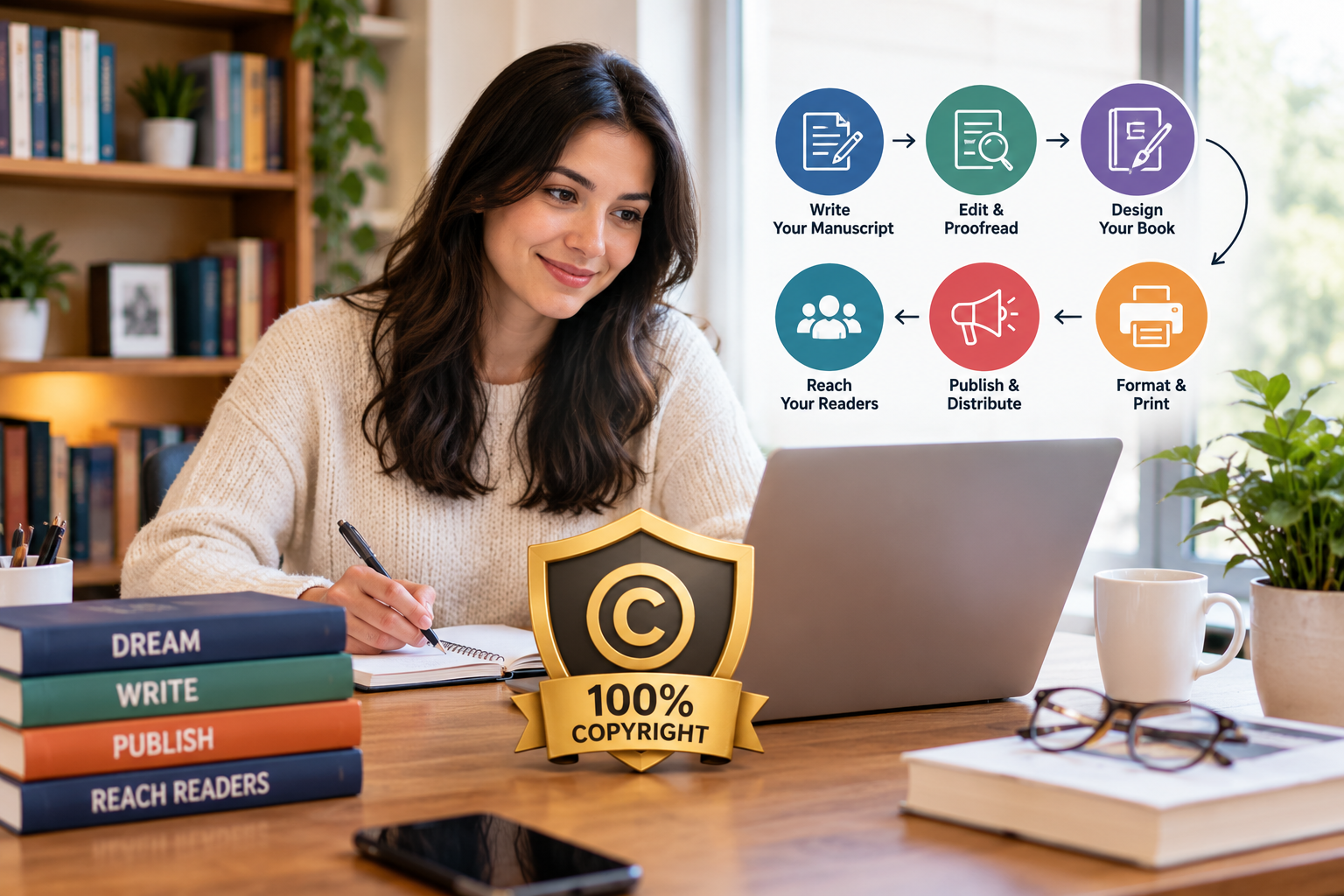
Self-publishing gives aspiring authors the opportunity to turn their ideas into professionally published books without surrendering ownership of their creative work. Unlike traditional publishing arrangements that may involve transferring certain rights, independent publishing allows authors to retain control over their manuscripts, publishing decisions, and future opportunities. By understanding each stage of the process, you can publish your first book confidently while protecting your intellectual property.
However, successful self-publishing requires more than writing a manuscript and uploading a file. You must prepare your content, refine the book’s design, understand publishing agreements, select suitable distribution channels, and develop a practical marketing strategy. With careful planning, you can create a professional book, reach readers worldwide, and retain 100% of your copyright while building a sustainable author career.
1. Understand What Self-Publishing and Copyright Ownership Mean
Before publishing your first book, understand the difference between copyright ownership and publishing rights. Copyright generally protects original creative works, including books, stories, poetry, and nonfiction manuscripts. In many jurisdictions, copyright arises automatically when an original work is created and recorded in a tangible form, although registration may provide additional legal benefits depending on the country.
Self-publishing allows you to release your book independently rather than relying on a traditional publishing house to manage the entire process. You can choose your publishing platform, establish your book’s price, approve the final design, and decide where your work appears. If you need professional guidance, a book publishing company can assist with editing, formatting, cover design, and distribution while allowing you to retain control over key publishing decisions. Most importantly, you can retain copyright while granting distributors only the specific permissions necessary to sell or distribute your book.
Know Which Rights You Should Retain
Copyright ownership gives you important control over how others reproduce, distribute, adapt, or commercially exploit your work, subject to applicable law. Therefore, review every publishing agreement before accepting its terms. Avoid signing contracts that transfer copyright ownership unless you fully understand the consequences and deliberately choose that arrangement.
You should also distinguish copyright ownership from platform distribution rights. For example, a digital bookstore may require permission to display, sell, and deliver your ebook. That permission does not automatically mean the platform owns your copyright. Nevertheless, some agreements include exclusivity requirements, so examine them carefully before enrolling your book.
2. Choose a Clear Idea and Define Your Target Audience
Every successful book begins with a focused concept. Decide whether you want to write fiction, nonfiction, poetry, a memoir, or a practical guide. Then identify the central purpose of your book and the readers who would benefit most from it. A clearly defined concept helps you organize your manuscript and communicate its value to potential buyers.
Next, research the books available in your chosen category. Examine their descriptions, reader reviews, formats, and presentation to understand what audiences appreciate and where existing titles leave unanswered questions. Use this research to identify opportunities for your own work without copying another author's ideas, wording, or distinctive creative expression.
Create a Realistic Writing Plan
Divide your book into manageable chapters and establish achievable writing goals. For example, you might aim to write 500 words each weekday or complete one chapter every week. A consistent routine makes progress easier to measure and helps you finish your manuscript without depending entirely on motivation.
Additionally, create a simple outline before drafting. List your main arguments, story developments, chapter topics, or practical lessons in a logical order. Although you can adjust the structure later, an outline provides direction and reduces unnecessary rewriting during the editing stage.
3. Write and Complete Your Manuscript
Once your concept and outline are ready, begin writing the complete manuscript. Focus initially on developing your ideas rather than perfecting every sentence. Constantly revising individual paragraphs while drafting can interrupt your momentum and make it harder to finish the book.
For nonfiction, support important claims with reliable sources, accurate examples, and useful explanations. For fiction, pay attention to character development, pacing, dialogue, and consistency. Regardless of genre, maintain a clear purpose throughout the manuscript so readers can understand the message, follow the story, or apply the information you provide.
After completing the first draft, take a short break before reviewing it. Returning with fresh eyes helps you identify weak sections, repetitive explanations, missing details, and inconsistencies. You can then revise the manuscript’s structure before investing time and money in professional editing.
4. Edit and Proofread Your Book Professionally
Editing plays a major role in turning an unfinished manuscript into a polished publication. Start with developmental editing, which examines the overall structure, organization, argument, pacing, and readability of your book. This stage is particularly valuable when your manuscript contains complicated ideas, multiple storylines, or chapters that need substantial restructuring.
Next, use copyediting to improve grammar, punctuation, word choice, sentence clarity, and consistency. Finally, proofreading helps identify remaining typographical errors and formatting problems before publication. Although these stages may overlap, each serves a different purpose. If your budget is limited, prioritize the editing services that address your manuscript's most significant weaknesses.
Protect Your Original Work During Editing
You generally retain copyright when an editor reviews or corrects your manuscript, but the agreement should clearly establish ownership and permitted uses. Choose professionals who respect confidentiality and do not claim unnecessary rights over your work. Keep dated drafts and correspondence to document your creative process.
If an editor, illustrator, photographer, or designer contributes original material, clarify the ownership and licensing terms in writing. Do not assume that paying for a service automatically transfers every intellectual property right. Obtain the permissions necessary for your intended publication, especially when using third-party images, quotations, or other copyrighted content.
5. Design a Professional Cover and Interior Layout
Your book's cover creates its first impression, while its interior layout determines how comfortably readers can navigate the content. Choose a cover that reflects your genre, intended audience, and overall message. Clear typography, appropriate imagery, and a balanced composition can help your book look credible alongside competing titles.
Interior formatting is equally important. Select a suitable trim size for print editions, establish consistent headings, and check margins, spacing, page numbers, and chapter openings. For ebooks, ensure that the text adjusts properly across different screen sizes. Before finalizing your files, review them on multiple devices or order a physical proof when available.
Prepare the Required Publishing Files
Different publishing platforms accept different file formats and impose specific technical requirements. Print books commonly require a print-ready PDF, while ebooks may use EPUB or another supported format. Cover dimensions, bleed, spine width, image resolution, and embedded fonts must also meet the chosen platform's specifications.
Additionally, consider accessibility when preparing your ebook. Use properly structured headings, meaningful image descriptions where appropriate, and readable typography. These improvements can make your content easier to navigate and help more readers enjoy your book.
6. Select a Self-Publishing Platform
Choosing the right platform determines how readers can discover, purchase, and access your book. Popular options include Amazon Kindle Direct Publishing, Draft2Digital, and IngramSpark. Each service offers different publishing features, distribution arrangements, fees, and eligibility requirements, so compare their current terms before making a decision.
Amazon Kindle Direct Publishing supports Kindle ebooks and print-on-demand paperbacks and hardcovers in eligible markets. Draft2Digital helps authors distribute ebooks through participating retailers and other channels. IngramSpark offers publishing and distribution services for print and digital books, subject to its current programs and requirements.
Compare these options based on your preferred formats, target markets, printing costs, royalty calculations, and distribution goals. Read the agreements carefully, particularly clauses covering exclusivity, licensing, account termination, and content removal. You can retain copyright while using a suitable platform, but your distribution choices should match your business objectives.
Understand Exclusive and Nonexclusive Distribution
Some publishing programs offer promotional benefits in exchange for temporary exclusivity. Others allow you to distribute your book through multiple retailers. For example, enrolling an ebook in Amazon's Kindle Unlimited-related KDP Select program requires digital exclusivity during the enrollment period, subject to the program's terms.
Exclusivity does not necessarily transfer copyright ownership, but it restricts where you may distribute the enrolled digital edition. If reaching readers across several platforms is important to you, evaluate nonexclusive options before enrolling. Always verify current conditions because platform policies and program requirements can change.
7. Set Up Your Author Information, ISBN, and Copyright Records
Before releasing your book, prepare your author name, title, subtitle, book description, categories, keywords, and cover files. Keep this information consistent across platforms to reduce confusion and create a recognizable author identity. You should also prepare a professional author biography and an appropriate author photograph if you intend to use one.
An International Standard Book Number (ISBN) identifies a particular book edition and format within the book supply chain. Requirements and purchasing options vary by country and publishing platform. Some services provide free ISBNs for eligible editions, while independently obtained ISBNs may offer greater control over the associated publisher identity. An ISBN is not the same as copyright registration.
Copyright registration is also separate from publishing your book. In some countries, including the United States, eligible authors can register their works through the relevant copyright office. Other countries have different systems and legal requirements. Check the rules in your jurisdiction to determine whether registration offers practical benefits for your situation.
8. Calculate Your Costs and Establish a Fair Price
Self-publishing gives you control over pricing, but your decisions should reflect production expenses, reader expectations, competing titles, and your publishing goals. Create a budget that includes editing, cover design, formatting, ISBNs where applicable, proof copies, and promotional activities. You do not need to purchase every available service, but avoid sacrificing essential quality standards.
Next, calculate your potential earnings using each platform's current royalty formula. Ebook royalties may depend on pricing eligibility, delivery costs, and the selected program. Print royalties generally account for printing expenses and other applicable deductions. If you need help comparing royalty structures and estimating potential profits, publishing consulting services can help you evaluate your options and make informed pricing decisions. Consequently, a higher list price does not automatically produce higher earnings or better sales.
Set a price that supports your objectives while remaining reasonable for your target audience. You can test different prices when platform rules permit, monitor reader responses, and adjust your approach based on actual results. Remember that retaining copyright and earning 100% of your royalties are different concepts: distribution platforms may deduct fees or production costs even when you retain complete copyright ownership.
9. Publish Your Book and Review the Final Proof
Once your manuscript, cover, metadata, and publishing settings are ready, upload your files to the selected platform. Complete the required review steps, check the displayed information, and inspect the digital preview carefully. Look for missing text, awkward page breaks, incorrect chapter headings, cover alignment problems, and other errors that could affect the reader experience.
For print editions, order a proof copy whenever possible. A physical review can reveal issues that remain difficult to detect on a computer screen, including uncomfortable margins, poor image quality, and unexpected page numbering. Correct any problems before approving the final edition.
After publication, verify that the book appears correctly in the intended storefronts. Check the title, description, author information, cover, price, and available formats. If you discover a significant error, update the files according to the platform's procedures rather than allowing avoidable problems to undermine reader confidence.
10. Market Your Book While Keeping Control of Your Rights
Publishing makes your book available for purchase, but marketing helps potential readers discover it. Begin by creating a professional author website or profile where readers can learn about your work and upcoming releases. Share useful content related to your subject, participate in relevant communities, and communicate with readers without relying entirely on paid advertising.
You can also pursue podcast interviews, guest articles, book bloggers, newsletters, and reader review opportunities. Build relationships with people whose audiences match your book's subject and genre. When requesting reviews, follow each platform's policies and never pressure readers to provide positive feedback.
Develop a consistent promotional plan rather than relying on a single launch announcement. Share excerpts, explain the inspiration behind your book, and highlight practical lessons or interesting themes. Track sales, website visits, reader engagement, and campaign performance to identify which activities deserve more attention.
Throughout these activities, continue protecting your intellectual property. Use written agreements for adaptations, translations, audiobooks, and other commercial opportunities. You can license selected rights while retaining copyright, provided the agreement clearly defines the permitted use, duration, territory, and other relevant conditions.
11. Maintain Copyright Ownership as Your Author Career Grows
Your first publication can create opportunities for future books, collaborations, translations, and licensing agreements. Therefore, keep organized records of manuscripts, contracts, permissions, publication dates, and relevant correspondence. Store backup copies of your work securely and maintain a clear record of the rights you have granted to third parties.
Before signing any agreement, identify whether it grants a limited license or transfers ownership. Review provisions covering exclusivity, royalties, termination, derivative works, and future editions. If the agreement involves substantial money or valuable rights, consider consulting a qualified intellectual property lawyer in the relevant jurisdiction.
Most importantly, do not assume that every publishing service requires copyright ownership in exchange for assistance. Many independent publishing arrangements allow authors to retain their rights while purchasing editing, design, printing, distribution, and marketing services separately. Choose partners whose terms support your long-term creative and commercial goals.
Conclusion
Self-publishing your first book while retaining 100% of your copyright is achievable when you approach the process with clear goals and informed decisions. Develop a strong manuscript, invest in appropriate editing and design, select a suitable publishing platform, understand distribution agreements, and review every requirement before releasing your book.
Above all, protect your intellectual property by keeping clear records and reading contracts carefully. Although publishing platforms may charge fees or deduct production costs, you can retain copyright while using their services under appropriate terms. With professional preparation, thoughtful marketing, and consistent attention to your rights, your first book can become the foundation of a rewarding independent publishing career.

 English
 Arabic
 French
 Spanish
 Portuguese
 Deutsch
 Turkish
 Italiano
 Russian
 Romaian
 Portuguese (Brazil)
 Greek
Greek
