


Demand Response Management System Market Trends Driving Energy Efficiency
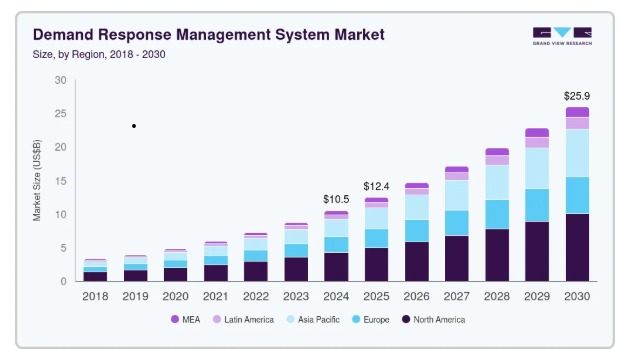
The demand response management system market is gaining momentum as utilities, industries, and households seek better ways to manage electricity consumption. Valued at USD 10.5 billion in 2024, the global Demand Response Management System Market is projected to reach USD 25.9 billion by 2030, growing at a CAGR of 15.8% from 2025 to 2030. Energy digitization, grid modernization, renewable energy integration, and regulatory efforts to improve energy efficiency are accelerating adoption.
What Is Changing in the Way Electricity Demand Is Managed?
Traditional electricity systems must balance supply and demand while managing consumption peaks. Demand response management systems (DRMS) help utilities and consumers adjust electricity usage according to grid conditions, pricing signals, and supply constraints.
Their growing relevance comes from three connected developments:
- Rising electricity demand: Urbanization and industrial expansion are increasing pressure on power infrastructure.
- Renewable energy integration: Solar power, battery storage, and other distributed energy resources require more flexible grid management.
- Digital energy infrastructure: Internet of Things (IoT) devices, advanced metering infrastructure, and real-time analytics enable more responsive energy management.
Cloud-based platforms are also making demand response programs more scalable, allowing utilities to monitor usage, automate adjustments, and anticipate future energy requirements.
Download a free sample report or claim your copy of this full market intelligence report
Which Technology Is Leading the Market?
Automated demand response accounted for more than 52.0% of global revenue in 2024, making it the leading technology segment.
Automated systems respond to grid conditions without requiring manual intervention. This helps utilities manage peak demand, improve grid stability, and reduce the operational costs associated with peak-load generation.
In May 2024, Honeywell International introduced Honeywell Forge Performance+ for Utilities, designed to help utilities optimize operations and improve the efficiency of existing grid assets and IT systems.
Conventional demand response systems also have a role in the market. These solutions encourage consumers to reduce electricity usage during periods of high demand, often through incentives. As electricity consumption rises, they can help utilities manage peak loads without relying exclusively on additional infrastructure.
Why Are Industrial Users Adopting DRMS Solutions?
The industrial segment accounted for the largest application revenue share in 2024. Energy-intensive businesses are increasingly focused on reducing electricity costs while maintaining operational efficiency.
Demand response management systems enable industrial users to shift or temporarily reduce electricity consumption during expensive peak periods. This flexibility can lower energy bills and support sustainability objectives.
Residential demand is also expected to grow as smart thermostats, connected appliances, and other IoT-enabled devices become more common. These technologies allow households to adjust energy consumption automatically during peak-demand periods.
Honeywell's January 2024 launch of Advance Control for Buildings further illustrates the focus on improving building operational efficiency and energy management.
How Are Regional Policies Influencing Market Expansion?
North America held more than 39.0% of global revenue in 2024, supported by grid modernization, infrastructure investment, sustainability goals, and growing demand for peak-load management. Dynamic pricing and real-time energy information are also encouraging participation in demand response programs.
In the U.S., the market is expected to grow at a CAGR of 14.7% from 2025 to 2030. Renewable energy targets and clean-energy commitments in states such as California, Texas, and New York are supporting demand-side management.
Europe is benefiting from decarbonization policies and regulatory initiatives. The European Union's climate-neutrality objective for 2050, alongside the Energy Efficiency Directive, is encouraging greater adoption of demand-side flexibility solutions.
Asia Pacific is anticipated to experience rapid growth as urbanization and industrialization increase electricity demand. Utilities are seeking ways to balance supply and consumption during peak hours while reducing pressure on existing power infrastructure.
What Recent Developments Illustrate the Market's Potential?
Two developments demonstrate how digital technologies are expanding the practical application of demand response management.
- Residential virtual power plants: In April 2024, EnergyHub partnered with CPower to launch a residential virtual power plant partnership available to 1.2 million Ameren Illinois customers across more than 1,200 communities in the Midcontinent Independent System Operator region.
- Utility automation: Honeywell's 2024 utility and building management launches reflect the growing emphasis on automation, operational efficiency, and better control of energy infrastructure.
These developments illustrate the increasing connection between demand response, distributed energy resources, and digital energy management.
Which Companies Are Shaping the Competitive Landscape?
Companies operating in the demand response management system market are developing solutions that support energy optimization, electrification, and grid flexibility.
Key companies include:
- ABB
- Eaton
- Enel SpA
- Alarm.com Holdings, Inc.
- General Electric
ABB offers energy management solutions that monitor, forecast, and optimize energy consumption and supply. Its portfolio includes the Ability Energy Management System and Microgrid Power Management Controller.
Eaton's electrical business serves utility, commercial, industrial, and residential markets, positioning the company within the broader shift toward digitalization and electrification.
What Comes Next for the Demand Response Management System Market?
The market's future will be shaped by the need to accommodate rising electricity consumption, integrate renewable energy, and improve grid resilience. Automated demand response, connected devices, cloud platforms, and distributed energy resource management are creating opportunities for more flexible energy systems.
With the global market projected to reach USD 25.9 billion by 2030, demand response management systems are becoming an important component of efforts to improve energy efficiency, manage peak demand, and support the transition toward more sustainable electricity infrastructure.
Explore Our Research & Intelligence Solutions
Prism AI: Ask. Analyze. Get Cited Market Insights. – Explore Now
Grand View Signal: Understand the Factors Shaping Commodity Prices – Explore the Platform

 English
 Arabic
 French
 Spanish
 Deutsch
 Turkish
 Dutch
Dutch
 Italiano
 Russian
 Romaian
 Portuguese (Brazil)
 Greek
Greek