


Next-Generation Gate Barrier System for UAE Security
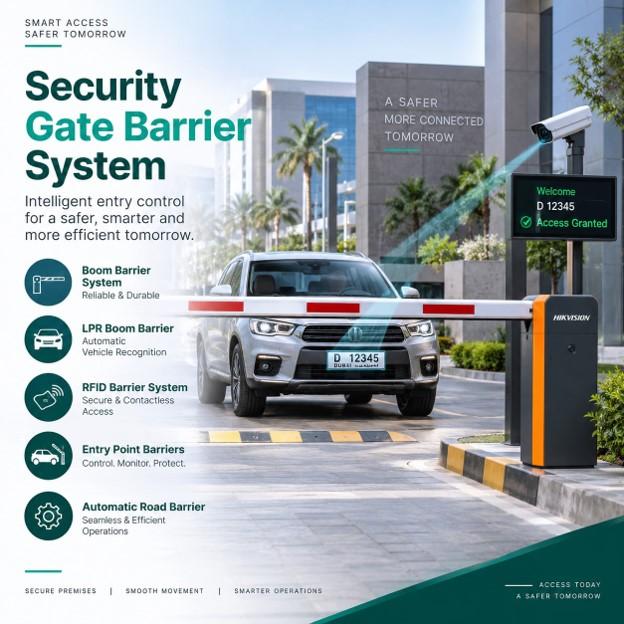
Vehicle-borne threats, from unauthorised entry to deliberate ramming attempts, have pushed UAE facility operators to treat the vehicle gate as a genuine security perimeter rather than a simple convenience feature. A properly specified Gate Barrier System is now the first line of defence for government buildings, critical infrastructure sites, financial institutions, and high-security commercial developments across Dubai, Abu Dhabi, and the wider Emirates.
UAE facilities with genuine security exposure can no longer treat the vehicle gate as a simple convenience feature, and a properly rated Gate Barrier System is now a core part of any credible perimeter defence. Whether a site relies on a crash-rated Automatic Road Barrier, watchlist-screening LPR Boom Barrier, or a fully integrated Security Gate Barrier System tied into the wider security stack, teams that specify hardware against a real threat assessment build a perimeter that holds up under both everyday use and a genuine incident.
This guide focuses specifically on the security dimension of vehicle barrier technology: how modern systems screen, verify, and where necessary physically stop a vehicle before it reaches a protected asset, and what UAE security teams should evaluate when specifying hardware for a genuinely high-stakes entry point.
Why the Vehicle Gate Is Now a Frontline Security Asset
For years, a vehicle barrier was treated primarily as a traffic-management convenience, something to keep unpaid parkers out or manage flow at a busy driveway. UAE security consultants now view the same equipment very differently: as the first physical checkpoint capable of stopping a vehicle before it reaches a building, a crowd, or critical infrastructure.
This shift matters for procurement decisions. A barrier chosen purely for cost or throughput speed, without regard to its actual physical stopping capability, leaves a genuine security gap at exactly the point where a facility's perimeter plan assumes protection exists.
Rethinking the Boom Barrier System as a Security Control, Not Just Traffic Management
A standard Boom Barrier System uses a motorised arm to control vehicle passage, but security-grade specifications go well beyond the basic mechanism found in a typical car park. For a genuinely protective deployment, the arm's crash rating, the anchoring of its base, and its resistance to manual defeat all need evaluation, not just its raise-and-lower cycle speed.
Facility security teams should distinguish clearly between a commercial-grade barrier suited to a low-risk staff car park and a security-rated barrier engineered to resist forced or accidental vehicle intrusion, since the two categories are built to entirely different standards despite looking similar from a distance.
Questions to Ask Before Specifying a Security-Grade Barrier
● What certified impact or crash rating does the barrier carry, and against what vehicle weight and speed was it tested?
● Is the foundation engineered to transfer impact force into the ground rather than the barrier simply shearing off?
● Does the arm include reinforcement or cabling that prevents a vehicle from simply driving through a raised or partially open arm?
Entry Point Barriers and Layered Perimeter Design
Serious facility security rarely relies on a single barrier at a single point. Entry Point Barriers are typically deployed in layers, an outer screening point where vehicles are checked before proceeding, an intermediate holding area where a vehicle can be inspected or held if flagged, and a final barrier immediately before the protected zone itself.
This layered approach gives security personnel multiple opportunities to intervene before a vehicle reaches a sensitive area, rather than relying on a single point of failure where one compromised or malfunctioning barrier removes all protection at once.
Parking Access Barriers with Genuine Screening, Not Just Ticketing
For high-security facilities, Parking Access Barriers need to do more than dispense a ticket or read a resident tag. Security-focused deployments incorporate under-vehicle inspection systems, weight sensors, and credential verification that confirms not just that a vehicle has a valid pass, but that the vehicle and driver combination match an expected, pre-registered profile.
This distinction matters most for government buildings, embassies, and critical infrastructure sites in the UAE, where a stolen or cloned parking credential should not be sufficient on its own to grant access without a secondary verification step catching the mismatch.
Vehicle Access Control Software Behind a Secure Perimeter
The barrier arm is the visible deterrent, but the Vehicle Access Control platform behind it is what actually makes access decisions, flags anomalies, and creates the audit trail security teams rely on after an incident. For a security-grade deployment, this software needs to integrate tightly with watchlists, visitor pre-authorisation systems, and the facility's broader security operations centre.
Key capabilities for a security-focused platform include real-time alerts when an unrecognised or flagged vehicle approach, integration with the facility's CCTV and guard dispatch systems so an alert triggers an immediate human response, and a complete, tamper-evident log of every vehicle movement for post-incident investigation.

 English
 Arabic
 French
 Portuguese
 Deutsch
 Turkish
 Dutch
Dutch
 Italiano
 Russian
 Romaian
 Portuguese (Brazil)
 Greek
Greek
