


Industrial Salt Manufacturing Companies in India: What B2B Buyers Should Check in 2026
Industrial salt may look like a straightforward commodity, but sourcing it at scale is a serious procurement decision. For chemical manufacturers, textile units, detergent companies and water-treatment businesses, inconsistent quality or late supply hits production directly.
That's why B2B buyers comparing industrial salt manufacturing companies in India should look beyond the price quotation. A reliable supplier can prove product consistency, manufacturing capacity, suitable packaging, complete documentation and dependable logistics.
Here are ten checks procurement teams should make before approving a supplier in 2026.
1. Start With a Detailed Product Specification
A vague request for "industrial salt" makes suppliers impossible to compare. Industrial salt varies in NaCl purity, moisture, particle size, calcium and magnesium content, insoluble matter, additives and flow characteristics, and your specification should reflect the final application.
Textile processing, for example, often needs low-hardness salt, while detergent production prioritises consistent particle size and solubility. Write these limits down before you request quotes.
2. Check Batch Consistency and the Certificate of Analysis
A supplier may send an excellent sample and still struggle to hold that standard across large monthly orders. Ask how often purity is tested, whether moisture and mesh size are monitored, whether production batches are recorded, and whether test results ship with each consignment. In a controlled process, small shifts in composition or particle size can upset dosing, dissolution and output.
A Certificate of Analysis (COA) gives you a technical snapshot of the product: NaCl percentage, moisture, calcium, magnesium, insoluble matter and particle size. For large orders, insist on a COA tied to the actual production batch, not just a generic specification sheet.
3. Evaluate Production Capacity and Product Range
Capacity becomes critical once you need recurring shipments. When comparing industrial salt manufacturers in India, ask about monthly production, annual capacity, peak-season supply, raw salt availability, backup stock and storage. A supplier that handles one trial container comfortably may not cope with a long-term contract.
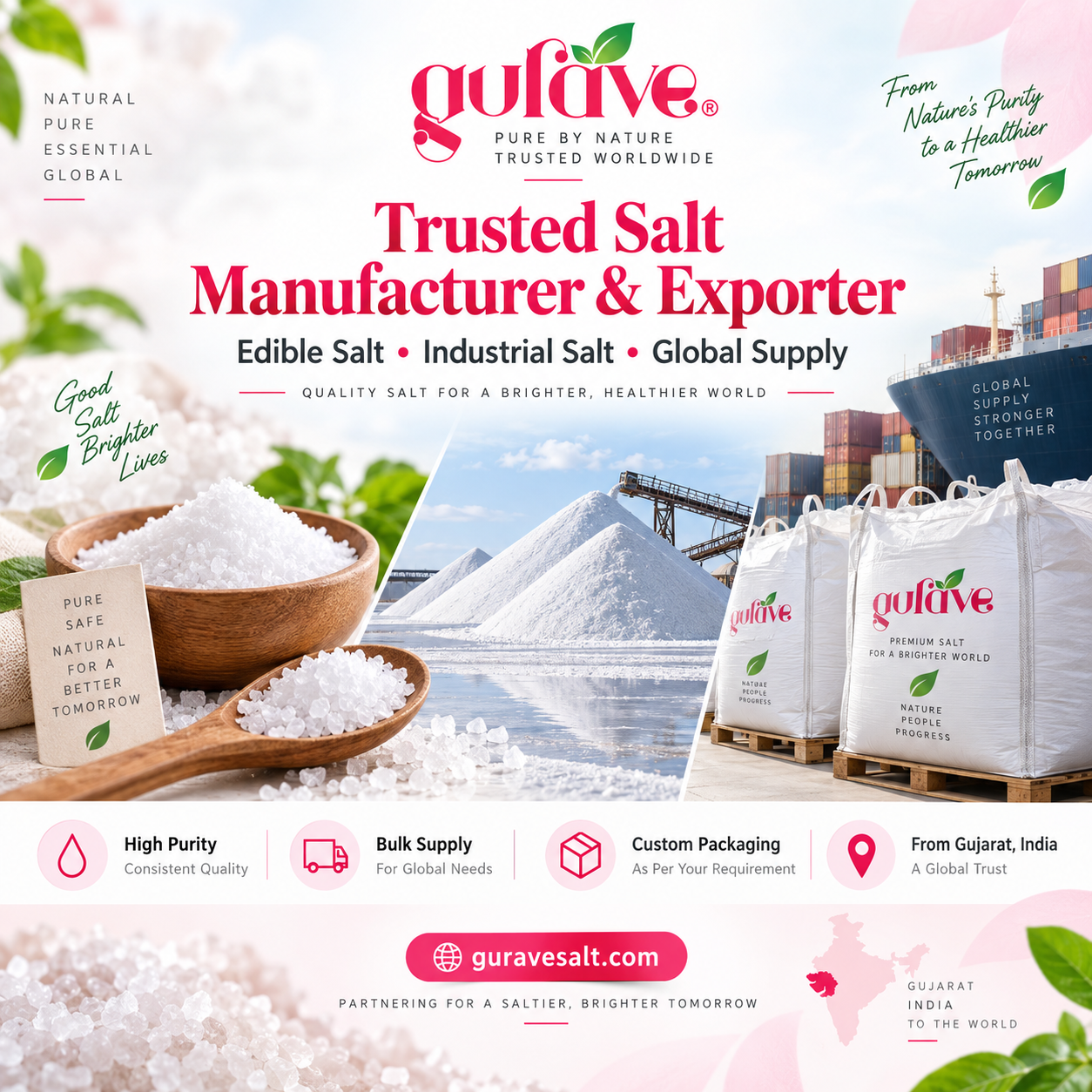
Gurave Salt, for example, lists bagged industrial salt supply of 3,000–5,000 MT a month, backed by annual capacity of about 200,000 MT of raw salt and 35,000 MT of refined salt.
A wider product range adds flexibility. Raw and refined industrial salt, low-hardness, fine, coarse, mesh, water-softener and free-flow grades from one source can serve different plants or production lines, though each grade should still be checked against its own specification.
4. Check Mesh Size and Moisture Control
Particle size affects dissolution speed, mixing, flow through equipment, dosing consistency and material handling. If your process needs a specific particle size, put the mesh range in the purchase specification and confirm the manufacturer can hold it across shipments. Custom grading matters most in textile, chemical and detergent applications.
Moisture causes its own problems: clumping, poor flow, awkward bag handling, storage issues and inconsistent dosing. Ask how the salt is dried, stored and protected before dispatch, especially if your plant is in a humid region.
5. Compare Packaging Options
Choose packaging around your warehouse and handling needs. Common options are 25, 35 and 50 kg bags, jumbo bags and loose bulk. Gurave Salt, for instance, uses PP and LDPE-laminated PP bags in standard bulk sizes. Whichever supplier you choose, check bag strength, inner liners, sealing, palletisation and moisture resistance. The cheapest bag is rarely the most economical if product is lost or damaged in transit.
6. Ask About Free-Flow Salt
Some operations need salt that stays easy to handle and won't clump in storage. Free-flow salt suits automated dosing, hoppers, feed systems, food processing, detergent production and chemical formulations. Businesses comparing free flow salt manufacturers in India should ask which anti-caking agent is used and confirm that it's acceptable for their end use.
7. Check Documentation and Lead Times
Don't rely on verbal claims. Ask for product specification sheets, COAs, a safety data sheet, batch test results, inspection reports and relevant certifications. Export shipments also need a certificate of origin, commercial invoice, packing list and bill of lading.
Then ask how long production, packing, documentation, inland transport and port delivery each take. Large orders and custom packing take longer. If salt is a critical input, keep safety stock rather than relying on just-in-time delivery alone.
8. Compare Logistics and Total Landed Cost
Salt is heavy and bought in large quantities, so freight can change the whole picture. Compare distance to port, container availability, bulk vessel capability, port handling, inland and ocean freight, customs costs, inspection fees and storage, not just the ex-factory price.
Suppliers near major ports have a clear edge. Gurave Salt ships through Mundra and Kandla and has loaded single industrial salt cargoes of more than 50,000 MT from Kandla to China, a good example of the bulk vessel capacity some industrial salt manufacturers in India can offer. A slightly higher factory price can still mean a lower landed cost if the logistics are efficient.
9. Place a Trial Shipment First
Before signing an annual contract, place a smaller trial order. Use it to judge product quality, packaging, documentation, delivery timing, communication and real performance on your production line before you commit to larger volumes.
10. Review Complaints Handling, Commercial Terms and Communication
No supply chain is risk-free. Ask what happens if a batch fails specification, bags arrive damaged, quantity is short, delivery slips or documents are wrong. A good supplier has a clear process for complaints and corrective action.
Confirm minimum order quantity, payment terms, Incoterms, currency, freight responsibility, inspection costs and packaging charges in writing. And watch how the supplier communicates. Clear technical answers, quick documents and accurate lead times at the quotation stage are a good sign of how your orders will be handled later.
Final Supplier Checklist
Before approving an industrial salt supplier, confirm:
-
Does the salt meet our technical specification?
-
Is monthly capacity sufficient, and can it scale?
-
Are batch test reports available?
-
Is packaging appropriate?
-
Are lead times realistic?
-
Is documentation complete?
-
Is total landed cost competitive?
-
Is communication professional?
Final Thoughts
Choosing among industrial salt manufacturing companies in India takes more than comparing price lists. Evaluate technical quality, batch consistency, capacity, packaging, documentation, logistics and communication. For high-volume operations, supply reliability matters as much as purity. In 2026, the strongest procurement decisions come from structured due diligence rather than the lowest quotation, and that approach builds more stable long-term supplier relationships.
 Turkish
 English
 Arabic
 French
 Spanish
 Portuguese
 Deutsch
 Dutch
Dutch
 Italiano
 Russian
 Romaian
 Portuguese (Brazil)
 Greek
Greek
