


Why Last-Mile Delivery Costs Are Escalating – Plus How Smart Routing Can Help
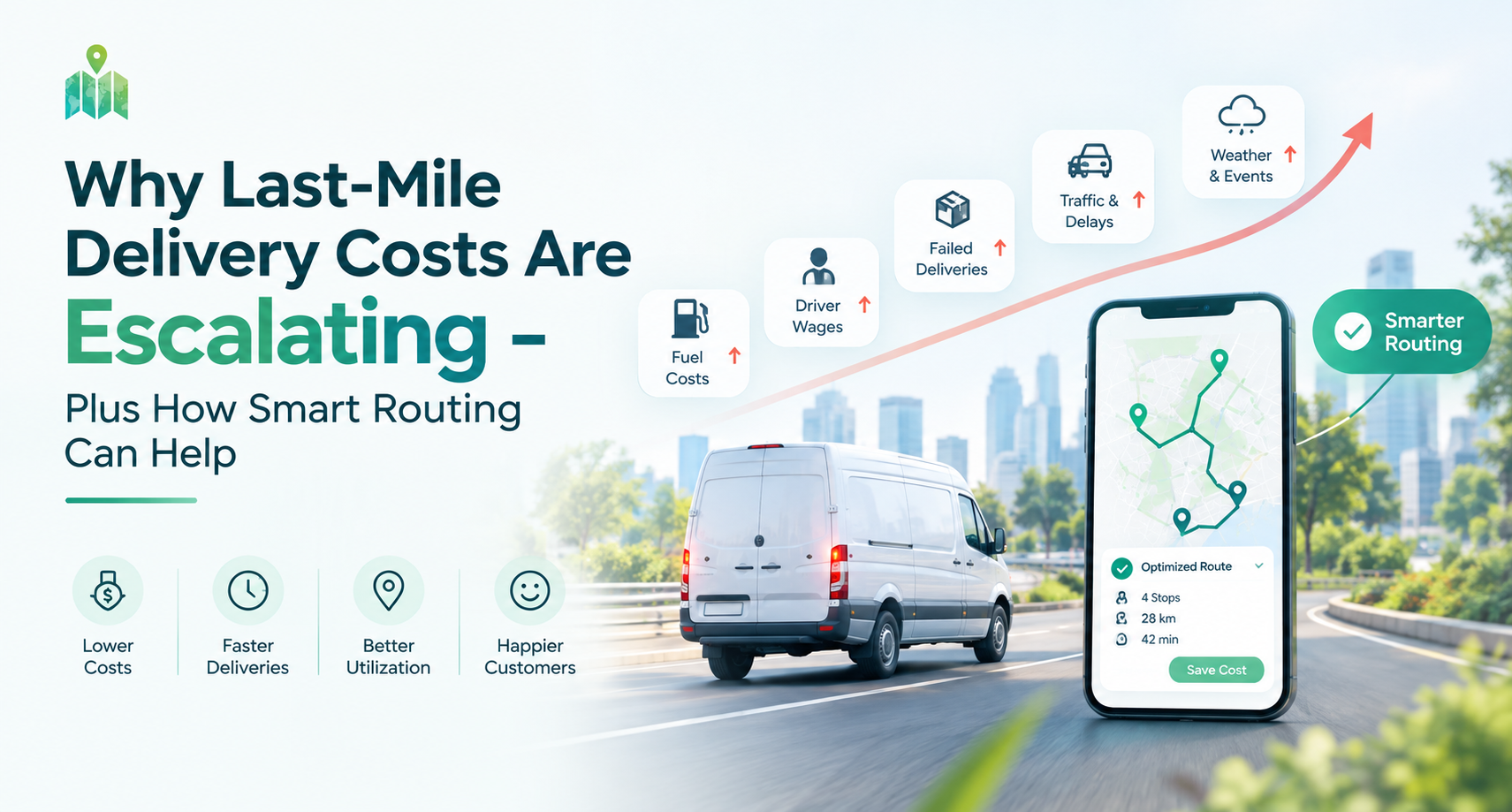
Last-mile delivery costs are rising, and businesses are looking for solutions. Customers expect faster delivery, easier delivery options, more accurate delivery windows, and better communication about their delivery status. Meanwhile, businesses must operate in a way that delivery costs remain affordable. Even minor inefficiencies when it comes to driver productivity, fuel burned, the number of failed delivery attempts, and other factors can add up to a significant expense with a high volume of orders.
Smart routing, when combined with a delivery tracking app, and delivery management software can help organizations streamline and optimize their last-mile delivery operations.
Why Are Last-Mile Delivery Costs Increasing?
There are several reasons why last-mile delivery costs are rising.
The first reason is increasing fuel and vehicle costs.
Inefficiencies in the delivery route can cause drivers to waste fuel on long backtracking trips and add unnecessary kilometres to their routes.
Another factor is the rising customer expectations. Same-day and next-day delivery is now the norm in many industries, and customers also expect narrow delivery windows and to have visibility into the delivery process.
Traffic is another factor that impacts delivery costs. A seemingly efficient route may be rendered inefficient by traffic patterns. Additionally, road closures, accidents, and other incidents may cause delays.
Failed delivery attempts also contribute to higher delivery costs. In order to reschedule a delivery, another driver must be assigned, and time is wasted.
Finally, the use of manual dispatching methods contributes to higher delivery costs. As the volume of deliveries increases, it becomes increasingly challenging to optimize delivery routes using methods like spreadsheets, phone calls, messaging apps, and manually-planned delivery routes.
How Smart Routing Lowers Delivery Costs
Smart routing software helps organizations reduce delivery costs by optimizing delivery routes.
Smart routing software takes into account not only the distance between stops but also the time it takes to complete a delivery. In addition, smart routing software can create optimized routes based on a variety of criteria, such as the vehicle’s capacity, the driver’s availability, and the delivery window during which the customer must receive the package.
For example, if a delivery driver has 25 delivery stops in a single day, an inefficient routing plan can add up kilometres and hours to the delivery route. A smart routing system can help to reduce the distance and time spent on the road by organizing delivery stops in a single, logical route.
This allows drivers to maximize the number of deliveries per day, with minimal kilometres driven.
The Role of a Delivery Tracking App
A delivery tracking app helps logistics managers keep track of what is happening on the road in real-time. It also helps them provide customers with regular and reliable delivery updates.
With a delivery tracking app, dispatchers can keep track of where drivers are, when they are scheduled to make a delivery, whether they are on time or running late, and which orders have been delivered and which are still waiting to be delivered. The visibility offered by a delivery tracking app can reduce the number of customer inquiries about their delivery status and give logistics managers the tools they need to manage their drivers and delivery routes more efficiently. A delivery tracking app can also help logistics managers detect and address bottlenecks and operational inefficiencies that impact delivery costs.
Why Delivery Management Software Matters
Delivery management software helps organizations keep track of all their deliveries, drivers, and logistics operations in one place. Using delivery management software, logistics managers can perform a variety of tasks that would otherwise be very time-consuming and require multiple applications to complete.
Delivery management software usually includes a variety of tools, including smart routing and real-time tracking of drivers, delivery tracking, the ability to assign orders to drivers, and the ability to capture and store proof of delivery.
Delivery management software can help logistics managers keep track of all their delivery-related activities, organize them more efficiently, and reduce overall delivery costs.
The main advantage of delivery management software is that it helps logistics managers organize all of their delivery-related activities in one place, reducing the likelihood of errors, inconsistencies, or miscommunication with customers.
Smart Routing for Smarter Delivery Scheduling
One of the primary advantages of smart routing is that it enables companies to get more out of each delivery by reducing the average kilometres driven per delivery.
If smart routing makes it possible to squeeze in a few more stops per driver per day, then the delivery company can handle more orders without having to acquire more vehicles or hire more drivers.
For smaller delivery companies, this can be a huge advantage. Instead of expanding their fleet and driver base as their order volume grows, they can analyze their current operations to identify any possible inefficiencies in their delivery routes.
Even small reductions in kilometres driven per delivery can have a major impact on delivery costs, especially when aggregated across all delivery drivers.
Smart Routing Helps Logistics Managers Reduce Failed Delivery Attempts
Smart routing can also help logistics managers reduce the number of failed delivery attempts. One of the biggest advantages of smart routing software is that it considers delivery windows in its route optimization calculations.
Incorporating delivery windows into the equation ensures that customers are available to accept a delivery. A delivery tracking app can also improve communication with customers and provide them with accurate information about the status of their delivery and the estimated time of arrival.
Less failed delivery attempts means that delivery drivers are more productive, and logistics managers can reduce the number of delivery attempts, which reduces delivery costs.
Using Delivery Data to Reduce Delivery Costs
It is important for delivery companies to constantly analyze the data generated by their delivery operations in order to find ways to improve the efficiency of their operations. A good delivery management software solution will include a number of analytical tools that can help logistics managers identify potential inefficiencies.
For example, an inefficient delivery route will generate data indicating that the delivery driver spent a large amount of time and kilometres driven on that particular route.
By analyzing data, logistics managers can get a clearer picture of the patterns and trends that impact their delivery costs.
For example, if certain parts of the city have high traffic during rush hour, the logistics managers may want to schedule deliveries in such a way that drivers avoid rush-hour traffic.
The Future of Last-Mile Delivery Cost Efficiency
Last-mile delivery costs will continue to be a concern for delivery companies, as customer expectations continue to rise. Fuel costs, vehicle costs, and driver wages will also continue to be a concern. Smart routing software can help logistics managers make the most out of their delivery drivers and vehicles.
A delivery tracking application gives logistics managers the visibility and control they need to keep delivery costs in check. Comprehensive delivery management software can help logistics managers keep track of their delivery drivers and customers, optimize delivery routes and schedules, analyze delivery operations to find inefficiencies, and manage their customers’ expectations.

 English
 Arabic
 French
 Spanish
 Portuguese
 Deutsch
 Turkish
 Dutch
Dutch
 Italiano
 Russian
 Romaian
 Portuguese (Brazil)
