


Maa Saraswati Murti The Sacred embodiment of Wisdom
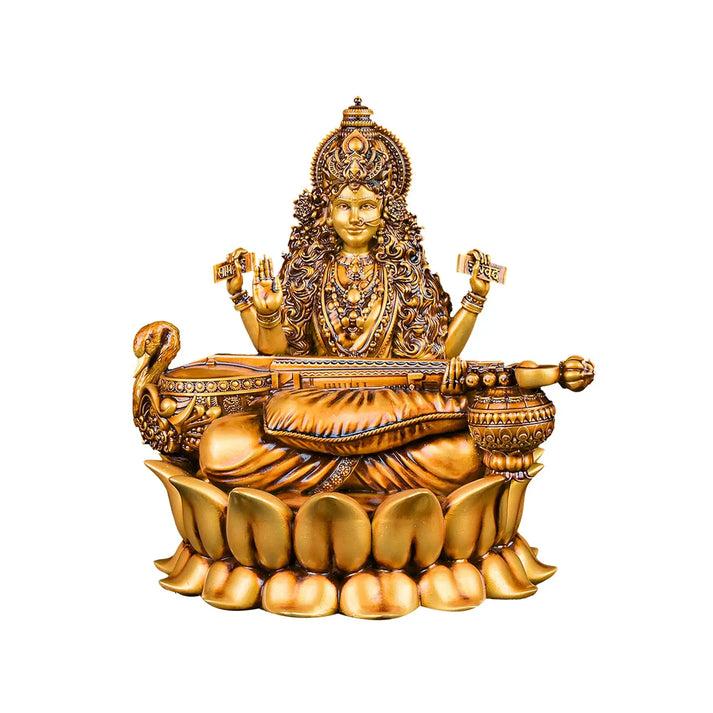
In the vast and intricate tapestry of Hindu iconography, every deity represents a distinct manifestation of the supreme reality, guiding humanity through different dimensions of existence. Among them, Maa Saraswati stands as the radiant embodiment of knowledge, wisdom, music, art, speech, and consciousness. She is the vac-devi (goddess of speech) and the repository of the cosmic sound from which the universe was manifested. The Maa Saraswati Murti (sacred idol) is not merely an object of aesthetic beauty or blind ritualism; it is a highly evolved, deeply psychological, and profoundly spiritual blueprint for human evolution.
Whether crafted out of pristine white marble, traditional clay, sacred wood, or resonant metal, a Saraswati Murti serves as a bridge between the material mind and spiritual intellect. In households, educational institutions, music academies, and spiritual centers across the globe, her idol is revered as the ultimate catalyst for clarity, creativity, and inner awakening. To gaze upon a Saraswati Murti is to read a visual scripture, where every posture, color, object, and companion carries an eternal truth designed to guide the seeker from the darkness of ignorance to the light of ultimate truth.
The Origins and Evolutionary Context of Saraswati
To fully appreciate the significance of the Saraswati Murti, one must understand her roots. In the oldest Vedic texts, particularly the Rigveda, Saraswati was primarily celebrated as a mighty, life-giving river. She was the fluid force that nourished the soil, sustained civilizations, and purified the body. Over millennia, as the physical river receded and altered its course, the physical waters sublimated into an intellectual and spiritual force. The flowing river became the flowing mind; the life-giving water became the soul-nourishing stream of knowledge and speech.
Thus, the contemporary Saraswati Murti beautifully captures this fluid, unblemished essence. As the consort of Brahma, the creator of the universe, Saraswati represents the dynamic intellect required to bring form and structure to creation. Without knowledge, creation is chaotic; without speech, thought cannot be conveyed. The murti, therefore, acts as a physical anchor for this abstract, free-flowing cosmic intelligence, bringing the infinite down to a form that human consciousness can contemplate and emulate.
Anatomy of the Divine Form: Decoding the Iconography
The classical depiction of Maa Saraswati within her murti is highly structured, rich with deliberate symbolism. Unlike other deities who may carry weapons to slay external demons, Saraswati holds instruments of refinement, meditation, and art to conquer the internal demons of ignorance, ego, sluggishness, and superficiality.
1. The Quadruple Arms: The Human Psyche and Consciousness
A defining feature of the classical Saraswati Murti is her depiction with four arms. These four hands correspond directly to the four inner instruments of human consciousness, collectively known as the Antahkarana:
-
Manas (The Mind): The seat of ordinary thoughts, emotions, and sensory processing.
-
Buddhi (The Intellect): The capacity for reasoning, discrimination, and deep understanding.
-
Chitta (The Memory or Conditioned Consciousness): The reservoir of past impressions and experiences.
-
Ahamkara (The Ego): The sense of self-identity.
The balanced, serene positioning of these arms in the murti signifies that true wisdom is achieved only when the mind, intellect, memory, and ego are perfectly aligned and operating in absolute harmony.
2. The Attire: The Splendor of White (Shweta)
Unlike deities adorned in vibrant red, gold, or silk of multiple hues, Maa Saraswati is almost exclusively draped in a spotless white saree (Shweta Vastram). White is the synthesis of all colors, representing absolute purity, truth, light, and transparency. It signals that spiritual and academic knowledge must be unpolluted by selfish desires, greed, or worldly corruption. The white attire reminds the student and the scholar alike that the pursuit of truth requires an unblemished, transparent heart.
3. The Sacred Seating: Lotus and Rock
In most murtis, Saraswati is shown seated either upon a pristine white lotus (Padmasana) or a solid rock.
-
The Lotus: The lotus root originates in muddy waters, yet the flower blooms high above the surface, entirely unaffected by the dirt beneath. This signifies that a true seeker of knowledge must live in the material world without letting its negativity, trivialities, and illusions taint their intellect.
-
The Rock: When depicted on a rock, it signifies stability, grounding, and unshakeable resolve. Knowledge is not a passing trend; it is a foundational bedrock that keeps a person steadfast during the storms of life.
The Divine Accoutrements: Tools of Light and Melody
The items held by Maa Saraswati in her hands are keys to unlocking human potential. They represent the holistic nature of learning, combining science, arts, spirituality, and mindfulness.
1. The Veena: The Harmony of Existence
Maa Saraswati holds the Veena, a classical stringed instrument, gracefully across her lap using two of her hands. The Veena represents the arts, music, and the literal expression of emotion through creative forms. On a cosmic level, it symbolizes the vibration of life—the primordial sound Anahata Nada that reverberates through the universe.
Playing the Veena requires extreme precision, patience, and tuning; if the strings are too tight, they snap, and if they are too loose, they fail to produce music. Similarly, human life must be finely tuned between worldly responsibilities and spiritual pursuits to create a beautiful, harmonious melody rather than chaotic noise.
2. The Vedas: Universal Knowledge and Science
In one of her left hands, she holds sacred manuscripts or books, usually represented as the Vedas. This represents the Jnana Kanda—the empirical, scientific, and textual knowledge necessary to understand the laws of nature and existence. It emphasizes that while intuition and art (represented by the Veena) are vital, they must be grounded in systematic study, documentation, intellect, and rigorous discipline.
3. The Sphatik Mala: The Power of Contemplation
In her right hand, she holds a rosary made of pure crystal pearls (Sphatik Mala). This string of beads symbolizes the process of Japa (repetition) and meditation. It shows that mere reading of books (Vedas) and practicing arts (Veena) are incomplete without deep contemplation, introspection, and spiritual integration. The crystal beads reflect light without absorbing it, reminding the devotee to remain detached and continually cycle through self-reflection to purify the soul.
The Sacred Companions: Avian Symbols of Discrimination
A Saraswati Murti is rarely complete without her divine vehicles (Vahanas), which provide profound insights into how knowledge should be utilized in day-to-day life.
1. The Hansa (Swan): Spiritual Discrimination (Viveka)
The white swan is the primary companion of Maa Saraswati. In Indian mythology, the swan possesses a unique, legendary trait known as Neera-Ksheera Viveka—the ability to separate milk from a mixture of milk and water.
The swan symbolizes the ultimate goal of education: discrimination. True education should not just accumulate data; it must grant the student the wisdom to filter out the useless, destructive, and false information from what is good, life-affirming, and true. It teaches us to absorb the essence of life and leave behind the superficial residue.
2. The Mayura (Peacock): Restraining the Ego
Often, a peacock is seen standing beside the goddess, gazing up at her. The peacock is breathtakingly beautiful, but it is also prone to vanity and erratic behavior, unpredictable due to its changing moods.
By positioning the peacock lower than herself, Maa Saraswati demonstrates that outer beauty, worldly talents, and fame must be subordinated to inner wisdom. The peacock represents our ego and desires, which must be kept under control so they do not overpower our rational intellect.
Materiality and Craftsmanship: Bringing the Form to Life
The creation of a Maa Saraswati Murti is treated as a sacred ritual in itself. Artisans across India follow precise guidelines detailed in the Shilpa Shastras (ancient texts on arts and sculpture) to ensure the proportions capture the divine Bhava (expression) of serenity, peace, and maternal grace.
-
White Marble: Highly favored for home temples and permanent shrines, marble captures the unblemished white radiance associated with her nature, allowing for smooth, fluid curves that mimic the grace of the goddess.
-
Clay Murtis: Most famous during the annual Saraswati Puja and Vasant Panchami festivals, especially in regions like West Bengal (Kumartuli). These idols are created out of organic river clay, decorated with brilliant eco-friendly colors, and later immersed in water bodies, reinforcing the cyclical nature of creation and dissolution.
-
Ashtadhatu and Brass: Sculpted from combinations of sacred metals, these murtis are durable, heavy, and used extensively for daily ritual bathing (Abhishekam) in traditional temples, radiating an ancient, timeless energy.
Vastu and Placement: Harmonizing Space and Energy
According to the principles of Vastu Shastra, placing a Maa Saraswati Murti in a living space requires conscious intention to optimize the flow of intellectual energy.
The Northeast direction, known as the Ishan Kona, is considered the ideal quadrant for the Saraswati Murti, as this direction is associated with water, spiritual growth, and the entry of divine wisdom into the structure. Alternatively, placing the murti in the West or East of the study room ensures that when students sit down to study, they face a auspicious direction, thereby improving concentration, retention, and focus. The environment surrounding the murti must always be kept immaculately clean, organized, and free of clutter, mirroring the pristine, unburdened nature of the goddess herself.
Conclusion: The Living Murti Within
Ultimately, the Maa Saraswati Murti is a mirror reflecting the highest potential of the human spirit. It serves as a visual manifesto for an idealized life—one that values truth over illusion, wisdom over wealth, harmony over discord, and discrimination over blind acceptance.
When a student, artist, or seeker bows before the murti, they are not praying to an external entity detached from their reality; they are invoking the dormant Saraswati residing within their own consciousness. By meditating on her serene form, her unblemished white attire, the gentle strings of her Veena, and the discerning gaze of her swan, one gradually dissolves the mental clutter of daily life. The physical murti fades into the background, leaving behind a clear, luminous mind ready to create, learn, and illuminate the world with the eternal light of wisdom.
If you want to focus on a particular section, let me know:
- Would you like to expand on the specific rituals of Vasant Panchami?
- Do you want to add mantras and prayers traditionally chanted in front of the murti?
- Should we dive deeper into the art of clay idol making in historical artisan hubs?

 English
 Arabic
 French
 Spanish
 Portuguese
 Deutsch
 Turkish
 Dutch
Dutch
 Italiano
 Russian
 Portuguese (Brazil)
 Greek
Greek
