


Grab Clone: Where Multi-Service Platforms Find Their Next Growth Opportunity
The Business Case for Connecting Everyday Services
A city generates different types of service demand throughout the day. Morning commuters need transportation, retailers require product deliveries, restaurants receive online orders, and households seek convenient access to essential goods.
For an entrepreneur, the opportunity is to identify whether these needs can be served through one commercially coordinated platform.
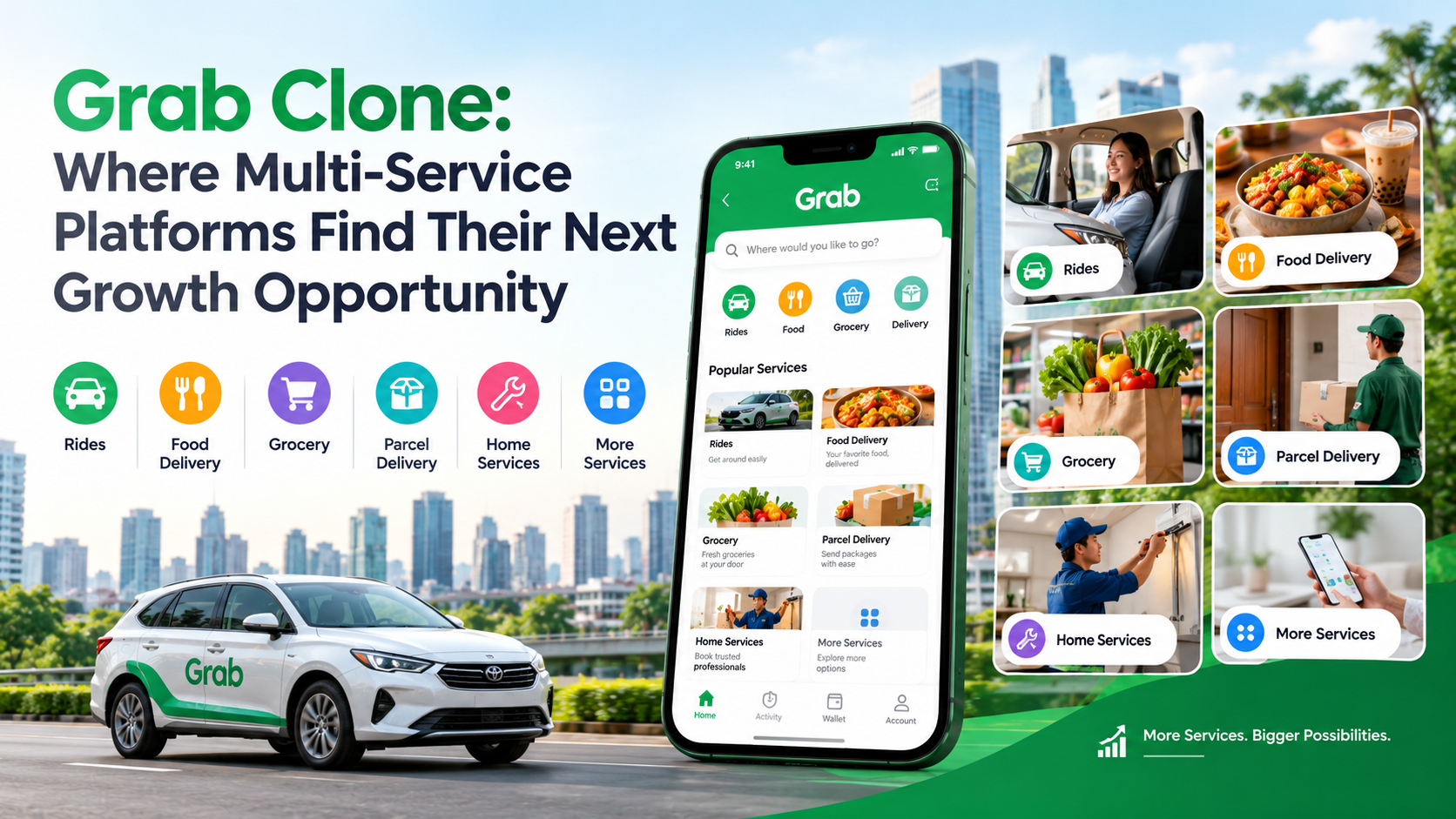
A Grab Clone enables businesses to develop a branded application that combines selected on-demand services, such as ride-hailing, food delivery, grocery ordering, and parcel transportation. Rather than building a company around one transaction category, founders can establish a business capable of serving multiple customer requirements through a shared digital channel.
The strategic question is not how many services the platform can accommodate. It is which combination of services can attract customers, retain business partners, and generate sustainable transaction revenue in the chosen market.
Market Entry: Start with a Commercially Relevant Service Combination
Imagine a mobility operator working with independent drivers in a rapidly developing city. The operator already understands local travel patterns but wants to expand beyond passenger bookings.
Nearby restaurants need delivery coverage, small retailers receive requests for local transportation, and businesses require dependable parcel movement.
Instead of entering every service category simultaneously, the operator could assess which adjacent services match its existing capabilities. Parcel delivery might be a suitable first addition if the business already has an established driver network. Food delivery could follow after securing restaurant partnerships and defining appropriate fulfilment processes.
This approach allows the business to build on existing market knowledge while testing additional revenue opportunities.
A Grab Clone provides a foundation for coordinating these services through appropriate booking workflows, partner management, tracking, and payment processing. The actual service portfolio should reflect local demand, operating requirements, and applicable regulations.
Competitive Positioning: Build an Identity Beyond Convenience
Established platforms often compete through brand recognition, service availability, promotions, and customer experience. A new entrant may find it difficult to match their scale immediately.
A more focused market position can provide an alternative route.
One business might concentrate on corporate transportation and scheduled parcel services. Another could build relationships with independent restaurants and neighbourhood retailers. A third might serve a particular geographic area where reliable service coverage remains a priority for customers.
Each positioning strategy attracts different partners and requires a different operating model.
The technology should support this commercial identity rather than dictate it. Entrepreneurs should evaluate customisation options, service-specific workflows, pricing flexibility, reporting capabilities, and integration requirements before choosing a platform.
The Partner Network: An Important Asset in Marketplace Growth
An application can attract initial interest, but its value depends on the quality and availability of the services customers can access.
Drivers need sufficient booking opportunities. Restaurants need orders that justify their participation. Retailers need dependable fulfilment, while customers expect accurate information and consistent service.
Entrepreneurs must therefore develop a partner acquisition strategy alongside the technology rollout.
This includes establishing commercial terms, verifying suitable service providers, defining operational responsibilities, and monitoring fulfilment quality. Partner incentives should encourage reliable participation without creating an unsustainable cost structure.
A Grab Clone can help manage partner accounts, booking allocation, status updates, and administrative processes. However, technology alone cannot replace strong local relationships and effective service management.
Expansion Decisions: Measure Before Adding Another Market
Multi-service businesses can increase complexity when they expand too quickly. Each new location introduces different customer expectations, competitive conditions, licensing requirements, and service-provider availability.
A structured expansion process should begin with measurable performance indicators.
Businesses can review completed bookings, fulfilment rates, repeat customer activity, average transaction value, partner utilisation, and contribution margin by service category.
If one category generates consistent demand and acceptable unit economics, expanding its coverage may be more valuable than introducing several new services at once.
Similarly, if a location has sufficient passenger demand but limited delivery-partner coverage, improving operations may offer a stronger opportunity than increasing advertising expenditure.
This evidence-led approach helps entrepreneurs allocate resources according to commercial performance rather than assumptions about market size alone.
Technology Selection: Build for the Business You Intend to Operate
The requirements of a multi-service platform extend beyond a customer-facing application. Businesses need appropriate tools for managing transactions, service providers, payments, operational oversight, and customer support.
With spotnrides, entrepreneurs can explore a customizable Grab Clone solution for developing a branded multi-service application. Depending on the selected solution, businesses can plan to support ride-hailing, food delivery, grocery ordering, parcel delivery, and other relevant offerings.
Before implementation, founders should establish which services belong in the initial release, which integrations are required, how partners will be managed, and what reporting capabilities are necessary for decision-making.
A clearly defined scope can help align technology investment with immediate business requirements while leaving room for future expansion.
Conclusion: Build a Business Model Before Expanding the Service List
The multi-service opportunity is not simply about combining several applications into one destination. It is about creating a commercially viable relationship between customers, service providers, and recurring market demand.
Entrepreneurs who identify a focused entry market, establish dependable partnerships, select appropriate revenue models, and validate unit economics can make more informed expansion decisions.
A Grab Clone App from spotnrides offers a starting point for businesses planning to enter this market with their own brand and service strategy.

 English
 Arabic
 French
 Spanish
 Deutsch
 Turkish
 Dutch
 Italiano
 Russian
 Romaian
 Portuguese (Brazil)
 Greek
