


Find the Right Access Control System in Oman
A government office in Muscat, a resort near Salalah, and a processing plant in an industrial estate all need to control who enters, yet their needs could hardly be more different. Choosing the right Access Control System therefore begins with understanding your own site, not with comparing brochures. The best system is the one that suits your doors, your climate, your workforce, and your plans for growth.
Tektronix supplies and installs security technology across the Gulf, and its access control solution for Omani organizations is built around practical selection rather than product pushing. This guide offers a step by step approach that facility managers, IT teams, and business owners in Oman can follow, from defining requirements to signing a contract with confidence.
Know Your Site Before You Choose Technology
Oman's geography produces very different operating conditions. Muscat combines modern offices with hot, humid summers. Salalah experiences a monsoon season that brings mist, drizzle, and high humidity, while the surrounding region is dry for much of the year. Inland industrial sites face dust and heat, and remote locations may have limited network connections. Each condition affects which readers, enclosures, and power arrangements will perform reliably over many years.
Define the Problem in Plain Language
Write down what you want to fix. Perhaps staff share cards, contractors keep passes after projects finish, a store room has no record of who enters, or attendance data cannot be trusted. Each problem points toward a different answer. Organizations that start from the problem usually buy less hardware and solve more, while those that start from a product catalogue often pay for features they never use.
Map Your Doors and Rank Their Risk
Walk the premises and list every entrance, from the main lobby to the service gate. Give each a simple risk rating based on what lies behind it and what would happen if the wrong person entered. A reception area and a records room should not receive the same treatment. Most sites find that only a few doors need high assurance, while the rest can be handled with an economical credential.
Biometric Access Control System: For Doors Where Identity Must Be Certain
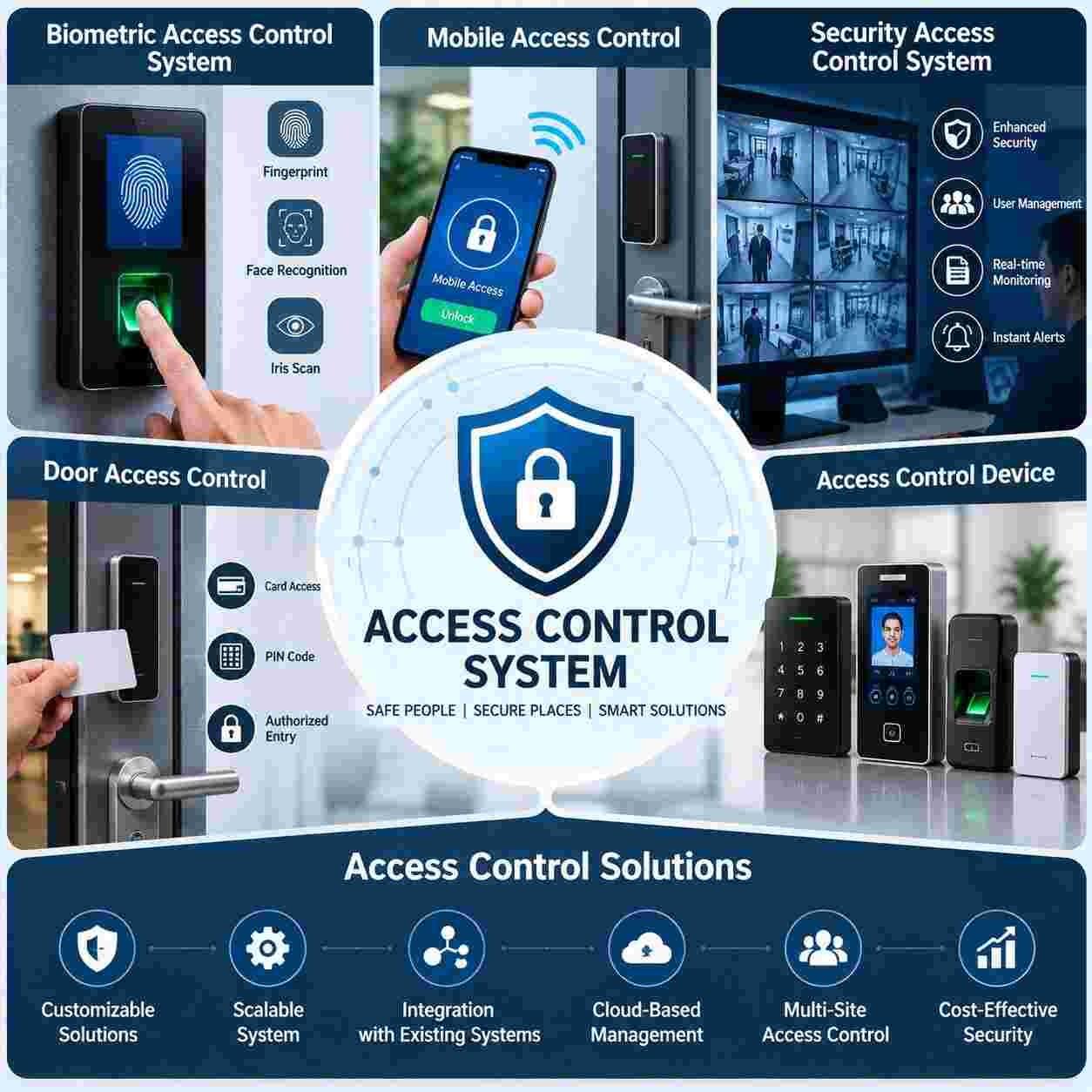
A Biometric Access Control System uses a fingerprint, a face, or another physical trait as the credential, which removes the risk of lent or stolen cards. It is well suited to finance rooms, laboratories, and large workforces where card sharing becomes routine. Buyers should weigh the higher cost per door and the need to handle personal data responsibly, including consent, secure storage, and deletion when people leave.
Security Access Control System: Layered Protection for Critical Areas
Where a breach would be serious, one check is rarely enough. A Security Access Control System combines factors, such as a card plus a PIN or a face match plus a supervisor approval, and adds features like anti passback, lockdown, and alarm integration. Energy facilities, government buildings, and data rooms in Oman typically specify this level of protection, while ordinary office areas may not need it.
Door Access Control: Fitting the Rules to Each Space
Door Access Control is where policy meets daily reality. Each door can have its own schedule, its own list of authorized people, and its own response to unusual events. A warehouse door might open for staff only during shifts, while a plant room opens for a small maintenance team at any hour. Keeping these rules simple matters, because a system with hundreds of exceptions soon becomes impossible to audit.
Mobile Access Control: Using the Phone People Already Carry
Mobile Access Control turns a smartphone into the credential, which removes the cost of printing and replacing cards and lets administrators issue or revoke access remotely within minutes. It suits hotels, offices, and contractors who work at several sites. Before choosing it, confirm that readers support the credential format and that you have a policy for people who cannot or prefer not to use a personal phone for work.
Choosing an Access Control Device for Omani Conditions
A reader that works well in an air-conditioned lobby may struggle on a gate exposed to sun, humidity, or monsoon mist. When selecting an Access Control Device, check its ingress protection rating, its operating temperature range, how readable its display remains in bright light, and whether it resists condensation. Look also at lock compatibility, power options, and how quickly a faulty unit can be replaced, since a reader that takes weeks to repair leaves a door unprotected or locked.
Access Control Solutions for Organizations with Several Sites
An organization with offices in Muscat, a branch in Sohar, and a depot in Salalah needs more than separate systems at each location. Complete Access Control Solutions provide a shared database of people and permissions, central reporting, and the ability to change a policy once and apply it everywhere. When comparing suppliers, ask how a new branch is added, how transferred staff are handled, and whether a remote site keeps working if its connection fails.
Access Control System Oman: Vision 2040 and Data Protection
Oman Vision 2040 is encouraging investment in tourism, logistics, manufacturing, and digital services, and new buildings increasingly specify security from the design stage. Access Control System Oman projects should also consider the country's personal data protection law, because enrolled biometrics and entry logs are personal data. Ask suppliers where data is stored, how long it is kept, and how records are removed when people leave, and confirm obligations with your own legal advisers.
Access Control System Muscat: Government, Business, and Hospitality
The capital brings together ministries, banks, hotels, hospitals, and growing business districts. Access Control System Muscat projects often value a polished lobby experience, smooth handling of visitors and contractors, and integration with parking and building systems. With many suppliers competing, buyers should insist on local references, nearby spare parts, and response times written into the contract.
Access Control System Salalah: Ports, Tourism, and Free Zone Activity
In the south, a busy port, a free zone, an airport, and a seasonal tourism economy create a distinct mix of needs. Access Control System Salalah projects must cope with monsoon humidity and mist, large temporary workforces, and sites where gates, containers, and storage yards matter as much as office doors. Robust outdoor hardware, flexible temporary credentials, and dependable local support are the priorities.
Matching Technology to Your Sector
Offices often combine mobile or card credentials with biometrics at sensitive floors. Industrial sites favour rugged readers and options that cope with gloves and dust. Hotels need guest and staff separation, with temporary credentials for events. Hospitals value touchless entry for clinical areas. Schools and colleges want simple credentials for students and stronger checks for staff and laboratories. Looking at how similar organizations solved the same problems saves time and avoids costly mistakes.
Understanding the True Cost
Quotes are easy to compare on hardware and difficult to compare on everything else. Ask for a price that includes readers, controllers, locks, cabling, software licences, installation, training, and the first years of support. Then ask what it will cost to add ten doors later, to replace a failed reader, and to renew licences. A system that looks cheaper at first can become the expensive choice once growth and maintenance are counted across five to seven years.
Run a Pilot and Test the Supplier
A pilot on a few doors reveals problems that no brochure shows. It tests recognition in real light, queues at real peak times, and the effort needed to enrol and manage users. Collect feedback from staff and security teams, measure rejection rates and response times, and adjust settings before a wider rollout. A supplier that welcomes a pilot is usually confident in its product, and one that resists it deserves extra questions.
Integrating Access Control with Other Systems
Entry hardware delivers more value when it shares information. Linking the platform to CCTV lets a security officer pull up video for any door event, while a connection to visitor management gives guests temporary credentials that expire automatically. Integration with fire alarm panels ensures that doors on escape routes release reliably, and a link to attendance and payroll systems removes manual data entry. Planning these connections at the design stage costs far less than adding them later.
Maintenance, Support, and Lifecycle Planning
An installation is not finished on the day it is commissioned. Readers need periodic cleaning, batteries in backup units need replacing, and firmware needs updating to close security gaps. A maintenance agreement that covers scheduled inspections and fast response for faults keeps a system performing as designed. Organizations should budget across a five to seven-year lifecycle, including replacement of components and software renewals, instead of treating the purchase price as the full cost.
Common Mistakes to Avoid
The most frequent error is buying readers first and thinking about enrolment and policy later. Without a clear plan for who gets which permissions, systems fill with exceptions that nobody remembers approving. A second mistake is skipping a proper site survey, which leads to readers placed where glare, humidity, or door frames cause constant faults. A third is neglecting offboarding, so former staff and contractors keep working credentials long after they leave. Addressing these points before installation prevents most of the frustration reported after the first year.
Engineering Experience and Trust Behind Every Deployment
Tektronix has engineered and commissioned access control, surveillance, and related security systems across the Gulf for many years. An in-house engineering team handles site surveys, network integration, and system configuration rather than passing installation to a subcontractor unfamiliar with the platform, and regional support and spare parts help keep a failed reader from leaving an entrance unprotected for long.
Technical information covering supported credentials, integration options, and hardware specifications is available through the company's access control system page, giving buyers specific detail to review rather than a marketing summary alone.
Making the Final Decision
With requirements written, doors ranked, options compared, and a pilot completed, the decision becomes much clearer. Organizations that want one accountable partner for hardware, software, installation, and support can review Tektronix's full range of biometric and mobile access control offerings alongside other shortlisted suppliers, and choose the one that answers the hardest questions most honestly.
Conclusion
The right Access Control System is the one that fits your doors, your climate, and your growth, not simply the most advanced. A Biometric Access Control System and a layered Security Access Control System belong at the doors where certainty of identity matters most. Careful Door Access Control and flexible Mobile Access Control keep rules simple while credentials stay easy to issue and revoke. The right Access Control Device and complete Access Control Solutions keep performance steady across humid, dusty, and multi-site conditions. Buyers planning Access Control System Oman, Access Control System Muscat, and Access Control System Salalah projects should choose a partner like Tektronix with proven regional engineering.
FAQs
1. Where should a small business in Oman start?
Start by listing the doors that matter most and the problems you want to solve, then ask suppliers for a simple design and a priced option that can grow, rather than buying a large package you may never use.
2. Is a biometric system always better than cards?
Not always, because biometrics cost more per door and involve personal data, so many organizations use them only at sensitive doors and keep cards or mobile credentials elsewhere.
3. Will readers cope with humidity and monsoon mist in the south?
Readers with a suitable ingress protection rating and sealed electronics can cope, and buyers should specify the conditions clearly and ask suppliers for evidence from similar climates.
4. Can a new system reuse the readers we already own?
Sometimes, depending on the credential format and the controller, so ask suppliers to review your existing equipment and explain what can be reused and what must be replaced.
5. What support should be written into the contract?
Contracts should state response times for faults, spare parts availability, the length of the warranty, how software updates are handled, and the cost of adding doors later.

 Arabic
 French
 Spanish
 Portuguese
 Deutsch
 Turkish
 Dutch
 Italiano
 Russian
 Romaian
 Portuguese (Brazil)
 Greek
